There’s a stigma around growing old, isn’t there? A perception that the elderly lack purpose in the absence of a job, lack their full cognitive abilities, lack physicality, lack sensuality. It’s such ageist notions that writer/director Maryam Touzani’s Calle Malaga— both a warm hug and a sorrowful reflection on the passing of time— seeks to dispel, via a winning lead performance by Carmen Maura.
Maura plays Maria Angeles, a 79-year-old woman who has lived in her home in Spanish-inhabited Tangier, Morocco, for 40 years. She’s alone— her husband passed away some years ago, and her daughter Clara (Marta Etura) lives with her family in Madrid— but, stylish and smart and accustomed to her usual routine of strolling through the neighborhood market and listening to her beloved records, she’s far from senile. At the start of Calle Malaga, she receives an unexpected visit from Clara, but pleasantries fast give way to her tense daughters ulterior motive. She’s newly divorced, and has children, and it’s messy, and she’s barely getting by, financially. Her father left Maria’s flat in her name, so technically it’s hers, and she intends to sell it, and all the furnishings therein. She gives Maria two options: she can either come live with her in Madrid, or she can take the spot that just opened up at the senior living facility in Tangier, where as a longtime city resident she can remain rent-free. Maria, steadfast in her refusal to leave the place she calls home, opts for the latter.
But just as Maria settles into her new surroundings and Calle Malaga appears to be zigging one way, it zags. Following a confrontation with a hairstylist, Maria decides she’s had enough. She checks herself out of the institution— whose spare furnishings and regimented daily schedule are a far cry from her lovingly-appointed home— telling the doctor that she changed her mind, and would rather spend her time close to her family. Instead, Maria returns to her house, now empty except for a mattress and few bits and bobs, the electricity shut off. Clara put it up for sale, and sold Maria’s furniture to a local antique dealer, but until the flat has a buyer, Maria determines to stay there.
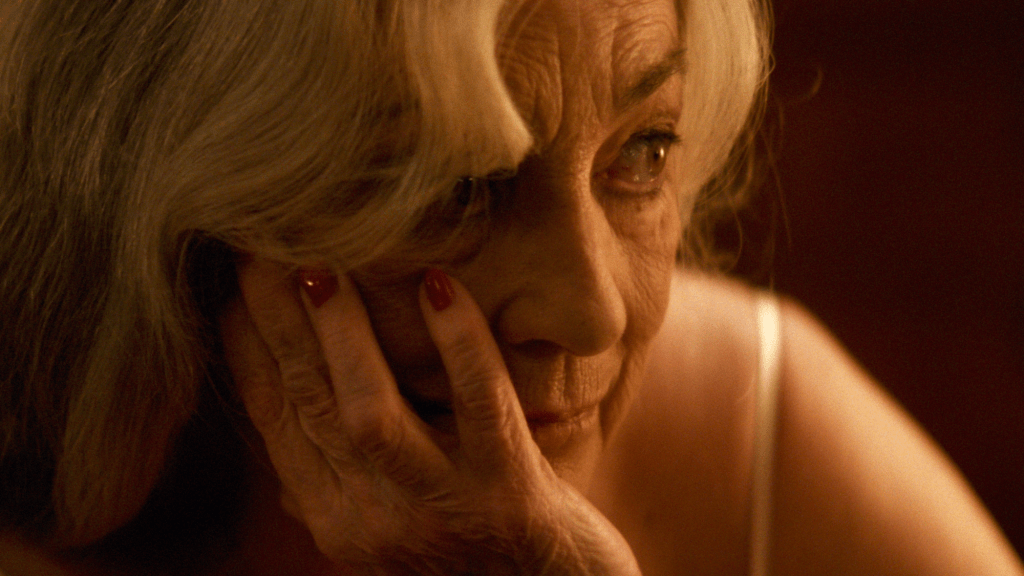
Touzani, working again with cinematographer Virginie Surdej (who collaborated on her previous features Adam and The Blue Caftan) is a filmmaker who revels in textured images, whether it’s the submerging of hands in flour or the crackle of a red pepper over a hot fire as Maria cooks, or the brilliant light that bounces off the multicolored crystals of her enormous old chandelier, or the scratch of a turntable needle on vinyl. Sight and sound work together to grant Calle Malaga a tangible sense of place, something of the utmost importance as place— and the memories we attach to it— is such an integral piece of the film. It’s clear in the way she values her possessions (records and such that conjure thoughts of her late spouse), and marvels at the person her daughter has become, that she always holds the past with her. Every item is a reminder of something, or someone. But something infinitely more special occurs once she reclaims her space. She begins to buy back her furniture from the antique dealer, Abslam (Ahmed Boulane), but she doesn’t have enough money for all of it. So she enlists the aid of her younger neighbors, and begins hosting football gatherings on game nights at her home, charging for alcohol and tapas to earn some income. As she builds her physical possessions, she also builds a community around her. She engages with her neighbors more than she ever had before. She falls in love. And she recounts it all— in hysterically graphic detail— to a nun who’s taken a vow of silence, her longtime friend Josefa (María Alfonsa Rosso).
Frustrating ambivalent ending aside, Calle Malaga is the sort of crowd-pleaser that’s a joy to discover: tender and funny and infinitely sweet, and all filtered through a unique voice. Touzani allows her protagonist to express her carnal desires, her camera never shying away from her body, exploring every crevice and every spot on her skin. As with The Blue Caftan, which centered on the simmering romance between a married middle-aged tailor and his new apprentice, Touzani pushes oft-marginalized people and stories to the front of her work with such confidence, never wasting a shot or a line. And Maura just sparkles. She’s irreverent and charismatic, leaving zero doubt that this is a woman who is filled with vitality— and still has a lot of life left to live.
Calle Malaga had its world premiere in the Venice Spotlight section of the 2025 Venice Film Festival. Runtime: 116 minutes.

 Katie at the Movies