Hope. That’s the element of Danny Boyle’s 2002 apocalyptic horror film 28 Days Later that surprised me the most. Of course, a lot of my reaction can likely be credited to the fact that, despite its generally enthusiastic reception, it passed me by until I finally sought it out a couple months ago, and that in the over 20 years since that movie’s release, dystopian media has become so widespread as to become predictable, every series or film appearing to try to top each other in overwhelming bleakness, reveling in despair. Creators ask how they can make their characters, and by extension, their audience, as miserable as possible, and those audiences continue to lap it up. 28 Days Later thrusts its characters into the most horrific circumstances imaginable, but it also refuses to let that define them, concluding on a refreshingly uncynical note so opposed to what I’ve become accustomed to that it left me genuinely impressed and moved by a film that otherwise up to that point was only working for me in fits and spurts.
The 2007 Juan Carlos Fresnadillo-helmed standalone sequel 28 Weeks Later may be an aesthetically and thematically darker (albeit more politically intriguing) movie, but 28 Years Later, which finds Boyle reuniting with 28 Days Later writer Alex Garland, effectively straddles the tone of each, resulting in a film that is both a gnarly genre picture and a moving treatise on the value of life in a world that’s teeming with death and decay. Picking up 28 years after the second outbreak of the Rage virus— a highly contagious disease that transforms the infected into violent zombies— the film finds Great Britain still existing in a quarantine state. On an island connected to the British mainland by a causeway that’s only passable at low tide sits a small village of survivors with a penchant for religious iconography in their decor (it’s giving cult, although Boyle doesn’t delve into the fervor or the meaning behind these images beyond brief flashes). Twelve-year-old Spike (Alfie Williams) lives with his bed-ridden mother Isla (Jodie Comer) and his father Jamie (Aaron Taylor-Johnson), a lauded member of the town who works as a scavenger, making brief but dangerous trips to the infected-infested mainland to hunt for supplies during the four hour intervals that the causeway is clear. When we first meet Spike, he’s preparing to embark on one of these journeys with his dad for the first time, in a sort of coming-of-age ritual that puts the whole town in a celebratory mood, cheering and plying the child with apples as they all gather around the front gate to send him off.
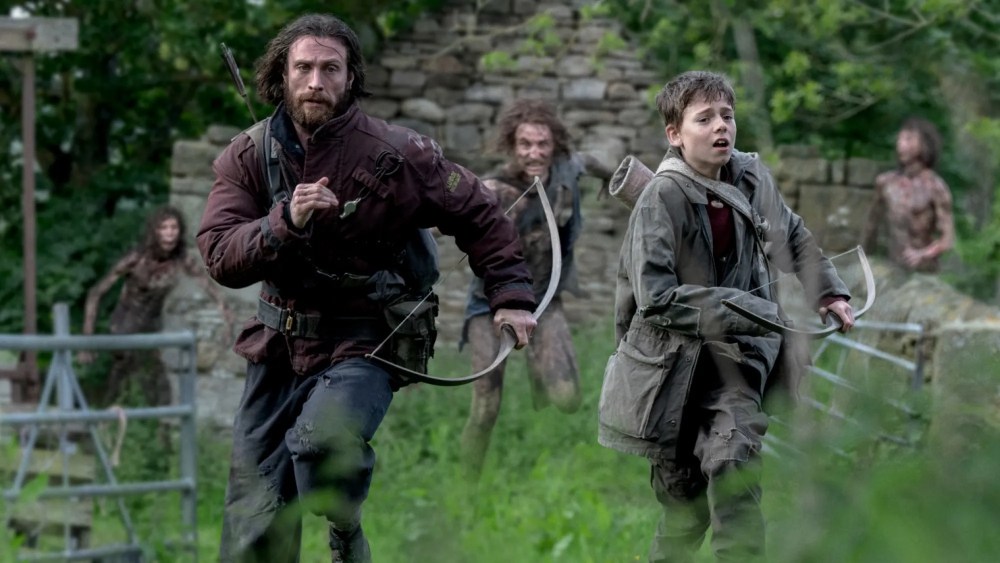
Boyle employs editor Jon Harris and 28 Days Later cinematographer Anthony Dod Mantle, and the director’s punk, pulsating style, marked by fast cuts and zooms and camera tilts that broaden the scope of the film one minute and tighten it to a more intimate level the next, shot primarily with drones and on iPhone 15 (a more polished nod to the low-res camcorder they used to navigate the empty streets of London on 28 Days Later) are well-suited to the chaotic environment the characters inhabit, pushing the stakes of the action scenes ever higher without sacrificing moments of pensiveness or quiet beauty (even a frantic chase scene is stunningly rendered against a backdrop of the glittering Northern Lights that skews closer to fantasy than reality). And he aligns the climate of the narrative with Britain’s political and military history via an effective and repetitive montage spliced into the father/son march, the footage from British war films spanning centuries and accompanied by the same audio snippets of Taylor Holmes’ 1915 recitation of the Rudyard Kipling poem “Boots” that were used so remarkably in the film’s trailer. “Boots,” which imagines the thoughts of a British infantryman marching during the Second Boer War, is read at a cadence that matches the rhythm of the soldier’s steps, and by extension, the rhythm of the film’s editing. Every stanza concludes with the phrase, “There’s no discharge in the war!” the words pointing to the never-ending slog Jamie and Spike and the others must endure to survive, the need for perpetual vigilance dominating their insular lives (and perhaps serving as the only thing keeping them from going insane).
In short, this first act is impressive, if familiar, setting up a story in which circumstances force a boy to become a man far sooner than he ought to, mining the corrupting power of violence on young innocents. But while 28 Years Later was planned as the first part of a presumed trilogy long before it was released (with its sequel having been shot simultaneously), it fast circumvents any resemblance to an IP-driven franchise. Rather than his quest with his dad even briefly empowering him, Spike becomes almost immediately disillusioned by the experience, and trades in the masculine-coded hunt for feminine-coded nurturing when he decides to make a break for it with his mom to try and find a doctor rumored to be living in the wild and engaging in bizarre rituals who might be able to help her. Suddenly, a character who initially appeared to exist on the narrative sidelines becomes its center, and Comer performs some exquisite juggling in her performance playing a woman who is alternately confused and aware, who recognizes the value of life and finds strength in caring for others even as she constantly battles the disorienting effects of her illness. Williams just as deftly plays Spike on many levels, reminding us even when he is taking charge that he is still just a kid with his occasional flashes of naiveté. There’s a stretch of this movie where, while searching for Dr. Kelson (played with great tenderness by third act scene-stealer Ralph Fiennes), Spike and Isla meet Erik (Edvin Ryding), a NATO soldier who was the sole survivor of his unit after their boat was forced ashore and they became overwhelmed by infected (in one of the film’s more on-the-nose but chuckle-inducing images, he’s found in an old Shell gas station where the “S” on the sign has prophetically long fallen off). His interactions with Spike, who grew up around the Rage virus in this apocalyptic environment, are a sharp reminder of how the rest of the world has moved on normally. Spike has never seen a cell phone, doesn’t even know what they’re used for; Erik shows him a photo of his botox-ed ex on it, and she’s dressed up and sipping a cocktail in a club. 28 Days Later may be a solid pandemic movie (made almost two decades before the world underwent the very real COVID-19 pandemic), but 28 Years Later and Spike are analogous to what humanity is going through now, five years later, when most people have moved on but others have not or can not, and those who were born or small children during the initial lockdown struggle to adjust to socializing outside the home. It’s difficult, for me at least, to suspend disbelief with this series; why are people returning to and continuing to exist in this hell when they could leave? But Boyle builds this world with such sincerity, it’s hard not stop trying to pick it apart and embark on the ride with him.
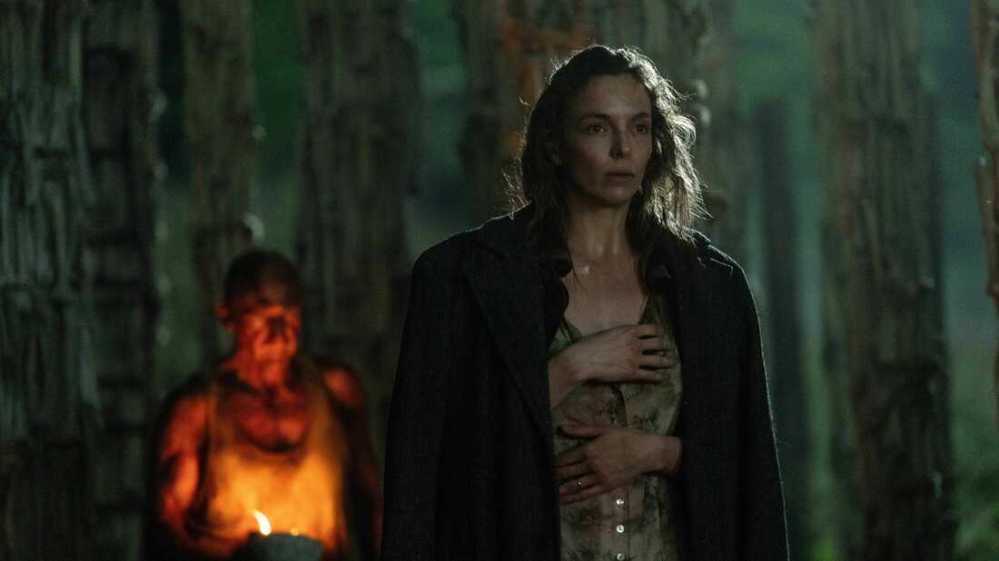
28 Years Later finds many of the infected having mutated over time into grotesque sizes and shapes, including a giant called the Alpha who follows Spike’s trail, and their occasional collisions with the non-infected character result in some gleefully gross bursts of violence (I’m not sure I’ve ever seen decapitations as gory as these, heads with faces frozen in expressions of horror and pain still attached to the spinal cord like some snake-like alien as they’re ripped from their bodies). And the final scene takes an equally delightful and dynamic swing, tying the story back to the film’s shocking (but up to that point, seemingly irrelevant) opening scene. But when Kelson enters the picture, it becomes far more contemplative, symbols that appear in the film’s first half reappearing in a new context: arrows used to kill with violent intent become darts used to subdue with mercy, decapitated heads that represent a horrible death become skulls reverently displayed as trinkets of remembrance. How do you measure the meaning of life and death, and how do you mourn? They’re questions Boyle and Garland not only ask of their characters, but could just as easily be applied as commentary on dystopian horror media as a whole. Because truly, how can you value a life when you’ve become so desensitized that death is almost always the expected outcome? 28 Years Later may not have all the answers, but fortunately, it matches 28 Days Later in its earnestness. It’s sad, but it isn’t cynical, and it isn’t despairing, and it doesn’t work to draw pleasure out of misery. And by this ending, 28 Years Later isn’t really a zombie movie anymore. It’s a film about new life and new beginnings emerging from even the darkest spot on the planet.
28 Years Later is now playing in theaters. Runtime: 115 minutes. Rated R.

 Katie at the Movies