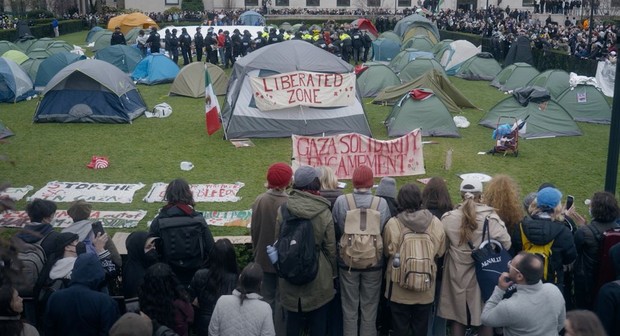
On April 17, 2024, a group of pro-Palestine students began an encampment on New York City’s Columbia University campus, standing in solidarity with Gaza in the broader context of the Gaza war that began on October 7, 2023, and demanding that the university divest from Israel. The immediate and global impact of the movement happened in a flash: that first encampment of about 50 tents was dismantled the next day, Columbia’s then-President Minouche Shafik (she has since resigned in the fallout) having authorized the New York City Police Department to enter the campus and conduct mass arrests— only for the students to immediately mount a second encampment on the adjoining lawn.
Directors Michael T. Workman and Kei Pritsker recount the Columbia University pro-Palestinian protests in their documentary The Encampments, which serves a dual function as both a propulsive document of a historic event, and an urgent plea for awareness of a conflict that is, at the time of this writing (and the film’s creation) ongoing. Workman and Pritsker open their film with a montage of news footage that stands firmly against the protesters; anchors and hosts refer to them as “radical” and “disgusting” (video of a Columbia University board meeting that comes a bit later in the film reveals that those in charge of the educational institution— and its students’ futures— possess similar beliefs). But then we’re introduced to the protesters themselves. Workman and Pritsker focus specifically on three of them: Sueda Polat, a human rights graduate student who was a key organizer of the encampment; Grant Miner, a Jewish student and president of Columbia’s student workers union; and Mahmoud Khalil, a Palestinian student who served as the primary negotiator between the protesters and school administrators. Their demands are simply that the institution they are giving so much money to themselves not invest in corporations that make weapons being used to kill innocent Gaza civilians in the current genocide.

It’s a complex issue that Workman and Pritsker distill to its essential pieces. Their filmmaking is routine, yet effective in its simplicity and straightforwardness: opting for a largely vérité approach, they cut between on camera interviews and riveting on-the-ground footage of the protests (a combination of video shot by Pritsker and by the protesters themselves) in a manner that disseminates information without ever losing sight of the humans caught up in the conflict. Some of that footage is distressing (the NYPD’s violent attempts to disperse and arrest the protesters, for one), but it also illustrates a surprising amount of harmony. The Encampments frequently takes a moment to depict the protesters joined in song or prayer, or to peel back the curtain to peek at some of the organizing that goes into organizing (ensuring that everyone at the encampment has a hot meal and essentials, for one), utilizing close-ups of the determined faces of those involved far more so than sweeping long shots. The film also seeks to dispel the prevailing assumption that pro-Palestine equals anti-Semitic, going perhaps out of its way to make it clear that many Jewish students also participated in the protests. One of the most compelling interviews is conducted with an anonymous Columbia administrator, who reveals his superiors’ efforts to manipulate the language used to describe the encampment and its organizers, while demanding to know the identities of the student protestors he had spoken to. It’s infuriating, and The Encampments makes effective use of archival footage to draw a clear line between Columbia’s past and present, comparing the pro-Palestinian protests to the 1968 Vietnam War protests— the last time that school administrators allowed police on campus to make arrests. The film makes further use of footage from the encampments that arose on other campuses (180 around the world, in fact, a montage of which is one of the movie’s more obviously inspiring sequences) following Columbia’s lead to demonstrate that this is not an issue specific to Columbia, even if their students started the fire (and their president and other leaders completely mangled the entire situation). To be a member of an educational institution is to grapple with the dissonance between your personal beliefs and the corporate machine that governs said institution every day.
While The Encampments firmly and admirably takes a side, there are times where it feels like it is reaching farther than it needs to to manipulate the audience’s emotions, whether its the score that, while used sparingly, clearly accentuates the movie’s emotional highs, or the segway into the story of Hind Rajab, a five-year-old Palestinian girl who, along with her family, was killed by Israeli soldiers in the Gaza Strip, and who the protesters renamed Columbia’s Hamilton Hall after; the film makes use of a heart-wrenching phone recording between Hind and an emergency responder just prior to her death in a way that is clearly intended to be heart-wrenching. And yet, desperate times call for desperate measures. There’s a sobering moment toward the end of The Encampments when Khalil, while being interviewed, is asked what he will do if he is deported. “I will live,” he responds. It’s a scene made doubly eerie by the fact that, on March 8, 2025, Khalil was arrested by ICE agents at his apartment and sent to a detention center in Louisiana, despite being a lawful resident with a green card, and despite the agents not possessing a warrant for his arrest (it’s part of a broader deportation effort by President Donald Trump and his administration to punish anyone said to be engaged in activities “aligned with Hamas,” another misconception the film tries to break down). A little more than a week later, Miner was expelled from Columbia for his role in the protests. The Encampments was rushed into release at the end of March for these reasons. The film thankfully doesn’t try to put a neat bow on its conclusion, its open-ended nature striking just the right chord of hopeful uncertainty for the future to come.
The Encampments is currently playing in select theaters, and is available to stream on Watermelon Plus. Runtime: 81 minutes.

 Katie at the Movies