There’s a string of scenes in the final stretch of Thunderbolts*— the final installment of Phase 5 of the Marvel Cinematic Universe, for those still keeping track— that’s as stirring and soulful as anything across the franchise’s 36 (and counting) film history. But like it’s title, the movie comes with an asterisk: any story element even briefly resembling something bracingly is sandwiched between vacuously quippy dialogue, clumsy exposition dumps intended to orient the viewer as to where they are in the MCU and where they’ve seen these characters before (because I sure as hell didn’t remember), and beats intended less to build upon each character’s interior life, and more to set up the next phase of the MCU. It’s as weary and adrift as Florence Pugh’s Yelena Belova admits she is at the top of the film.
That using-an-entire-movie-for-set-up bit has been an issue throughout the MCU almost since its inception 17 years ago. Admittedly Thunderbolts* pulls it off better than most, under the capable direction of Jake Schreier (most recently behind the acclaimed Netflix series Beef, and whose last film credit is the 2015 adaptation of the John Green novel Paper Towns) paired with regular Marvel writer Eric Pearson. Yelena is working under CIA head Valentina Allegra de Fontaine (an expectedly neurotic Julia Louis-Dreyfus, whose role in this franchise I personally have yet to discern), tasked with destroying all evidence of the O.X.E. Group’s failed Sentry superhuman experiment that de Fontaine is facing potential impeachment for. But Yelena’s final mission turns out to be a trap: she, along with Taskmaster (Olga Kurylenko), Ghost (Hannah John-Kamen), and disgraced Captain America successor John Walker (Wyatt Russell) were all sent to a remote underground lab to die. The team not only quickly discovers de Fontaine’s betrayal, but meet living proof that her Sentry program wasn’t a flop after all in the form of the apparently awkward and withdrawn Bob (Lewis Pullman).

With the Avengers having disbanded some time ago and no formal group of heroes existing in this current point of the timeline, it’s clear almost from the jump that Thunderbolts* is reaching to recapture some magic that was likely one-and-done. We’re meant to believe that this group of antiheroes will spearhead not only the next act of the MCU at large but also, within the context of the in-film universe, serve as humanity’s next great hope, but— unlike the lengthy build-up to The Avengers— the legwork hasn’t been put in to earn that audience. It’s perhaps less the fault of any individual member of the crew or cast, and more just the nature of the beast. Thunderbolts* demands instant audience investment in the lives and deaths of characters who we’ve mostly only seen once or twice in other MCU projects several years back. Perhaps for diehard fans, that’s a no brainer, but for the casual viewer, it’s a big ask, and the clunky dialogue referring back to these past events that dominates the first act of the film underlines the fact that the creators understand this.
The cast does exhibit good chemistry, however, which makes the poor writing all the more frustrating. They strike a winning balance between hatred, reluctant camaraderie, and earnest care and support that feels well-honed, even though the script doesn’t grant them the time to really build up those relationships. Pugh is a standout, imbuing Yelena with a believable mixture of roiling emotions, exhibiting everything from trauma to toughness to dry humor, while David Harbour, reprising his role as Yelena’s surrogate father Alexei/Red Guardian from Black Widow, injects each scene he’s in with some much-needed levity, but also gravitas when it’s called for (the same goes for Sebastian Stan, back again as Bucky Barnes/Winter Soldier, now a congressman fumbling his way through D.C. politics). The film dips heavily into themes involving mental health and depression, with each character being met at their all-time low (Alexei, for instance, drives a limo, and spends his off time at home watching old videos of his past glories; John Walker is separated from his wife and daughter). While much of the dialogue on this matter makes rather clunky generalizations of the sort you’ve heard a million times before (and while there’s a shadow version of the Sentry called the Void that literally spreads darkness), visually, it’s executed quite stunningly, culminating in a free-wheeling climax in which have to fight their way out of rooms housing their past traumas. The team works together beautifully here, and the final act of love defeating violence and hatred is enacted with clarity and sincerity.
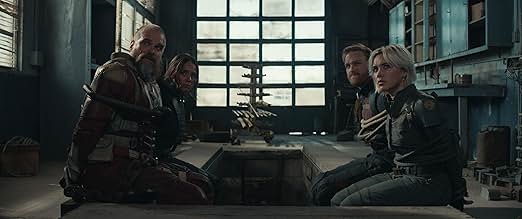
The rest of Thunderbolts* is just fine. There’s little of note about the action scenes, which include an aerial rehash of the Oldboy hallway sequence and a long take in which the Sentry demonstrates the full range of his powers against the entirety of the Thunderbolts team; they’re a bit more physicality than special effects driven, which is always nice to see. The humor works best when the team engages in running gags that work to build their relationships: swiping their group name from Yelena’s peewee soccer team, for instance, serves both as a fun bit of humor and a glimpse into Yelena’s past. The film grants tantalizing glances at some intriguing political avenues (the restitution of artifacts, for one), but largely sidesteps those tangled concepts in favor of more scenes with Louis-Dreyfus being a cringey pseudo-villain. It’s all entertaining enough, but never feels like a bold new step forward either, despite some creatively invigorating choices on paper (the title change post the film’s theatrical release, for one) and some occasional flashes of brilliance on screen. This may be The New Avengers, but it feels like old hat.
Thunderbolts* is now playing in theaters. Runtime: 136 minutes. Rated PG-13.

 Katie at the Movies