I am not a baseball fan. This has plagued me for most of my life. Having lived in St. Louis— widely regarded as one of the nation’s most fanatical sports towns— for over half of my life now, I’m used to shrugging off the question I receive most from people when I’m out of town and inform them of my home: “Oh, so you must be a Cards fan?” It’s much easier to give a stock non-committal response; I try to keep the fact that, when my parents would drag me to games when I was a kid, I’d bring my book with me, to myself.
But I love baseball movies. Those long stretches of little to nothing of note occurring on the field when watching a game in real life are condensed or practically non-existent in most films that center their narratives around the Great American Pastime, where the technical minutiae of the sport fades away, serving instead as a playing field for human drama. The crack of the bat signifies familial reconciliation in Field of Dreams, female friendship and liberation in A League of Their Own, coming-of-age in The Sandlot and The Bad News Bears, and romance in Bull Durham.
Several of those ideas are rolling about in Carson Lund’s debut feature Eephus, which also enters the grand tradition of hangout movies that prioritize the collective over the individual. Pensive shots of the warm early morning sun hitting brown and gold leaves scattered over the park grass play over audio from a local radio station broadcast, the announcer’s reading of local bulletins setting the place as a small town in Massachusetts, and the time as somewhere vaguely in the 1990s, just approaching Halloween. When Franny (Cliff Blake), arrives at Soldier’s Field, the old baseball diamond that’s about to be demolished to make way for a new school, he intones, under his breath, the speech Lou Gehrig— the legendary New York Yankees first baseman who retired from the sport after being diagnosed with ALS— delivered in his 1939 farewell to the public: “Today, I consider myself…self…self”— mimicking the echoes from an imaginary microphone— “the luckiest man…man…man…on the face of the earth…earth…earth.”

There’s a wealth of meaning in Franny— who keeps score for Adler’s Paint and the Riverdogs, two amateur teams who meet at Soldier’s Field every Sunday to play ball— choosing this particular quote. On the one hand, it illustrates a pure love of the game, the one thing these guys who differ in age and skill all possess, the one thing that keeps them coming back every week, in spite of their jobs and families and other life events; that world falls away the moment they step up to the plate. In a more literal sense, that speech is the one that Gehrig delivered as his farewell to the sport and to his fans, and this game marks the final time these two specific teams will meet at this specific field before it’s gone forever. Eephus never leaves this location over the course of the day, and Lund— who steps into the director’s chair as an experienced cinematographer— establishes such a tangible and cozy sense of place by circling this same group around the field and the dugout and the stands, that by the end of the movie, the audience feels about the same about of sentiment for the location as the players do. Although, miraculously, Eephus isn’t an overly sentimental movie. Lund and his cowriter Michael Basta space out the contemplative scenes between moments of offbeat and even absurd humor, like when Ed (Keith William Richards), the Adler’s Paint coach, is practically kidnapped by his family to attend a christening he almost missed because of the game. Even between the members of rival teams, petty squabbles remain largely on the field; off the field, they ruminate and bond together over what turns their lives and careers will take when they’re not playing ball.
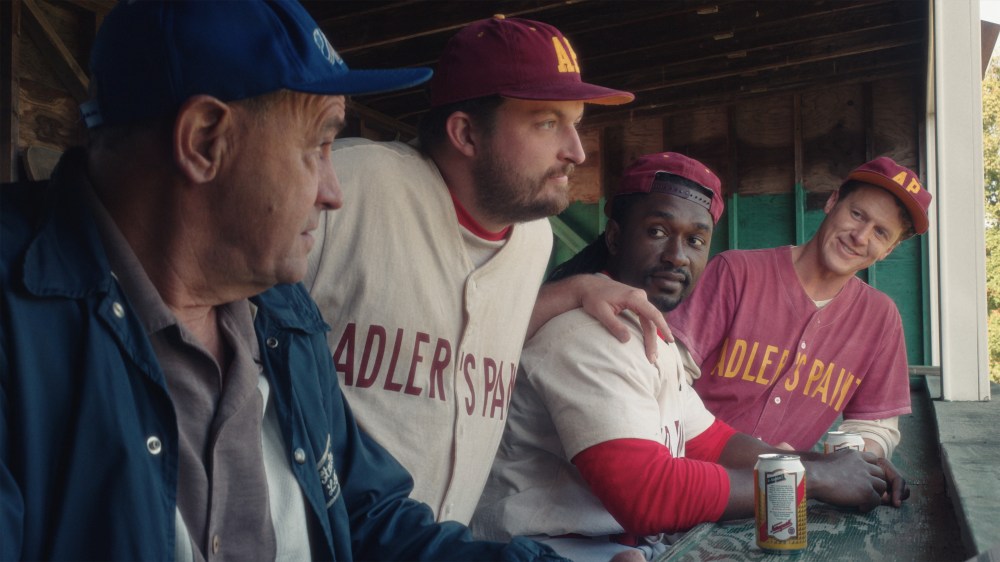
That uncertainty about the future hangs in the air with the stretch and endurance of the pitch that Eephus is named after. That pitch, as one of the ball players explains to another when the film slows down for a brief exposition dump, is a rarely-thrown one which catches the hitter off guard with its high arc and low velocity, which make it appear to move almost in slow motion, hanging in the air for an interminable amount of time. The thematic implications the pitch eephus has for the movie Eephus are obvious, and yet the film’s ability to extract such rich feelings from such a low-key setup is impressive. More than any other baseball movie, Eephus replicates that feeling of watching or playing the game, that feeling that I said above made me not enjoy the actual sport that much: long moments of repose are punctuated by bursts of excitement. But Eephus’ exploration of time as it’s relative to the game also extends to life: that unexplainable way in which minutes can feel like hours, and years can flash by in seconds. Sure, there’s plenty of specificity to please baseball fans, from the language to the casting of eephus-pitcher extraordinaire Bill “Spaceman” Lee in a small role to the production design, like the diegetic sounds of the radio that effectively score the film, and the use of scorecards as title cards to announce everything from the credits to the time of day, as the game stretches from morning til night, the players supposedly unable to let it go in a tie, although it appears more likely— as they pull their cars onto the field, using their headlights to light their way, improvising as they go— they’re just unable to let go of this place and this moment in time that none of them will ever quite experience the same way again. The casting of such a diverse group of performers as not only the players, but the observers who wander in and out of the game as it runs its course— this is a real character actors’ movie— generates and maintains interest, while the use of Frederick Wiseman— the legendary documentary filmmaker known for his observational portraits of American institutions— as the voice of the radio announcer at the top of the movie points to Eephus’ similarly grounded and intimate approach to its subject. This is first and foremost a film about community, and the spaces that foster it. I stand by my dislike of the sport at large, but when confronted with such a tender portrait of how it brings people together, for even the briefest moment in time— for the camaraderie felt with others who share the same interest, for the escape from the daily grind, for the feeling of elation that flutters in your belly when a truly exciting play unfolds before your eyes— I can’t help but pull a quote from another baseball movie, 2011’s account of the Oakland Athletics’ general manager’s efforts to assemble a team for the 2002 season, Moneyball: “How can you not be romantic about baseball?”
Eephus is now playing in select theaters, and will be available to watch on demand on April 15. Runtime: 99 minutes.

 Katie at the Movies