Inspiring stories make great fodder for documentaries, and such is the case with the following three films that screened at the 2025 True/False Film Festival: Seeds, a gorgeous and moving portrait of Black farmers in the American South, and Deaf President Now!, a rousing tale of student protest told through a bounty of archival footage, new interviews, and recreations, both Sundance premieres; and The Track, a world premiere following Sarajevo’s luge team as they surmount remarkable obstacles to compete in the 2022 Winter Olympics.

For its rather sprawling runtime— at 123 minutes, it’s the longest film I watched at this year’s True/False by a hefty margin— Seeds couldn’t be more intimate or tightly focused. The feature directorial debut of Brittany Shyne is a patient and lovingly detailed portrait of a subsection of American life and labor that rather enters the consciousness of most of this country’s citizens: farmers. Black farmers in Georgia, to be specific. Most of the handful of farmers Shyne follows, including Willie Head Jr. and Carlie Williams, are elderly, and their land has been in their families for generations; the family of the 89-year-old Williams have possessed their land for over 100 years. Shyne, also serving as cinematographer, pieces together a patchwork of tender moments: Head caring for his great-grandchildren, his worn hands securing the baby to a mechanical toy horse, allowing them to run and play in and touch the grass so they’ll develop a love of the land early in life. Neighbors gathering for a funeral, and casually conversing through car windows. Tractors cutting through the land, and farmers bringing their harvest to town. Shyne intersperses wide shots of farmland with close-ups of faces and hands, lending Seeds a distinct character and texture, and shoots the film in black-and-white, making the footage she captures feel more like a precious memory.
But for all that Seeds often feels like Shyne is documenting a way of life that is rapidly disappearing, it also shows how vigorously her subjects, young and old, are fighting for their future. The U.S. Department of Agriculture has a history of denying Black farmers loans and other assistance afforded to white farmers. Even though the department recently, in a restitutionary move, agreed to distribute $2 billion in funds to thousands of Black farmers country-wide, they’ve been slow to process payments, leaving the farmers to spend almost as much time on the phone navigating all the bureaucratic red tape as they do actually farming. Their financial situation is precarious; in a heart-breaking scene early in the film, Williams goes to the eye doctor, but even with his insurance cannot afford the new glasses he desperate needs. The one time the action in Seeds moves beyond the farms is when it follows some of the farmers traveling to Washington D.C. to protest in front of the Capitol, reinforcing the urgency of their plight. Farming may be, as one character affirms, “the backbone of the world,” but it’s treated as an afterthought by those who have never worked the land, and don’t need to give a second thought to how the food they eat made it to their table. Seeds possesses a vital and fiercely political undercurrent, but it’s also about tradition and family, and instilling a love for the former in the latter. When Head holds up a photo of his mother next to his young great-granddaughter as she fidgets and squirms to illustrate their resemblance to each other, it’s evidence of how these traits are passed down to sprout in new generations, just as seeds are planted in the earth to grow.

When Jerry C. Lee, the president of Gallaudet University— the world’s first university specifically for deaf and hard of hearing students, located in Washington D.C.— resigned from his post in 1987, there was a significant push by the school’s students and the deaf community at large for the college’s board to appoint a deaf president. The thing is, no person in any position of power at Gallaudet had any knowledge of American Sign Language or deaf culture, let alone were deaf themselves. So when the university’s board of trustees passed over two qualified deaf candidates— Harvey Corson, superintendent of the American School for the Deaf, and I. King Jordan, Gallaudet’s Dean of the College of Arts and Sciences— in favor of a hearing person, Elisabeth Zinser, the student body immediately revolted.
Deaf actor and activist Nyle DiMarco and documentary filmmaker Davis Guggenheim join forces as co-directors on Deaf President Now!, a galvanizing retelling of that one week in May 1988 when students fought back not only for their own rights, but to raise awareness for the othering of deaf people that had been occurring globally for decades. An impressive wealth of archival footage illustrates key events, from a meeting at a hotel with Gallaudet board chairperson Jane Bassett Spilman, to students gathering en masse outside the university, locking the gates and essentially shutting the institution down until their demands are met. The filmmakers effectively bridge the past to the present by including new interviews with the protest’s five key players— Jordan, and the student leaders Greg Hlibok, Jerry Covell, Bridgetta Bourne-Firl and Tim Rarus— granting them the space to reflect on that time and on each other. The film doesn’t shy away from showing how, despite sharing the same end goal, each of these individuals were markedly different from each other in ways that frequently caused conflict. Covell is revealed to be a charismatic yet brash leader, someone quick to take charge and stir up excitement in a crowd. Hlibok, ultimately elected student leader over Covell, is quieter and more level-headed. Bourne-Firi struggles to balance her elation over the election of a woman to the presidency with her belief that the school needs deaf leaders. These interviews are straightforwardly conducted, the subjects sitting against an all-black backdrop as off-camera interpreters voice what they’re saying, but so much about their personalities can be gleaned just by watching their faces and how they sign. Covell signs with sweeping gestures; his hands frequently fly outside the bounds of the frame. Hlibok, meanwhile, signs close to his chest.
Deaf President Now! supplements its recounting of the demonstration with some examination of the history of deaf education, including how even figures like the Alexander Graham Bell, the inventor of the telephone who had deaf family members, believed deafness was a disease that needed to be cured, as opposed to providing deaf people with the tools they need to succeed in the world just the way they are. To see how this belief carried over even to a college for deaf individuals is infuriating, and the film finds its villain in Spilman, a prim woman with superior airs who— when talking to students at the Mayflower Hotel at the start of the protests— provides as her reason for not wanting to listen to their perspective as “Deaf people are not ready to function in a hearing world” (she would later be seen to refute this in a television interview, claiming her words were misinterpreted).
Deaf President Now! occasionally inserts recreations to add excitement when needed; these are often seamless, but sometimes a bit much, like a cut to a car door locking when Jordan recounts being ferried off to a press junket he didn’t sign up for. The film’s needle drops, which range from Public Enemy’s “Fight the Power” playing over protest scenes to ELO’s “Mr. Blue Sky” pointing to the changing tide in favor of the students, are on-the-nose. And the narrative itself builds to a predictably inspiring conclusion. Nonetheless, it’s remarkably effective in a way that surprised even me, going into this movie expecting a routine history lesson. With the civil rights of so many groups currently at risk right here in America, Deaf President Now! is a rousing and moving reminder that speaking up for yourself— no matter in what language— can lead to real change.
Deaf President Now! has been acquired for distribution by Apple TV+.
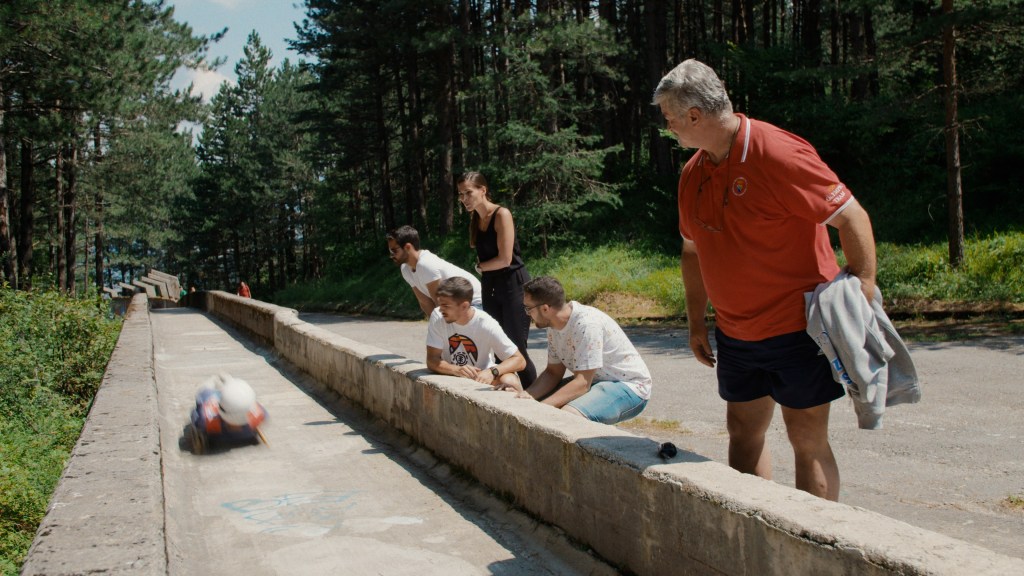
Hamza, Zlatan, and Mirza are normal teenagers with big dreams. But even though it’s been years since the Bosnian War waged in the wake of Yugoslavia’s disintegration tore apart their homeland, it’s specter still haunts them. This is especially true of the luge track located in Bosnia and Herzegovina’s capital, Sarajevo, one of only 16 working tracks in the world. Today, its concrete is riddled with bullets and covered in graffiti. Anyone who wants to use it for practice has to navigate the numerous tourists who walk on the track, using it as a hang-out spot or a unique photo op.
But Hamza, Zlatan, and Mirza aspire to represent their country in the 2022 Winter Olympics, and their dedicated coach, Senad, is determined to get them there. In his directorial debut, The Track, Ryan Sidhoo follows his subjects over the course of five years, beginning in 2018, as the foursome work to overcome the limitations that snowball into more hurdles they have to leap to meet their goals: they don’t have the funds for equipment or to repair the track that they need to be able to practice on, and if they can’t practice they can’t improve, and if they can’t improve they can’t win the preliminary competitions they need to to make it to the Olympics. Lack of state support means that they have to strike out on their own for help.
Sidhoo inserts sweeping shots of the luge athletes whizzing down the track at high speeds with close observational shots that serve as potent reminders that they are just young people trying to make their way in the world: going on bike rides with girlfriends, or playing games with family. The Track is structured so that it gives each boy ample screen time while hitting all the familiar sports movie beats, and its soaring score works harder to conjure emotion that it really needs to; Sidhoo’s images, whether they are close-ups of faces or stunning aerial shots of the track, frequently speak for themselves. Still, whether you are familiar with this story already or not, its hard not to cheer for these athletes, and feel moved by their clear pride in their sport and in their homeland.
The Track is this year’s recipient of the True/False Film Festival’s True Life Fund, meaning that any donations made through March 15 will go to Senad and his team to help them continue to pursue their dreams.

 Katie at the Movies