I do wonder how I might have received Paddington in Peru had I not had such an immediately ardent reaction to the two preceding films in the series. I’m not exaggerating when I say that 2014’s Paddington and 2017’s Paddington 2 are masterpieces of family entertainment that I’ve rewatched ad nauseam in the years since their respective releases. They’re movies that admirably pull off a rare balancing act: whimsical without being cloying, funny without being cringe, and clear in with their messaging about family, home, and identity in a way that never feels like it is working too hard to cater to adults or talk down to kids. That universal appeal goes a long way toward explaining why the Paddington movies— based on Michael Bond’s also universally beloved book series— are so acclaimed even outside its origins in the United Kingdom.
Paddington in Peru shakes things up quite a bit, both in front of and behind the camera. Paddington opens with the titular, duffel coat-wearing, marmalade-loving bear (voiced by Ben Whishaw) journeying from his home in the Peruvian jungles to London, based on the encouragement of his adopted Aunt Lucy (Imelda Staunton). There, he meets and is taken in by the Brown family, and their adventures across the city— which continue through Paddington 2— are accented by Paddington’s fish-out-of-water status as a strange bear in a strange land, and his pure heart, which win over virtually every person he comes into contact with.
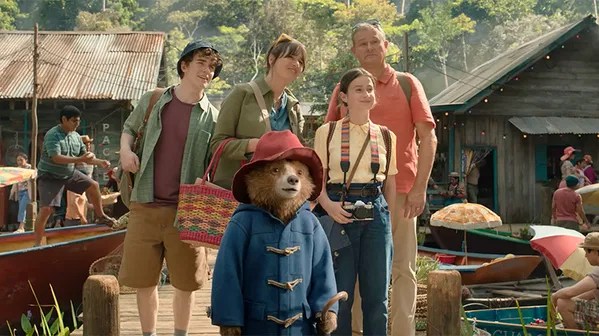
This threequel, however, flips the script. Now, it’s the Brown’s who are out of their element when they accompany Paddington— now officially a British citizen— back home to Peru, after he receives a worrisome letter from the Reverend Mother (Olivia Colman) at the Home for Retired Bears where his Aunt Lucy resides. Apparently, Lucy hasn’t quite been herself, and by the time Paddington and the Brown’s arrive at the home, she’s gone missing. After finding clues in her cabin indicating that Aunt Lucy might be at a place called Rumi Rock, Paddington and his family set out to find her, enlisting the aid of boat captain/treasure hunter Hunter Cabot (Antonio Banderas)— who claims that the search for El Dorado, the lost city of gold, is rumored to begin at Rumi Rock— and his daughter Gina (Carla Tous).
The first two Paddington films soared to success under the guidance of director Paul King, whose touch is so magical he even managed to accomplish the unthinkable a couple of years ago (make a musical prequel to Charlie and the Chocolate Factory about Willy Wonka’s origin story actually kind of good). While King maintains a story credit on Paddington in Peru, Dougal Wilson steps into the director’s chair in his feature directorial debut. Under his hand, the film’s overall tone and aesthetic is a capable continuation of the combination of whimsy, clever verbal and physical comedy, light adventure, and thoughtful probing of the meaning of family established by King, but it lacks the inventiveness of the first two films that pushed them to another cinematic plane. The film still cuts a lush figure, visually, with its use of bright, bold colors, and the rendering of Paddington and the other bears themselves— as animated characters inhabiting a live-action world, they’re neither too cartoony to be believable, nor too hyper-real to exist in that uncanny valley that fosters unease. But many of the series’ most fanciful flights— animated interludes, for one— are underutilized. Perhaps it’s a case of too many hands in the marmalade jar: while Paddington was solely written by King, and Paddington 2 by King and Simon Farnaby, Paddington in Peru boasts a screenplay by no fewer than three people (Mark Burton, Jon Foster, and James Lamont), from a story by Burton, King, and Farnaby. The charming first act gives way to a rather tiresome middle section that splits up the characters, with Paddington, the Brown’s, and Mrs. Bird (Julie Walters, reprising her role as the Browns’ spunky housekeeper) all embarking on their own quests that largely forsake slapstick-y shenanigans in favor of more straightforward action peril. The film cribs from a range of delightful (if at times too on-the-nose) references, from The Sound of Music to The African Queen to Steamboat Bill, Jr. (Wilson also specifically cites Werner Herzog’s Peru-set epics Aguirre, the Wrath of God and Fitzcarraldo as key inspirations on the story), but removing Paddington from London decreases the gag ratio by a significant amount.

A lot of that does have to do with the players surrounding him. Gone are Paddington and the Browns’ eccentric neighbors (played by the likes of Peter Capaldi) and the villains (more wacky than genuinely frightening) who threatened them (first played by Nicole Kidman, then, more memorably, by Hugh Grant). Colman is pitch perfect as the nun whose behavior leans toward the suspicious side, and Banderas seems to have fun playing not only Cabot, but a range of his ancestors through the years, but he’s generally a bit too self-serious, and piling his family drama on top of that of Paddington and the Browns’ leads to a plot that becomes unnecessarily overstuffed and not especially engaging. As a result, some of the Brown family’s storylines set up at the start of the film get the short shrift. Hugh Bonneville, Madeleine Harris, and Samuel Joslin all reprise their roles as father Henry Brown and children Judy and Jonathan, respectively, while Emily Mortimer steps into the role of free-spirited mother Mary Brown (and struggles to match the blend of maternal warmth and quirky charm Sally Hawkins brought to the role). As a hefty amount of time has passed since Paddington 2, those kids are now teenagers, with teenage problems: Judy with preparing to leave home— and the smothering of her mom— for university, Jonathan with typical young adult ennui (he spends all his time cloistered in his room, inventing clever gadgets to help him chill, to the chagrin of his parents). The safety-prone Mr. Brown, meanwhile, accepts the voyage to Peru as an opportunity to take his new boss at his insurance firm (Hayley Atwell, in a brief role) up on her challenge to take more risks. Although the film, like its predecessors, does an admirable job of circling back to them and giving them all a decent payoff, these threads feel more like afterthoughts than consequential pieces to the greater story.
But that greater story is ultimately about Paddington, and while some of that gets muddled in all the Indiana Jones-esque hullabaloo, it delivers an emotional body blow by the end, neatly tying up its themes of displacement and definition of what family is and can be with piercing clarity and wrenching vulnerability. Paddington in Peru may not be as memorable, rewatchable, or creatively stimulating as the first two films in the series, but it’s almost unfair to compare an otherwise solidly crafted piece of family entertainment— one that elicited loud laughter from the kids and adults at my screening in equal measure— to something that’s virtually perfect. At this level of consistent quality, I could easily watch another ten of these, as smoothly as that lovable bear could digest a sticky stack of marmalade sandwiches.
Paddington in Peru is now playing in theaters. Runtime: 106 minutes. Rated PG.


<a href=”https://filmymyntra.com/“>It is a nice blog-read film information </a>
LikeLike