About midway through The Last Showgirl, we see Pamela Anderson’s Shelly Gardner curled up in the living room of her Las Vegas home, watching a movie. The two shots we briefly see flash across the screen— first of woman clad in a long gown hoisting a glittering hoop, a bevy of chorus girls lying at her feet, and then of another woman flanked by beautiful butterfly wings—are instantly recognizable as being from Glorifying the American Girl, a 1929 musical revue from Paramount Pictures produced by Florenz Ziegfeld. The bulk of the movie is shot in black-and-white and careens from comedy to drama as it tells the story of Gloria Hughes (played by Mary Eaton, who was actually a member of the Ziegfeld Follies at the start of the 1920s), a young woman who leaves her devoted hometown boyfriend behind to pursue a career as a performer in New York City. But the finale, while idolatrous, is dazzling, shot in early two-strip Technicolor and essentially existing as a Follies routine that audiences would see on stage at the time: gorgeous women parading around in shimmering costumes staged against elaborate fantasy scenes. As a vaudeville show, the Ziegfeld Follies took on many forms, but it was— and still is— mostly known as being a showcase for female beauty.

It’s an on-the-nose reference, but still an appropriately pointed one when it comes to Shelly, a 57-year-old dancer in a Follies-esque show on the Vegas strip called Razzle Dazzle. Director Gia Coppola’s film boasts a screenplay by Kate Gersten based on her own unpublished play Body of Work, inspired by her own observations of the long-running Vegas show Jubilee! just prior to its permanent closure in 2016. Razzle Dazzle has similarly been a fixture since the 1980s, Shelly having been with the show for the last three decades of her life. It’s, as they say in the film, the last show of its kind on the strip, a vestige of the old Vegas: scores of women prancing across a stage in a assortment of sparkly bustiers and feathery headdresses. But its nostalgia factor hardly compensates for the changing times, and Razzle Dazzle is being pushed out in favor of shows that contain more nudity, lewd dancing, and sexually-explicit acrobatics. At a dinner gathering early in The Last Showgirl consisting of Shelly, her younger Razzle Dazzle colleagues Mary-Anne (Brenda Song) and Jodie (Kiernan Shipka), and her showgirl-turned-cocktail waitress friend Annette (Jamie Lee Curtis), the revue’s producer Eddie (Dave Bautista) drops the bomb: the official announcement of the Razzle Dazzle’s final show in just a couple week’s time is imminent. And for the first time in 30 years, Shelly— who threw everything into her art— is facing an uncertain future.
Gersten’s story wisely takes its time unveiling information about Shelly— past relationships, the existence of her estranged college-aged daughter Hannah (Billie Lourd), her struggles to balance parenthood with her career— gradually pulling out these pieces of her past as needed to show how they may inform her future. At the same time— and even more heartbreaking— we witness how the discrepancy between dedication to and passion for her craft in an industry that devalues women while cashing in on their beauty and bodies begins to break her down. It’s a role that’s more than a little personal for Anderson, who rocketed to fame as a sex symbol as a Playboy Playmate and the star of Baywatch in the early 1990s, but was never taken seriously as an actress. And she’s more than up for the challenge. Her performance here— the crowning achievement of her career thus far— is brimming with both fire and pathos. If it seems like she’s trying too hard, that’s because Shelly is trying too hard: to cling on to her career, to maintain some sort of relationship with her daughter, to find romance (the latter isn’t explicitly depicted in the film, but conversations with Annette convey Shelly’s tendency to date men who don’t see past the smiling showgirl on stage). Her breathy voice and rapid delivery indicate the type of person who is always feels the need to justify herself and her actions, whether it’s explaining to Hannah why she couldn’t afford to take care of her, or pleading with a director (a pitch-perfect bit by Jason Schwartzman) to give her a chance as a dancer, or explaining to Mary-Anne (for whom the Razzle Dazzle is just a job) ad nauseam why the show is so important, denigrating the dirty new shows while praising the traditional and historical value of the Razzle Dazzle. It’s a clever choice by Coppola to never actually depict the revue on screen, at least until the very final scene. For the entirety of the movie, our knowledge of it doesn’t extend past Shelly’s words and the images of showgirls changing in their dressing rooms and rushing up and down the stairs to the stage in their flashy attire (the film utilizes some of the original costumes by Bob Mackie from Jubilee!), which makes Hannah’s mid-film confrontation— when she finally watches the show and realizes that her mom dedicated her life to a production that requires so little talent or artistry over caring for her— that much more cutting.
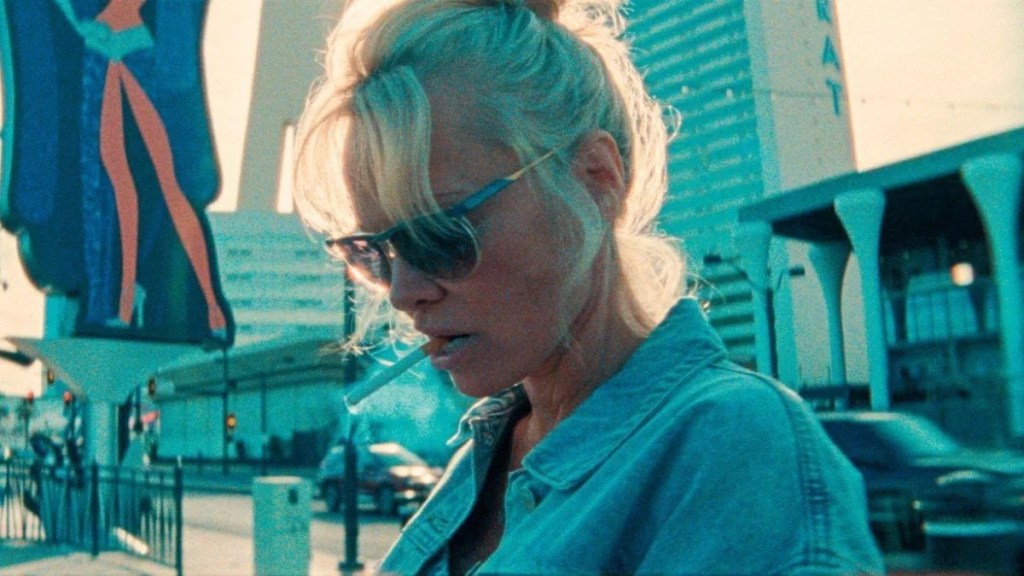
The Last Showgirl’s empathetic gaze is aided by Autumn Durald Arkapaw’s (who also shot Coppola’s previous two features) cinematography, which neither leers at these women nor glamorizes Sin City. Shooting on 16 mm film and with a handheld camera, she captures intimate moments in a place that’s typically all too easy to get lost in. The movie’s most stunning shots are far from the usual neon Vegas scenery that most films love to indulge in; rather, they include rooftop chats set far above the strip, or Shelly wandering among the now-desolate reminders of the city’s past. If some shots appear out of focus or oddly framed, it’s a feature, not a bug, of a production that seeks to capture the messy spiral of not just its protagonist, but those around her. Curtis, lipsticked and leathery-faced and navigating the world with a ball-busting attitude, is doing a lot, but has never done more better as the friend who’s clearly gone through what Shelly is now going through, and may be about to go through it again as she ages out of job after job in favor of younger, fresher faces. Shipka— who’s recently had a helluva run doing character bits— is wonderful as the sort of naive surrogate daughter, who sees the Razzle Dazzle crew as her family but is also— at 19 years old— so young that the prospect of landing another show is far from daunting. And Bautista is remarkably tender. As the sole male character of note, his presence also provides some much-needed perspective: he’s the one person who’s able to stay in his current position as he goes on to produce the circus show that’s replacing the Razzle Dazzle.
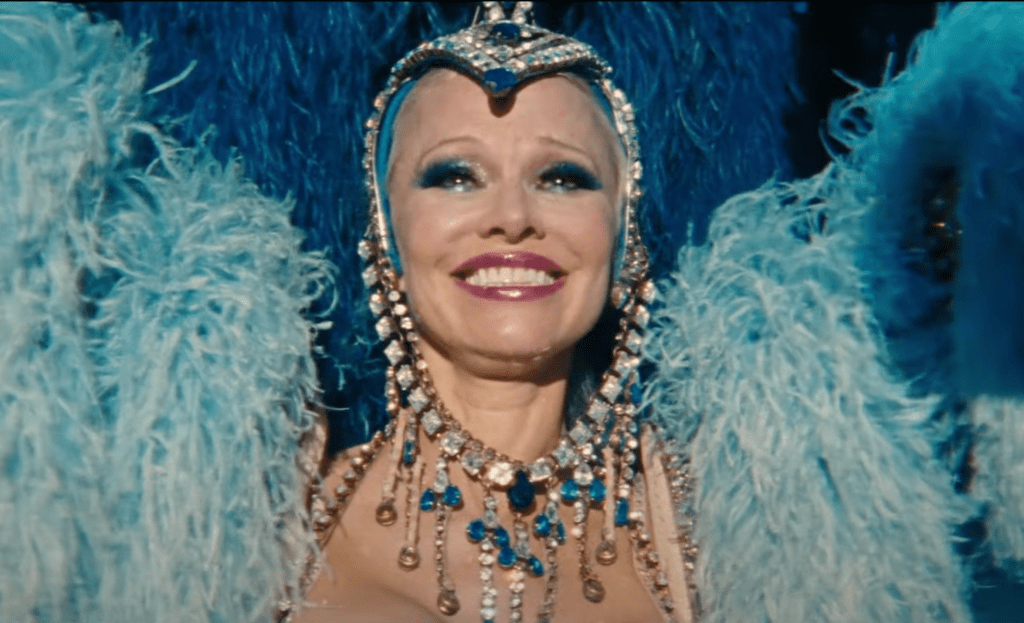
Glorifying the American Girl surprisingly veers away from the predictable Hollywood happy ending. Gloria spends her initial time in New York City finding out how women’s bodies are used as currency in the entertainment industry, when she discovers that her new partner wants sex in exchange for elevating her to stardom. Ultimately, when she does take the stage, she’s realizing her dream, but left her old boyfriend behind in the arms of another woman. Early Hollywood films that depict career-focused women without finding a way to punish them in some capacity are hard to come by, but the question of whether or not Gloria will be happy with this life she’s chosen is left on the table. It’s easy to see how— even nearly 100 years later, yet another indicator of how little systemic change has truly occurred— her story runs parallel to Shelly’s: as some of the other characters in the film point out to her, there are other paths she could have taken, other lives she could have led, but she opted to work at something she loved only to have it chew her up and spit her back out with nary a rhinestone left on her back. But what’s so impressive about Shelly— and Anderson’s portrayal of her— is her perseverance in the face of it all. In another heavy-handed yet effective bit of symbolism— and possible additional homage to the Follies— Shelly wears a costume that features massive butterfly wings, but she keeps tearing the delicate fabric on the door handle every time she tries to get on stage. And yet she still goes back and tries to fix them, even as Eddie tells her that they don’t have to be perfect. Fragile and flawed though she may be, Shelly has everything she needs to soar.
The Last Showgirl is now playing in theaters. Runtime: 89 minutes. Rated R.

 Katie at the Movies