In 2021, numerous unmarked graves were discovered on the grounds of St. Joseph’s Mission, a former Canadian residential school situated near the Sugarcane Indian Reserve near Williams Lake in British Columbia. This wasn’t the only school where such a discovery was made. It is, however, where directors Julian Brave Noisecat and Emily Kassie choose to narrow the focus of their documentary Sugarcane, which simultaneously investigated and reckons with the abuse of Native children that occurred at the over such institutions spread across North America (139 in Canada, over 400 in the United States), established by the Catholic Church to assimilate indigenous people into white society— essentially strip them of their culture through forced separation from families and communities and verbal and physical, often sexual, violence that the Church and others turned a blind eye to.

Whitney Spearing search through newly released records to identify deaths and abuses of
children at St. Joseph’s Mission.(Credit: Emily Kassie/Sugarcane Film LLC)
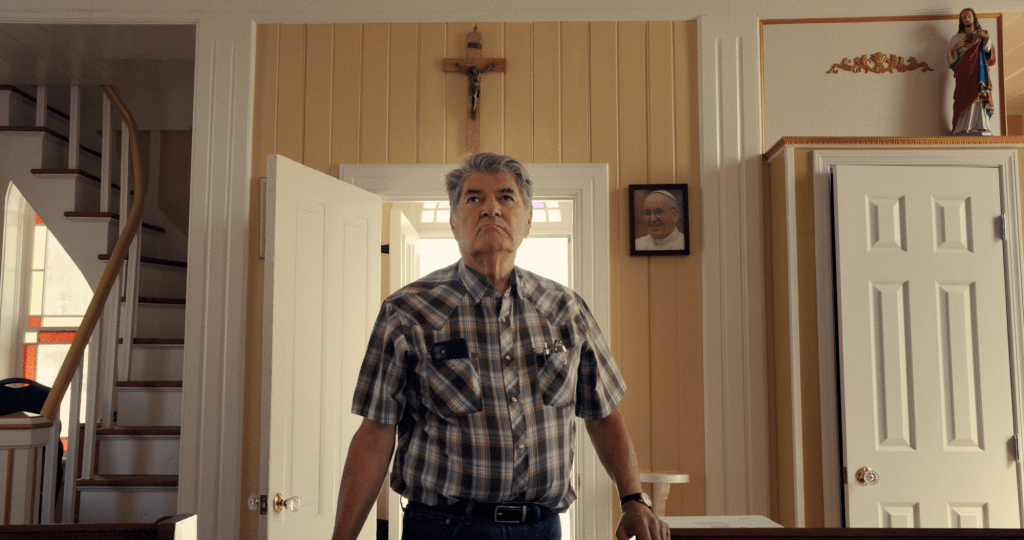
The decision to center Sugarcane here becomes even clearer when the real personal nature of the story comes to light: both Noisecat’s father and grandmother were survivors of St. Joseph’s, his father born and abandoned there. Noisecat himself becomes a key on-camera character in the film as well, as the depth of the intergenerational trauma stemming from these schools manifests itself. There are a couple other strands Sugarcane follows, including the story of Rick Gilbert, former chief of Williams Lake First Nation who struggles to reconcile his upbringing at St. Joseph’s with his devout Catholicism, and a pair of investigators working with the community to uncover the extent of the atrocities committed at the school, but they’re all closely tied. There’s a real journalistic spirit to Sugarcane, likely at least partially due to the directors’ backgrounds in the field (Noisecat and Kassie sat next to each other working at the Huffington Post). While the cultural genocide committed at the residential schools has previously been officially recognized (albeit fairly recently, considering the institution originated in the late 1800s and the final school didn’t close until 1997), we witness the discovery of infanticide committed there unravel on screen through new evidence uncovered and eyewitness accounts. Children born in the schools were often tossed into the incinerator on property; Noisecat’s father, Ed, was found inside it, still alive. Yet, complicity in systemic racism from the Church, police, and government meant that despite concrete allegations, no one was ever prosecuted except for his unwed, indigenous mother.
It’s an upsetting topic to think about and write about, much less confront head-on. Fortunately, there’s nothing clinical about Noisecat and Kassie’s filmmaking. They eschew the interviews typical of this sort of investigative documentary, opting for conversations instead. These scenes are as painful as they are cathartic: Noisecat asking his father why he abandoned him, or Rick— summoned to the Vatican for an audience with Pope Francis as part of a group of Native people seeking reparations from the Catholic Church— discussing his story with a priest, the tragic tendrils of which creep across the film with increasingly heavy weight. The directors— and their subjects, reluctant or otherwise— invite the audience to sit in on these intimate discussions, which are incredibly personal but not invasive. Rather, the audience becomes a participant, forced to sit with these revelations and their feelings about them. Married with Mali Obomsawin’s evocative score, well-integrated snippets of archival footage depicting the commonly-held ideas of Native people as being something less than human in action, and Christopher Lamarca’s cinematography, which is brimming with rich images of the land that grants the film a tangible sense of place, it’s a sobering experience.
Indian Reserve. (Credit: Christopher LaMarca/Sugarcane Film LLC)
Yet Sugarcane is nonetheless hopeful, even as it zooms out to depict how this handful of experiences we’ve witnessed over the course of the film are representative of larger institutionalized issues and colonialist ideology. The community Noisecat and Kassie introduce us to bear the weight of their pain, but their resilience and pride in their culture is even more prevalent. Sugarcane joins the ranks of the past few years’ great Native cinema, including films like the documentary Missing From Fire Trail Road and the narrative feature Bones of Crows that reckon with the impact of the residential schools specifically, but its clear-eyed and empathetic approach makes it essential viewing.
Sugarcane will be available to stream on National Geographic on December 9 and on Disney Plus and Hulu on December 10. Runtime: 107 minutes. Rated R.


Sugarcane is by far, the most important and beautifully crafted documentary this year. Its social impact cannot be overstated. Most significantly, it has helped a wounded community to heal and inspired other indigenous North America communities to speak their truth after a central of repression.
LikeLike
i hope that films like this will open the door for more investigation and public knowledge for these type of atrocities that also happened in the United States. It is definitely unfortunate that too many people have turned a blind eye to these events due to lack of awareness.
LikeLike
A superb film that has captured hearts and minds across North America. Despite the immense sadness depicted on screen, it has moments of light and hopefulness. In a sea of excellent documentaries this past year, this one stands out as the most important and impactful.
LikeLike
Sugarcane is a confusing film.
The issue of Ed Archie’s paternity is muddled for the sake of the movie’s story, but everyone in the film/community knew that Attoinette Archie, ( co-director Julien Brave’s grandmother)had Ed with Ray
LikeLike