It would be all too easy to dismiss Sean Wang’s Dìdi as the exact sort of semi-autobiographical, coming-of-age comedy/drama that seems to become the Sundance darling on an annual basis. In fact, when Dìdi premiered at the festival earlier this year, it won the Audience Award, cementing its position as a sturdy crowdpleaser. Sure, in general, Dìdi is overly familiar. But making his feature directorial debut, in addition to writing and producing, Wang— who was nominated for an Oscar earlier this year for his documentary short Nǎi Nai & Wài Pó, a sweet ode to his immigrant Taiwanese grandmothers— brings enough of his specific experience and personal flair to the film to make it worthy of praise.

Set in the summer of 2008, Dìdi follows Chris Wang (Izaac Wang), a 13-year-old about to start high school. Affectionately called dìdi— a Mandarin term of endearment— by his mother Chungsing (Joan Chen) and the more derisive Wang Wang by his friends, Chris doesn’t exactly fit in in his mostly white Bay Area home town. That is partly due to his race— his peers make casually racist comments that run the gamut from new friends calling him nicknames like “Asian Chris” or a girl he likes saying he is “cute for an Asian”— and partly due to his own feelings of inadequacy about what he should and shouldn’t be doing at this stage of his life. His best friend Fahad (Raul Dial) pressures him to hook up with Madi (Mahaela Park), the girl he has a crush on, but when push comes to shove, he’s too nervous and simply not ready for even the most innocent sexual encounter. He uses his budding interest in filmmaking (the exact extent of this interest is one of a few things the film gestures toward but ultimately glances over, to its detriment) to ingratiate himself into a group of skateboarders, but he fumbles his initiation into what he believes is a better social circle by sugarcoating his abilities. And he engages in a lot of behavior that isn’t really him just because it seems like the cool thing to do, from talking back to his mom to fighting with other boys to talking trash with his buddies.
Wang ably depicts the inherent shame in one’s race and the desire to assimilate through Chris’ behavior; at one point, he tries to deflect by saying he is only half-Asian. But there are also glimpses at the burden of familial expectation. The drama that plays out between Chris, his older sister Vivian (Shirley Chen) who is preparing to enter college and with whom he constantly bickers, his mother, and his paternal grandmother Nai Nai (Chang Li Hua), who lives with them, at the dinner table is funny, but it also lays bare all their troubles, including an absent father and husband working aboard and Nai Nai placing all the blame for the children’s explosive behavior on the mother. Elsewhere, the very typical expectation placed on Asian families to have their children earn great grades and attend the best schools manifests itself in another conversation with a family friend with a son Chris’ age, the mother softly critiquing the hardships in choosing an artistic (re: unstable) profession (Chungsing is a painter). These moments lend Dìdi a personal angle, which further finds its voice in Wang’s making Chris a teenager who is Extremely Online circa 2008. That means he communicates strictly through AOL Instant Messenger (and sometimes, slowly, via text on his flip phone), keeps tabs on his friends via MySpace and the fledging Facebook, and spends an inordinate amount of time going down weird rabbit holes on YouTube. Very often, the computer screen takes over the film, becoming an outlet for Chris to voice his emotions. But while Wang exhibits an acute understanding of the importance of the right choice of emoji, he also frequently relies on text too much to tell what Chris is feeling in a too on-the-nose fashion (such as when, with no friends left to turn to, he tells an AOL chat bot about how he messed up). It’s overall a neat storytelling device, however, and an accurate and amusing time capsule of the era (I was preparing to enter my senior year of high school in the summer of 2008, and laughed a little too hard at the fleeting glimpse of a post on someone’s Facebook wall of a photo with the caption “Dark Knight round 6 with the homies”).
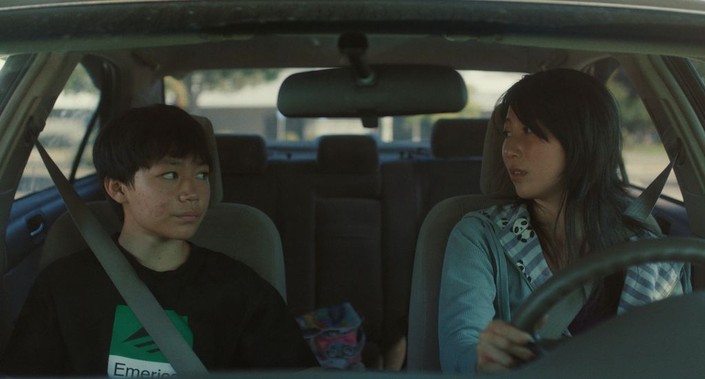
Wang further leans into the visual style of the era by imbuing it with some DIY camcorder aesthetics. It’s in step with Sam A. Davis’ cinematography, which captures the summer of youth and the specificity of the locations they circle around— playgrounds, empty parking lots, a mini-golf course— with a shadowy realism that avoids any nostalgic warmth. Occasionally, the narrative feels like it is going through the requisite motions— the protagonist’s breakdown, the mother’s touching third act monologue— while its loose structure meanders somewhat toward the end, but Wang grants it some of his own stylish touches, like hallucinatory dream sequences that include a talking fish and a reanimated squirrel (voiced by none other than Spike Jonze). Dìdi could have benefited from more of that, honestly, but it gets by on the strength of its cast, which includes a swath of non-professional actors (these are real teenagers, and if they come off as too much like selfish, immature, unlikeable kids, well, that’s the point) and Chen, who delivers an earnest performance that breathes life into a character operating on the periphery of the bulk of the movie. And it avoids wrapping up all of Chris’ dilemmas with a neatly saccharine bow. For all of its humor, Dìdi is tinged with more melancholy than hope. These are times that the characters all just need to get through; they may be okay eventually, but they aren’t right now, in this moment, and that’s okay too. So if you think Dìdi looks like another overly sweet indie darling, think again, and give it your time.
Dìdi is now playing in theaters. Runtime: 94 minutes. Rated R.

 Katie at the Movies
nice!!
LikeLike