“To be good is to be forgotten. I’m going to be so bad I’ll always be remembered. The reason good women like me and flock to my pictures is that there is a little bit of vampire instinct in every woman. I will continue doing vampires as long as people sin.”
Theda Bara reportedly stated the above around the time of her retirement in 1926. The silent film star, nicknamed “The Vamp” for her penchant for portraying scantily-clad, seductive women, was one of Hollywood’s most popular and lucrative performers between 1915 and 1919, appearing in such films as Cleopatra and Salomé. But her whole persona was based on a lie; her home studio, Fox, crafted an elaborate backstory for her that started in Egypt, where they claimed she was born in the Sahara desert under the shadow of the Sphinx, her name— an anagram for the phrase “Arab death”— only enhancing her exotic appeal. In reality, Bara was born Theodosia Burr Goodman in Cincinnati, Ohio, to Jewish parents. But who would remember that?
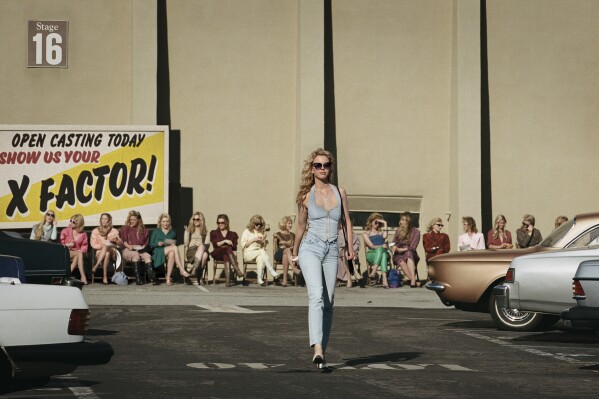
Early on in MaXXXine, the third and reportedly final installment in his X horror films series, writer and director Ti West connects Bara’s story to his protagonist’s when Maxine Minx (Mia Goth) reaches a decision while standing on Hollywood Boulevard and stamps out her cigarette on Bara’s star on the Walk of Fame, the camera lingering on her name just long enough for it to register. At the end of 2022’s X, of which MaXXXine is a direct sequel to, it’s revealed that Maxine— an aspiring adult film star who is the sole survivor of a massacre— is the missing daughter of a small town preacher. In the space between X (set in 1979) and MaXXXine (set in 1985), Maxine has changed her name, changed her look (gone is the dark hair and dowdy clothes, traded for tousled blonde waves, leather pants, and a shiny jacket), and become a big name in adult entertainment. But that isn’t quite enough for Maxine, whose aspirations for stardom extend beyond her ability to get men off. At the start of the film, she auditions for the lead in a movie— a horror sequel titled The Puritan II— and she gets it. At the same time, Maxine is being stalked by a dark, leather-clad figure, and her friends and colleagues start turning up dead.
Just as the pointed nod to Bara’s star indicates, West is nothing if not unsubtle in his approach to storytelling. Maybe Maxine hasn’t outright lied about her background, but she has tried to bury it. This stalker (which the characters for a time believe could be the Night Stalker, an allusion to the real-life serial killer who murdered 14 people in Los Angeles around this time period) knows things about Maxine, as he sends her videotapes that resurrect pictures from her long-buried past. Maxine literally has to kill her past to rise to fame; and just as we saw in X, she’s pretty ruthless when it comes to stardom.

X and its follow-up, the prequel Pearl, were both surprisingly successful and unique films. Their influences were clear, but they used those associations to craft something wholly fascinating. X, a Texas Chainsaw riff, explored ageism, granted depth by Goth’s dual role portraying both an old and a young character. Pearl harnessed the Technicolor beauty and glamor of Old Hollywood musicals to tell the sort of deeply disturbing tale of one woman’s isolation and drive to be somebody that never would have flown in that era of Hollywood history in reality. Similarly, the vibe that West is reaching for with MaXXXine is obvious: the grimy thrillers and giallo pictures of the 70s and 80s. But the story and the setting are not nearly sleazy enough to successfully pull it off. West gets too carried away in trying to create the ultimate ode to Hollywood as a whole to truly reckon with its sinister underbelly. With about as much forcefulness as Maxine stomping on the balls of a Buster Keaton impersonator who pulls a knife on her with her stiletto heel, West thrusts upon the audience an opening title card with Bette Davis’ quote about being viewed as a monster, scenes set on the Universal Studios lot, particularly the Psycho house and the Bates Motel set, Brian De Palma-esque split screens (a director whose trashy 80s thrillers are one of West’s clear inspirations, and whose own penchant for lifting from the likes of Alfred Hitchcock is well-documented, but who translated previously-tread stories to his own gleefully unique style), styling Maxine as a “Hitchcock blonde” and calling it out, and— most cringe of all— a climax set at the foot of the Hollywood sign, where Maxine’s rise to fame or descent into obscurity will be sealed once and for all. On top of that, there are some half-hearted allusions to more interesting issues like censorship and video nasties and the moral outrage surrounding Hollywood projects (protesters hefting signs denouncing satan surround the gates of the studio while The Puritan II preps filming) and some culling from the grainy, low-budget aesthetics of the rising home video market. Despite some bursts of gore and goo, it’s all too polished, a breakneck tour of Hollywood history that’s filled with recognizable icons rendered as hollow images thanks to an obvious and remarkably poor script. This is especially apparent when it comes to Elizabeth Bender (Elizabeth Debicki), the director of The Puritan II who recognizes Maxine’s ruthlessness beyond her earnestness in her audition. Every one of her lines reads like it was spat out by an A.I. machine told to make a cool, high-powered female character who can also serve as an exposition delivery service. In perhaps an unfortunate moment of meta commentary, Elizabeth— when pointing out the Bates Motel to Maxine— says that a sequel Hitchcock’s incredible original film was made there a few years ago, for some reason.
Debicki’s performance is not good— laughable, even, but that’s more due to the abysmal writing than anything else— but none of the supporting cast really is, despite MaXXXine boasting more big names than either of its predecessors. Michelle Monaghan and Bobby Cannavale play smug detectives investigating the murders that surround Maxine, the fact that the latter is a failed actor played up as a piece in the film’s picture of how fame is a game that you either win or lose. Halsey, Lily Collins, and Moses Sumney pop up as some of Maxine’s friends; the latter works at the video store downstairs from her apartment, another empty effort at gesturing toward the aesthetic of the era without mining it for much narrative or thematic purpose. Kevin Bacon does an over-the-top and borderline offensive accent as a private investigator trailing Maxine, but at least he seems to be having fun, as does Giancarlo Esposito, who boasts a beautiful head of hair as Maxine’s agent. Ultimately, as with the previous two films, this is Goth’s movie, but while she is frequently electrifying to watch, she isn’t granted impressive dramatic moments on the same level as X and particularly Pearl.
The main reason that Theda Bara retired from movies is that she struggled to find work after her Fox contract expired, which she— tired of being typecast as a vamp and yearning to branch out into other roles— allowed to happen. None of her projects made between 1920 and 1926 really took off, and her attempt to appear on stage resulted in critics savaging her acting. Many of her films are now lost to time, having been destroyed in the devastating 1937 fire that occurred at the Fox vaults. MaXXXine concludes with a question mark still hovering over the character’s pursuit of fame. While Maxine clearly sees The Puritan II as her big break, other characters throughout the film gently question the horror genre’s ability to turn her into a big star. At her audition, she delivers a heartfelt and tearful monologue to the camera that stuns the director— and then she’s immediately asked to take off her top so they can see what her breasts look like. There’s a reason why MaXXXine’s finale shifts from dream to reality. It’s so easy to read her future into just a couple of scenes: a career that moves from being typecast as an adult film actress to typecast as a scream queen in low-budget B horror movies, a life that’s overshadowed by controversy, an eventual tiring of never being able to move beyond the roles that made her famous— but the satisfaction of never being forgotten. Those are interesting questions that MaXXXine only limply raises, and doesn’t answer. Perhaps West will hold on to them for the fourth film that he is supposedly currently developing. Or perhaps he’ll leave them on the table and let Maxine— the character and the film— exist in the words of Theda Bara: so bad they’ll always be remembered.
MaXXXine is now playing in theaters. Runtime: 104 minutes. Rated R.

 Katie at the Movies