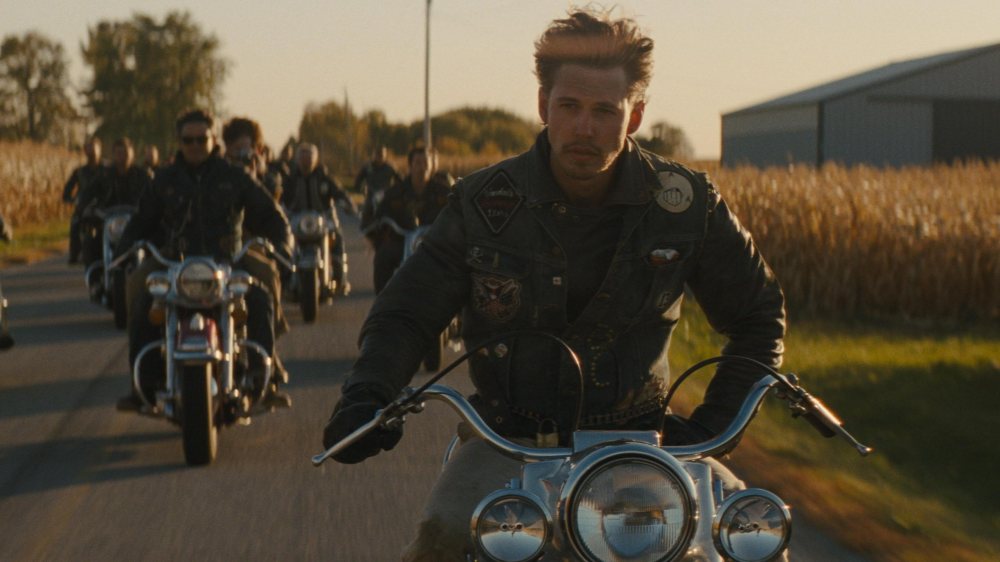
As someone who spends approximately 85% of her time driving around the Midwest, I’m afraid I have no choice but to call bullshit on The Bikeriders’s portrayal of the region. It isn’t so much an aesthetic issue, although it’s fairly obvious that the film, set in Chicago and its nearby suburbs, wasn’t shot in Illinois (Cincinnati, Ohio, a frequent stand-in for the entirety of the Midwest for mainstream Hollywood productions, was where filming took place). While this location discrepancy results in a movie that lacks regional specificity, it does ably capture a more general sense of place. Neighborhoods consist of tall brownstones with wide porches sitting in neat rows on streets lined with old trees. Dingy corner bars serve as common gathering places, the bright light from the late afternoon sun penetrating glass block windows to illuminate the inside, the low, warm glow of a its sign hanging over the entrance a beacon in the night outside. Once you begin to venture out of town, the buildings fall away, and you’re left with nothing but farmland intersected by two-lane highways.
It’s an impeccably-crafted atmosphere, but it’s all a veneer that never feels fully lived in. That seems like an odd thing to say about a film by Jeff Nichols. The Arkansas native’s filmography is largely what I can only describe as “Midwest core,” from his 2012 drama Mud, set on an island off the Mississippi River, to 2011’s Take Shelter, in which an Ohio husband and father (played by Nichols’ frequent collaborator, Michael Shannon) is plagued by apocalyptic (for my money, one of the most unnerving films of the last couple decades). For his first feature since 2016’s one-two punch of Midnight Special and Loving, the writer and director drew inspiration from a photo book published in 1968 by then up-and-coming photographer Danny Lyon. Also titled The Bikeriders, Lyon followed the Chicago chapter of the Outlaws Motorcycle Club between 1963 and 1967, by which time he became disillusioned by the group’s values. In a 2014 interview with The Guardian, Lyon recalls one of the members using a Nazi flag as a picnic blanket, saying, “By then I had realized that some of these guys were not so romantic after all.”
That curdling of the romanticism of the frontier lifestyle promised by riding into unmitigated violence and anger is a subject Nichols brushes up against in The Bikeriders, a film that otherwise lacks a center, drifting between characters and in and out of various set pieces with an aimlessness akin to the freewheeling nature of a motorcycle gang. For his film, Nichols dubs that gang the Vandals, led by the hulking Johnny (Tom Hardy). The Vandals are a family, strong together but— in a too-little explored corridor of the masculine fronts the characters put on like a leather jacket— defenseless on their own.
Nichols looks back at the Vandals— who operated around Chicago throughout the 1960s— in a flashback format, through a series of interviews Lyon (played by Mike Faist) conducted with Kathy (Jodie Comer) in 1965 and later in 1973. Kathy is the outsider’s in to the group; when she first comes across them at the dive they usually hang at to drop off something for a girlfriend, dressed neatly in a purple sweater and white jeans, she feels more than a little out of place. The leering looks and strident come-ons directed toward her by the surrounding men don’t help, but she’s oddly drawn to the more brooding Benny (Austin Butler). Benny pursues her, quietly but forcefully enough that she can’t help but acknowledge him. Five weeks later, as she tells Lyon, she married him.
That description makes it sound like The Bikeriders centers around Kathy and Benny’s relationship and how it fits into the ebbs and flows of the Vandals, but the film isn’t really about that either. In fact, we get little sense of what Kathy and Benny are like as individual people, and as a couple. The bulk of the first half of the film is comprised of Kathy delivering exposition about the group and Benny to us by way of Lyon, but there’s a good stretch where we don’t even see the two of them on screen together. In other words, the movie is doing a lot of telling rather than showing, and the erratic placement of the flashback scenes does it no favors. It’s tough, especially when the movie’s electric opening scenes suggest a magnetism drawing them together that we just never witness. And it doesn’t help that Comer’s performance verges on atrocious. It’s not entirely her fault; she’s working with a thin sketch of a character who seems to have no life or personality beyond her relationship to Benny and the Vandals. But her off-handed, almost perky line readings in the interview scenes opposite Faist (another good actor given nothing of note to do here) strive too hard for likability, and her swing for a broad Chicago accent is frankly distracting. To my surprise, the real draw in the cast is an actor who I’ve previously been lukewarm to negative on. Butler, at the very least, knows how to work the camera with those intense stares. Benny clearly isn’t too bright— he’s the type of guy who has his own name tattooed on his arm— but he revels in a life where he isn’t chained down, a trait Butler best manages to convey when an accident nearly forces Benny to do just that. Unfortunately, in another instance of the film’s lack of focus, he vanishes from the film for a decent chunk of its second half. Hardy, meanwhile, is at his best not when he’s doing a gonzo accent (which he does here, to an extent), but when he’s playing the strong silent type; in The Bikeriders, he’s that, but he plays it with an undercurrent of love and loyalty to his community that transforms into abject sorrow as the world begins to change around him. The quick couple glimpses of his home life— a wife, children, and some sort of steady, regular job— are more than we get for Kathy and Benny, but are so shallow (we’re given no sense of the relationship between him and his family) they nearly might as well not have been included in the movie at all.

The Bikeriders is populated with a lot of other great faces in supporting roles, including Shannon as Vandals member Zipco, Damon Herriman as Vandals cofounder Brucie, and Norman Reedus as a California biker called Funny Sonny. As alluded to before, Adam Stone’s cinematography captures the era and location well (this is especially evident when some of Lyon’s actual photographs play over the end credits) while Julie Monroe’s editing— often cutting quickly away from sudden bursts of violence back to moments of calm— contributes to the feeling that all these bikers are, for lack of a better word, dissociating. They can’t deal with violence, but they won’t show their emotions either. That violence only ramps up in frequency and intensity as the freewheeling 60s transition to the 70s. The Bikeriders wears its influences on its sleeve; Johnny was inspired to form the Vandals after watching The Wild One, the 1953 biker movie that turned star Marion Brando into an icon of rebellious youth. When we see Johnny watching the film on TV in his living room, he leans forward, locked in, as Brando delivers his famous response to the question, “What are you rebelling against?” “Whaddaya got?” It’s rather blunt showing that movie within this one when its influence already so clearly permeates every frame, at least of the first half of the film. This is no more evident than when the Vandals ride into town, stirring ire and envy in the locals in equal measure, particularly drawing the eye of a young man who clearly sees in them both an outlet for his anger and an escape from his suffocating existence. But like Brando, the things that the Vandals are rebelling against are vague to nonexistent; the club grants them the experience of rebellion minus the need to invest in an actual cause. Like their faux masculinity that crumbles as the group disbands, it’s all a veneer. Meanwhile, the young men who come home from fighting in Vietnam chafe at a government that doesn’t value their lives, not to mention the lives and rights of citizens who aren’t straight white men; they channel that anger through hard drugs, rough sex, and gang violence. This shift in membership, when it’s clear that the group is slipping from Johnny’s hands and it isn’t all fun and games anymore, when at a gathering Kathy suddenly finds herself in danger from those who ought to be her peers (the film’s most bluntly horrifying scene), is when The Bikeriders starts to go somewhere really interesting, but it’s too little too late. Perhaps had Nichols used the film more as a study in how those traditional Midwestern values eroded with the changing times, it would have packed more of a punch. Occasionally, it very nearly does. Instead, what we’re left with is a loose story that wavers between a few different characters, unsure of who they are when they’re not on the back of a motorcycle, grasping at ideas and a mood without ever fully embracing them.
The Bikeriders is now playing in theaters. Runtime: 116 minutes. Rated R.

 Katie at the Movies
I’m yet to watch this film do u recommend it? Also I’m a fellow reviewer myself
LikeLike