“It’s like a modern-day Goonies” has turned into a catch-all phrase covering any sort of adventure story centered on children, particularly ones that are steeped in nostalgia (perhaps the most recognizable example is the Netflix series Stranger Things, which begins in the early 1980s a mere couple of years before Richard Donner’s The Goonies was released). That statement could just as easily be applied to writer and director Weston Razooli’s debut feature Riddle of Fire, but it also doesn’t feel adequate enough to cover the wide range of genres, tones, and aesthetics that Razooli is playing with.
For one thing, Riddle of Fire is set in the present day— or thereabouts, at least, as evidenced by the smart phones the children can be glimpsed whipping out every so often to use a funky futuristic scanner-type app. But it also feels like it exists out of time. Razooli opens on what in another film may have been the climax: brothers Jodie (Skyler Peters) and Hazel (Charlie Stover) and their friend Alice (Phoebe Ferro) desperately want a new video game, so they steal it from the manufacturer. Razooli stages this heist with the playfulness appropriate to such an event unfolding from a child’s perspective, as they sneak around and through narrow spaces and tiny crevices before triumphantly pedaling away on their bicycles. This all occurs over the course of just a few minutes; the kids get home, rip open the box, start up the game…and discover that Hazel and Jodie’s mom Julie (Danielle Hoetmer) locked access to the TV behind a password. Julie is currently sick in bed, so when the kids come to her pleading for the password, she makes a deal with them: if they’ll bring her a specific blueberry pie from the bakery down the road, she’ll give them the password.
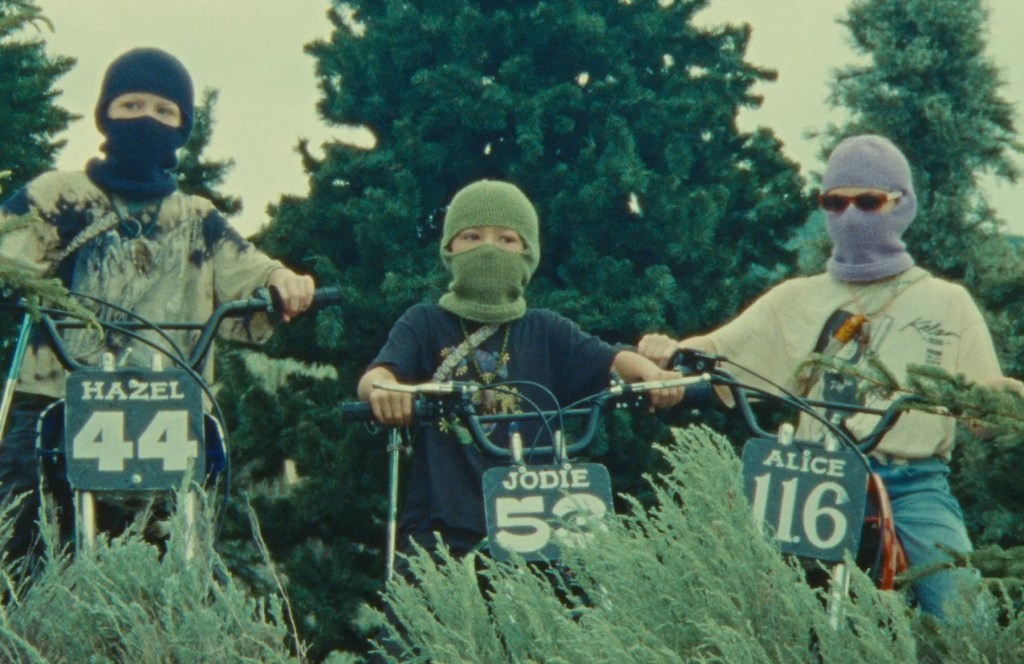
Naturally, obtaining the pie turns into a quest that’s likely more epic than anything to be found within that video game. A mission to get the pie fast turns into an errand to get the recipe, and then the ingredients so they can bake the pie themselves, but another customer at the grocery store snatches the last carton of eggs (speckled eggs, as the recipes specifically states), and Jodie, Hazel, and Alice fast find themselves in over their heads with poachers and witches, new friends and deadly enemies.
Razooli dubbed Riddle of Fire a “neo-fairytale,” and that seems like an appropriate way to succinctly categorize this concoction of fantasy, folklore, thriller, and adventure that captures the feeling when you’re a child of even the simplest task feeling like a monumental quest. There’s literal fantasy baked into the story— like with Petal (Lorelei Olivia Mote), a lonely young girl the threesome befriend who can murmur spells under her breath— but it’s also evident in its visual language, from the style of the font used for poetic interludes to the synth score that recalls old video games. The cinematography conjures a sense of nostalgia, and contributes to that aforementioned feeling of the film existing in no one specific time; DP Jake Mitchell shot around the Wyoming forests and hills where the story is set (near where Razooli grew up) on 16 mm Kodak film, and the soft, sun-dappled greens that are the film’s dominate color lend the film a fuzzy warmth that’s evocative of childhood without veering into the overly sentimental.

It’s not all sweetness though; like most children versus adult stories, the kids are put into peril at times, but in Riddle of Fire those shifts are quite dark in a grounded way that feels too much at odds with the rest of the film’s whimsy. This unevenness carries over to the pacing; this is a 90-minute premise stretched to nearly two hours, and the longer it goes on, the less engaging and more frustrating it becomes. The Goonies isn’t really an apt comparison to Riddle of Fire; thanks to its quirky humor and carefully-crafted aesthetic, the better pull that others have been floating around since the film’s premiere in the Cannes Directors’ Fortnight sidebar last year is that of Wes Anderson’s more kid-centric movies, most notably Moonrise Kingdom. The quality of the kid performances really make all the difference, and at times, the children in Riddle of Fire come off as a tad too affected— an approximation of how a child might behave from an adult’s point of view, which causes some of their scenes, namely the ones in which they play against adults (who in this film teeter between truly menacing to a fluffier “if it wasn’t for those meddling kids” vibe), to lack some sincerity. That’s not to say that the actors’ aren’t good, or that they lack decent chemistry. The strongest scenes are the ones in which the kids are interacting just against each other, and occasionally that reaches peaks of real poignancy. Take, for instance, the scene in which they talk about moms with Petal, who feels a distance from hers, or a moment in which Jodie and Hazel converse with each other while sitting on a hilltop, Hazel asking his older brother about his “marriage” to the tough Alice. It’s the exact sort of conversation that kids have about relationships, played straight and with total earnestness. Riddle of Fire is a lovingly-crafted oddity filled with peaks and valleys. But when it hits its stride in scenes like that, the flashes of what’s really special about it shine through.
Riddle of Fire opens in select theaters on March 22. It screens locally at the Arkadin Cinema and Bar in St. Louis, Missouri on March 22 at 7:30 PM. It is distributed by Yellow Veil Pictures and Vinegar Syndrome. Runtime: 113 minutes. Rated PG-13.

 Katie at the Movies