This collection of capsule reviews from the 2024 True/False Film Festival is all about quests: movies in which a filmmaker goes on a road trip to locate her country’s last remaining phone booths (Allo la France), in which stories involving giraffes across human history are gathered from virtually every corner of the world (sr), and in which a band of Iranian treasures hunters evade the law while searching for the big score that could set them up for life in their economically unstable homeland (A Band of Dreamers and a Judge).
ALLO LA FRANCE
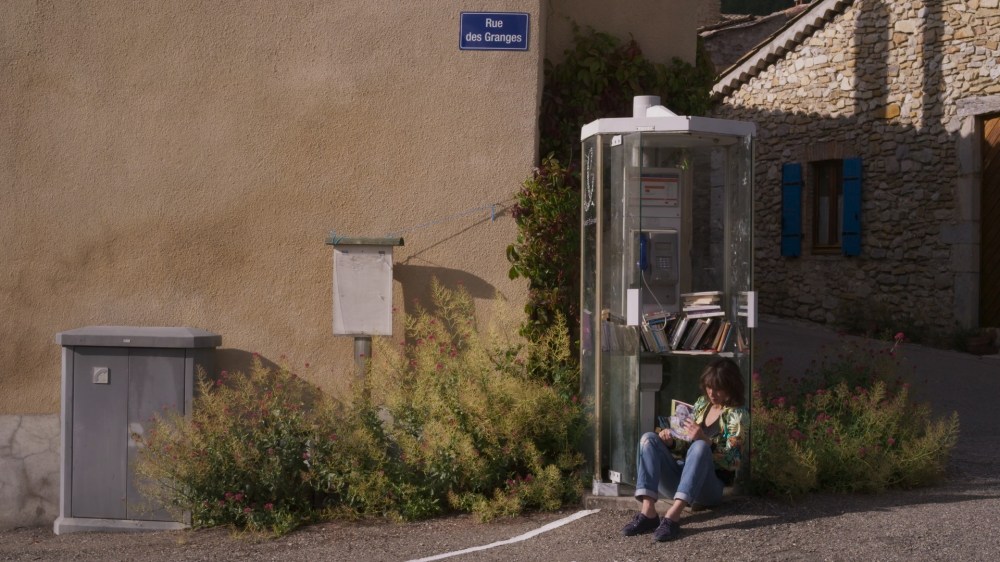
Things we take for granted; items we don’t notice until they’re gone. In creating a series of films about objects, Floriane Devigne landed on the phone booth, something she admits at the start of Allo la France she doesn’t hold any special nostalgia for. Phone booths in general slot easily into this description, but especially the ones in France; more nondescript than the U.K.’s eye-catching red boxes, popular sites now for Instagram photo shoots as opposed to making phone calls, France’s drab transparent boxes blend into their surroundings.
And yet, even if you’ve never used one, there’s something aching in watching one of these boxes being dismantled, the phone lines disconnected, the decades of graffiti papering its interior vanishing on the back of a flatbed truck bound for oblivion. They are more than just places to make a phone call: they are clandestine meeting spots, shelters from a storm, a quiet place to be alone, or, as Devigne playfully asserts,a “dressing room for superheroes.” The widespread use of cell phones resulted in the 2015 repeal of a law requiring that Orange S.A., France’s leading phone and internet provider, continue regular maintenance of public phone booths. Today, there are only 26 phone booths still in operation across the country. Devigne begins her journey at the last booth standing in Paris at the time of filming— it prominently figures in a scene in Jacques Rivette’s 1981 film Le Pont du Nord.
But she doesn’t stay in the city long, soon venturing on a road trip across the countryside and tracking down phone booths in rural areas, often showing up literally in the middle of the government workers removing them. Maybe some of the residents of these small towns don’t care; one older woman says that she’d never really noticed the booth until asked to take a picture inside it with her husband. And yet, they serve a vital public service in remote areas where cell phone and internet service is sketchy at best. When Allo la France begins turning in this direction, it becomes less a pleasant and whimsical 20th century time capsule, and transforms into a polemic on the ruthless stripping away of public services, and a rumination on what constitutes progress (Devigne, for example, juxtaposes the decline of phone booths with the rise of devices like medical booths that allow patients to visit their doctors for a check-up remotely). The way that Devigne chooses to deliver information to the viewer— she is guiding the film from in front of in addition to from behind the camera often, and has former telephone company workers and government officials call her for interviews at the phone booths she visits— sometimes sits on the border of being too cutesy. But the wealth of information about political, economics, technology, and humanity that Devigne pulls from a seemingly nondescript object is impressive. As phone booths are being gradually repurposed (for little libraries, or art installations) and in some locations reinstalled all together, Allo la France leaves us with the idea that progress rarely occurs in a straight line.
Allo la France screened at the 2024 True/False Film Festival. Runtime: 77 minutes.

SR
In the first dictionary of the Egyptian language is the hieroglyphic for the giraffe: “sr.” The roots of its name can be traced back to Arabic and Persian. That the Earth’s tallest terrestrial being would be a fascination for ancient cultures is little surprise— even among the African continent’s varied collection of native species, the giraffe’s odd features— from its long neck and uniquely patterned coat— and gentle demeanor continue to make it a favorite feature in zoos, toys, and children’s books today.
That’s also likely why my screening of German director Lea Hartlaub’s essay film sr seemed unusually packed for midday on a Friday, even at a film festival. But Hartaub’s movie (she wrote and edited it as well) isn’t about the giraffe, exactly. Rather, she uses the animal as a starting point to look at incidents throughout human history, beginning in the 1990s, with the purchase of four giraffes on behalf of two different zoos: one in Israel, and one in Palestine (the giraffes died after several years, unable to survive the climate outside of their natural habitat). Giraffes are a recurring motif across every narrative thread she pursues (the press notes cite 91 depicted in the film), their images manifested in ancient stone carvings, old photos, grainy newsreels, and contemporary footage of zoos (many of which now allow guests, for a price, to feed the giraffes themselves).
The amount of travel involved in sr is remarkable, spanning across the globe from New York to the Sahara Desert to Beijing. That’s not to mention that it is meticulously researched and observed, even if the presentation is rather dry (monotone narration guides us through the film, and many of the visuals consist of slideshows). Individually, the tableaus contain a wealth of interesting information (even though it feels like some of them could have reached a little deeper; the Israel/Palestine association in the first story, for instance, nimbly avoids treading on any potentially tricky political territory). But the fact that they are all united by the giraffe isn’t strong enough connective tissue for a feature film. There’s no thesis that all of this research is working toward, and to watch sr is to wait in minor frustration for an epiphany that never comes.
Sr screened at the 2024 True/False Film Festival. Runtime: 103 minutes.

A BAND OF DREAMERS AND A JUDGE
Treasure hunting is strictly prohibited in Iran, but that, along with the multiple economic crisis that have beset the country in recent years, is far from enough incentive to dissuade eager looters who have heard stories of the ancient treasures supposedly buried deep in the northern mountains. Director Heslam Eslami follows a tight-knit group of these treasure hunters, his camera naturally finding the dualities in their perilous work and their tender (and almost painfully normal) personal lives. Meanwhile, the law— unable to protect and preserve the treasures themselves, only to prosecute those discovering them— is always hot on their heels.
There’s a gaggle of great characters in Eslami’s A Band of Dreamers and a Judge. The judge, for one, is an unflappable woman who seems to tower behind her desk as she presses prisoners for answers to her questions. A main source of the conflict ultimately stems from the group’s leader having his long-awaited first child; the need for the quick cash selling artifacts on the black market can provide outweighs the danger of arrest. The contrast between the two sides of these men’s lives is striking, and as meticulously observed as the frequently hard physical labor involved in uncovering these objects is, the film is less concerned with the mechanics of grave-robbing than with those reasons why they would turn to this line of work (some more context on the political and historical backdrop they are working against could have been helpful, however). But there’s a complicating factor late in the film where Eslami becomes arrested for robbing himself, accused of using his movie as a front for a grave-robbing operation, that strays too far from the film’s form and focus as the situation morphs into something borderline absurd. Watching this misfit band of looters and their primitive tools, I couldn’t help but think of one of my favorite films from last year, Alice Rohrwacher’s La Chimera, which follows a similarly shabby group in Italy who illegally dig up artifacts to sell on the black market. That fictionalized version of such events is so concerned with both the human factors motivating the characters to do this as well as the mechanics of the job and the moral and ethical concerns in looting ancient graves, I couldn’t help but feel that A Band of Dreamers and a Judge, as thrilling as it is to watch, is lacking some other angle to elevate to a place of real profundity.
A Band of Dreamers and a Judge had its U.S. premiere at the 2024 True/False Film Festival. Runtime: 80 minutes.

 Katie at the Movies