Quite a few films that screened at the 2024 True/False Film Festival dealt with memory, using photos and videos of the past to create a dialogue with the present. The three films I’ve reviewed below all take this approach in a broad sense, but use it to different ends: to learn about a mother her daughter never knew (A Photographic Memory), to re-experience the traumatic events of childhood through a different lens (Three Promises), and to connect with a distant father (Background).
A PHOTOGRAPHIC MEMORY
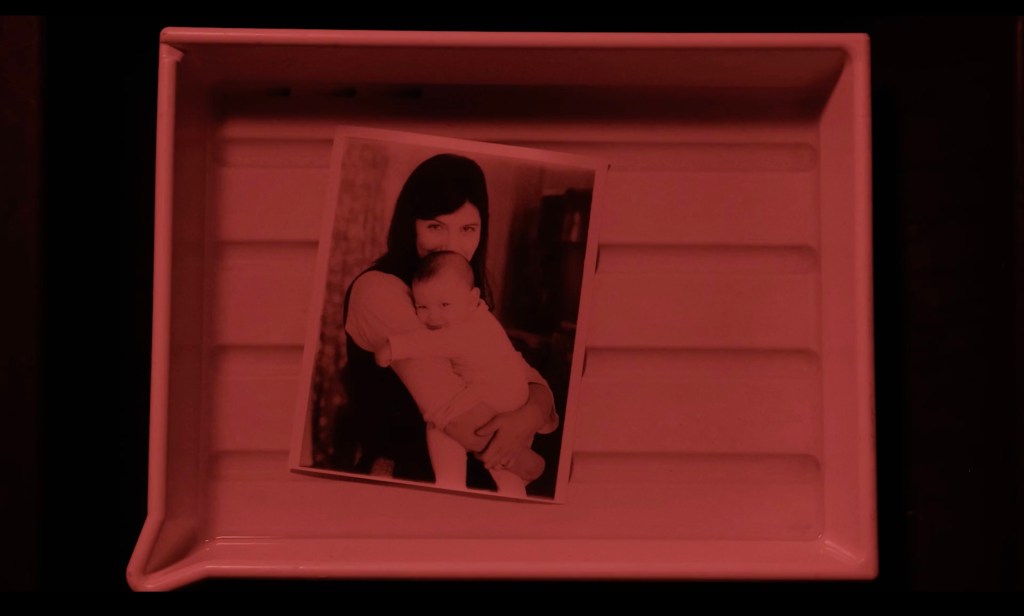
Rachel Elizabeth Seed never really knew her mother. Sheila Turner Seed passed away suddenly from a brain aneurism at the age of 42, when Rachel was 18 months old. A celebrated journalist, Sheila only exists to Rachel through the work she left behind, including the discovery that provided the impetus for Rachel’s debut feature film, A Photographic Memory: around 50 hours of audio tapes of interviews Sheila— a former editor for Scholastic— conducted with some of the most celebrated photographers in the world: the likes of Cecil Beaton, Gordon Parks, and Henri Cartier-Bresson (a famously elusive subject who later said it was the best interview he ever gave). After Sheila’s passing, the reels gathered dust at the International Center of Photography (ICP) for decades until Rachel uncovered and digitized them. A photographer herself, the audio provided Rachel with a path to begin learning about who her mother really was. She tracks down some of those surviving interview subjects, like Bruce Davidson, who welcomes Rachel into the same Upper West Side apartment where Sheila interviewed him in the early 1970s; even the chairs they sat in are still there. After a lot of digging, she finds some surprising, unlabeled photographs of Sheila in Parks’ archives. There’s a television interview Sheila gave as well, which Rachel watches with a look of awe, marveling at her mother’s “flirty” personality.
It’s through these tangible objects and people— even her own father, Time-Life photographer Brian Seed— that Rachel begins to form a connection with her mother, and the similarities between the two women that start to manifest themselves add another dimension to the film. Rachel interviews Sheila’s old boyfriend; their relationship fell apart after Sheila sought an abortion that he didn’t want. Meanwhile, Rachel (who narrates the film, giving voice to her mother’s thoughts) struggles with her own uncertainties about motherhood and the toll her work increasingly takes on her marriage; at one point, she muses about the footage a friend shot of her courthouse wedding, wondering if she asked her to film so she’d have memories of the day, or something to put in her movie. This is accomplished with just enough subtlety to create a dialogue between the past and present without diverting the focus away from Sheila. The information in the film is thoughtfully presented (Rachel shot some scenes imagining Sheila and her interviewees that are not overused and contribute an almost dreamy quality to the narrative), creating both a monument to Sheila’s expansive yet mostly forgotten body of work, and a tender, mournful picture of a daughter following in the footsteps of a mother she never knew. The final shot is about as breathtakingly perfect a capper as it gets.
A Photographic Memory had its world premiere at the 2024 True/False Film Festival. Runtime: 87 minutes.

THREE PROMISES
Around the start of the 2000s, Suha was always filming the daily life of her family in the West Bank. The footage she shot during this time vacillates between moments of levity and times of stress, fear, and uncertainty as Suha, her husband, and their two young children take shelter as the Israeli army retaliates against the Second Intifada. Years later, Suha’s son, director Yousef Srouji, unearths these films that his mother had kept hidden from him, an archive of repressed memories from his childhood in Palestine, and uses the footage as the basis for his feature documentary Three Promises.
These home movies, which are what we see on screen for the majority of Three Promises, tell a story all on their own; the closeness of the family is evident from their camaraderie, but there is clearly some indecision as to what to do with the situation they are faced with. Should they stand their ground in the place they call home? Or should they leave for their own security (the cries of Yousef and his sister as the bombs pick up and the family descends to the basement or the nook underneath the stairs are something I haven’t shaken since I watched this film). But what Srouji does with this footage enriches it even further. In the present day, Suha records voiceover commenting on her films and that time in their lives, maintaining a constant conversation between the past and present. Faced with an impossible choice, Suha makes regular promises to God (promises that divide the film into its three act structure) to leave if she and her family survive each danger they are faced with. It’s an essential document not only of a side of history that is rarely reflected media, but of a mother’s love, made all the timelier with the current genocide in Palestine seeing the same heart-rending results: forced migrations, stolen childhoods, and families torn apart. Srouji doesn’t need to explicitly articulate the urgency in his movie, however; the tender final shots of Three Promises, which bring together mother-and-son filmmakers onscreen in the present day, speak to their resiliency.
Three Promises is the recipient of the 2024 True Life Fund, which raises money through donations for Srouji and his family, which Srouji plans to use to establish an archive for Palestinian films like those his mother shot.
Three Promises screened at the 2024 True/False Film Festival. Runtime: 61 minutes.
BACKGROUND
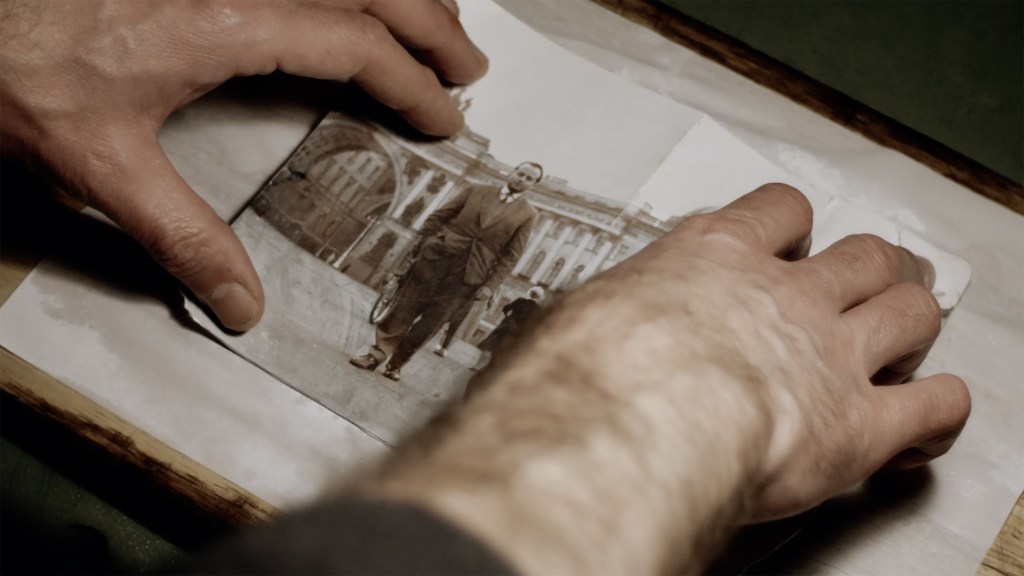
It begins with a camera: hands clean it, assemble it, test the shutter, all clicks and whirrs. This tactile imagery and manipulation of objects carries over to the rest of Syrian filmmaker Khaled Abdulwahed’s film Background, which lays audio recordings of conversations and musings between Khaled and his father Sadallah over old photographs. Namely, these are two black-and-white photos of Sadallah as a young man, who moved to East Germany as an exchange student in 1956, which Khaled digitally plays with over and over: retouching, duplicating, and cutting and pasting, reconstructing different imaginary scenarios and placing his father into different backgrounds, some real, some not. As an artist who was granted asylum in Germany in 2015, the separate but parallel journeys of father and son hold some dialogue with each other, but it’s a tentative one. Perhaps it is because the one consistent visual throughout the film is a photograph of a person frozen in time; as much as Khaled’s manipulations breathe life into it, the coldness, right down to the textured audio (those clicks and scratches and whirrs continue throughout the film), prevents Background from fully achieving some real emotional profundity. Technology can be a burden to communication (background noise, sounds of daily life but also of war, in Sadallah’s phone recordings render his speech at times almost unintelligible) but it can also provide an outlet to bridge the past and present, and Background is a fascinating and lovingly crafted exercise in one person striving to connect to another across time and space.
Background screened at the 2024 True/False Film Festival. Runtime: 64 minutes.

 Katie at the Movies