For this dispatch from the 74th Berlinale, I’m looking at three films (coincidentally all directed by women) that merge history and filmmaking. Mati Diop’s magnificent Dahomey and Iranian filmmaker Farahnaz Sharifi’s My Stolen Planet both operate in the nonfiction sphere, while Portuguese director Margarida Gil’s Hands in the Fire is a loose adaptation of Henry James’ The Turn of the Screw that frames the narrative from the perspective of a documentary filmmaker. Read my reviews of those films below.
DEU, IRN 2024, Panorama
© Farahnaz Sharifi
MY STOLEN PLANET
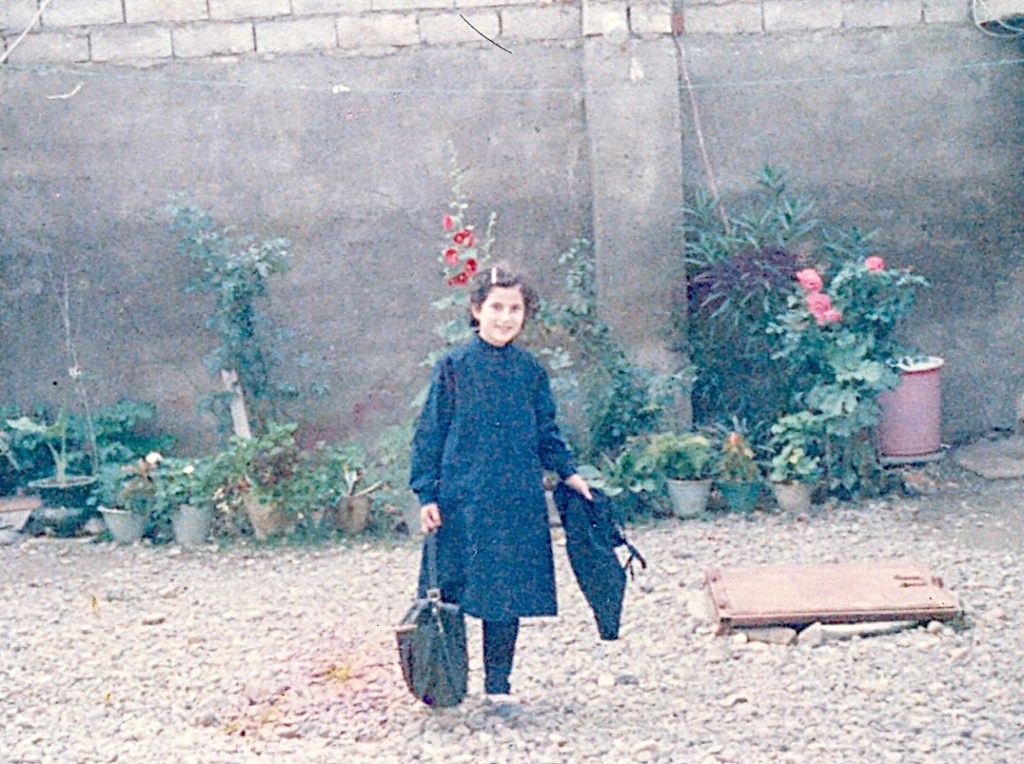
Silent images, backed by nothing but the whirr of the projector. These old 8 mm films often wear the damages of time— they’re splotchy and grainy— but the feeling of the pictures is clear as day: women dancing joyously, children playing. Filmmaker Farahnaz Sharifi was born in Iran during the Islamic revolution, and grew up with one foot each in two different worlds: a public one, where she had to cover her head with a hijab and felt stifled, and a private one, where she was free to be herself. One of her film My Stolen Planet’s most striking images, appearing at the beginning and echoed again at the end, is a photograph of Farah as a child, standing in her yard, clutching the hijab she had just ripped off her head in her hand.
Farah, as she puts it, developed an “addiction to recording,” using the camera on her first smartphone to document everything from family gatherings to protests in the streets. This addiction later morphed into an obsession with accumulating old films, often found in the trash; they’re usually home movies, and Farah doesn’t know who the subjects are, or how their memories ended up in her hands.
Farah’s fiercely political My Stolen Planet (Sayyareye dozdide shodeye man) is assembled entirely from this archival footage, documenting Iranian women’s battle for their rights both by zooming out and looking at the country as a whole, and zooming in on Farah’s personal experience. Forced to go into exile in 2022, Farah describes, through images and video calls, the aching difficulties of being so far from home: authorities raid her house, and she’s unable to see her mother, who has Alzheimer’s. The film moves loosely between global events we know (such as the eruption of outrage in the aftermath of Iran shooting down a Ukrainian aircraft flying to California with surface-to-air missiles in 2020, killing 176 people) and intimate, first-hand stories, and while the latter takes more direct aim at the heartstrings, together they form a powerful collage of images of women across time and space, young and old, pushing for change in the present and, by extension, a better future.
My Stolen Planet had its world premiere at the 74th Berlinale on February 21. Runtime: 82 minutes.

FRA, SEN, BEN 2024, Competition
© Les Films du Bal – Fanta Sy
DAHOMEY
In Mati Diop’s films, the ocean is a bridge between worlds. In her feature film debut, Atlantics, there’s the promise of work, and therefore, money, for young Senegalese men if they venture away from their home country and across the water to Spain. In her second feature, Dahomey, it’s a point of transition. The film opens in Paris, the lights of little model Eiffel Towers arranged neatly on the ground glittering against the black night. This is not the Paris most of us think of; the real treasures in this film are a collection of 26 royal objects from the former kingdom of Dahomey, now the present-day Republic of Benin, that were stolen and shipped off to museums in France after French forces, under the command of Colonel Dobbs, took Dahomey’s capital Abomey in 1892. Now its 2021, and after many years of attempts to obtain restitution of cultural property for Benin and Senegal, 26 works, from statues to altars, are being returned to Benin.
Dahomey is technically classified as a documentary, and Diop observes the packing, shipping, and unboxing of these objects with thoughtful precision. But here as with her previous films, particularly her short works, Diop merges nonfiction filmmaking with fiction, imbuing the story with a sense of mysticism. She cuts to the perspective of one of the objects— item 26— giving it a voice of gravelly, non-specific origin (created by Makenzy Orcel) speaking in the Fon language, allowing this voice to ruminate on where it has been and where it is going. Editor Gabriel Gonzalez seamlessly cuts between these sequences and those that are more grounded in reality.
Filmmaking that is initially primarily observational at the start turns more urgent as Dahomey takes a different shape in its second half. Diop arranges a forum of Benin university students to debate the issues and feelings aroused by the restitution. The result is a passionate back-and-forth that demonstrates how the return of these objects is no cut-and-dry victory; thousands of royal artifacts from the kingdom of Dahomey remain in France. How should these religious items be displayed: in a museum, or in their true place of origin? And how does one deal with regaining something that you never felt the loss of in the first place? The conversation may be specific to the Dahomey treasures, but it’s also a microcosm of how the effects of colonialism trickle down through generations. An equally sobering and hopeful work crafted with great artistry, what Diop accomplishes in just under 70 minutes of screen time is nothing short of miraculous.
Dahomey had its world premiere at the 74th Berlinale on February 18. Runtime: 68 minutes.

Mãos no fogo | Hands in the Fire by Margarida Gil
PRT 2024, Encounters
© 2024 Ar de Filmes
HANDS IN THE FIRE
How many adaptations of Henry James’ The Turn of the Screw have been put to film? Too many, perhaps. If I can say one thing for Portuguese writer and director Margarida Gil’s Hands in the Fire (Mãos no fogo), it’s that she offers a fresh perspective on the material. Billed as being inspired by James’ story, Carolina Campanela stars as Maria do Mar, a young filmmaker working on a thesis titled “Real in Cinema.” She shoots in and around manor houses in the country north of Portugal, and has just reached her last one, where she becomes inextricably linked with the home’s inhabitants. There’s Lou (Rita Durão), governess to two children: Flora (Sofia Vilariço) and the decidedly strange Manelinho (Elgar do Rosario); the cook, Céu (Adelaide Teixeira); and the owner of the estate, Leonardo (Marcello Urgeghe), who has a close yet somewhat indefinable relationship with Lou, while serving as a seductive figure to Maria.
The elements of gothic horror and psychosexual themes that are so tangible in James’ 1898 novella are at least semi-present in Gil’s adaptation. Creaky floorboards, thunderstorms, secret rooms, and a looming sense of dread permeate the manor house, but Gil also plays with its rustic beauty (the sun is frequently shining brightly through its windows) as a backdrop for the odd behaviors of its inhabitants. The archetypes from the original story are still there, but they are all viewed from the perspective of Maria and her camera. All of these people are too much of a cypher, however, even Maria, who doesn’t even seem to know what she is doing herself; she jots down production notes in her room every evening, little comments about the people she’s met, but it’s difficult to decipher where all her work is pointing to. The opening scene, where she appears uneasy watching Céu try to catch a turkey she plans to kill and cook for their meal, suggests that Maria is good-natured at heart and perhaps a little naive, but as the narrative progresses, she observes every occurrence with the same odd mixture of bemused curiosity and revulsion. While there are some interesting ideas floating around about how people behave for the camera versus how they really are, as well as the function of cinema as an art form, they’re a bit too abstract to grasp on to. Hands in the Fire has great atmosphere; Acácio de Almeida’s cinematography and Carlos Subtil’s production design are particularly rich and detailed. But the attempt is more admirable than the result, an amalgamation of gorgeous and haunting images that mean very little.
Hands in the Fire had its world premiere at the 74th Berlinale on February 22. Runtime: 109 minutes.

 Katie at the Movies