Origin is about as ambitious an adaptation imaginable. It’s a fitting project for director Ava DuVernay, who—whether working in narrative features or documentaries or television— has always swung for the fences. Her film is based on journalist Isabel Wilkerson’s 2020 nonfiction bestseller Caste: The Origins of Our Discontents, which posits that racism in the United States is part of the caste system (into which people are born into fixed social groups dictated by such ideas as hierarchy and purity). Wilkerson’s book is an essential study, to be sure, but its material seems better-suited for the documentary treatment. That’s where the brilliance of DuVernay’s screenplay comes into play: she explores not only the ideas put forth in Caste, but turns Wilkerson herself the film’s central figure, exhuming such concepts as race and grief and creation through the process of following Wilkerson (played by Aunjanue Ellis-Taylor) as she writes and researches Caste.
Origin opens with an immediately nauseating event we’re all unfortunately all too familiar with by now: a young Black man visits a convenience store, and— as he happily chats on the phone on his walk home— gradually becomes aware that he’s being followed. DuVernay doesn’t show us the eventual act of violence— she doesn’t need to— but after the film jumps to Isabel’s perspective, we learn that what we were watching before was the prelude to the 2012 murder of 17-year-old Trayvon Martin at the hands of George Zimmerman. We also witness another familiar scene unfold, albeit of a less urgent nature: it’s been two years since Isabel last published a book, 2010’s The Warmth of Other Suns, and it’s following a sold-out talk about that book that her editor (Blair Underwood) pressures her to start again—specifically, by looking at the Martin case.
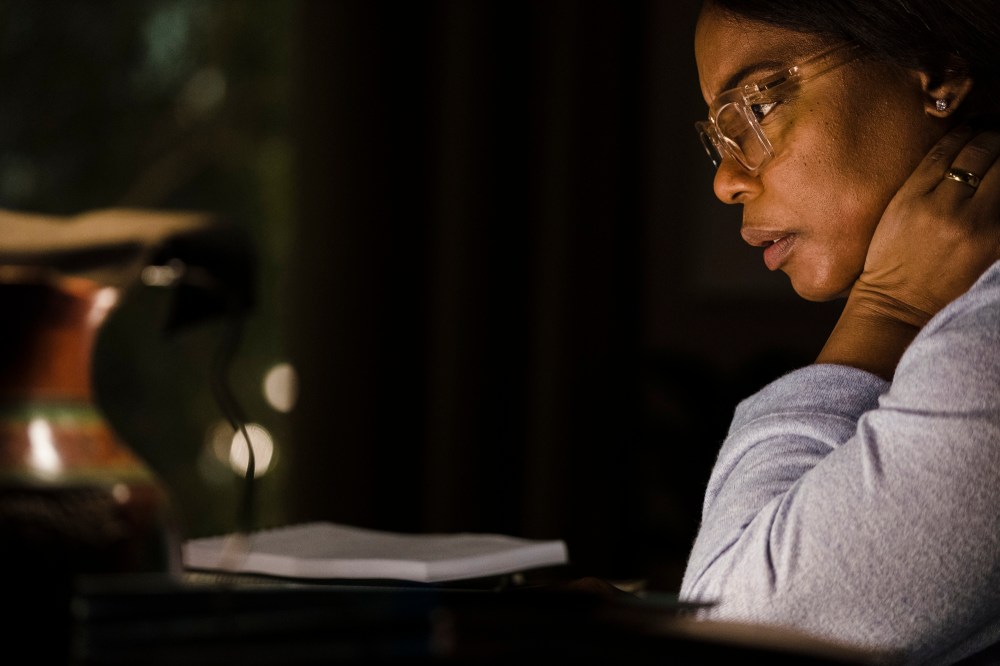
Isabel has other matters on her mind, however; her mother is ill, and she’s been looking at putting her into a nursing home. It’s not only that, as Isabel expresses; she needs the time to live in her research. But when her world is rocked by a sudden tragedy— the loss of her husband, Brett (Jon Bernthal)— Isabel pushes through her grief to begin fleshing out her theory about the tie between race and class. Isabel’s argument, stated in broad terms to colleagues and family as “Everything can’t be racist,” is bold, but in listening to Zimmerman’s 911 calls— the reasoning of a man who believed he was acting to protect his neighborhood— she realizes that this mindset stems from a deeper place of privilege.
DuVernay’s filmmaking is as bold as the ideas within it. As Isabel travels from Germany to India, researching the Holocaust and India’s brutal caste system (in which the lowest caste, the Dalits or “untouchables,” are born into circumstances that automatically restrict them from basic human rights), the film also puts us directly in the world of some of the stories Isabel is rifling through, accompanied by her narration. One brought up early on is that of August Landmesser (Finn Wittrock), the German worker who refused to give the Nazi salute in a famous 1935 crowd photo; August, as we learn, was engaged to a Jewish woman (Victoria Pedretti), violating the Nazi miscegenation laws. Another story with Germany roots is that of Allison Davis (Isha Baker) and his wife Elizabeth (Jasmine Cephas Jones), Black anthropologists who leave for America just as the Nazis come to power and end up studying life for Blacks compared to whites in Jim Crow-era Mississippi with the aid of their white colleagues. This story is particular is given a heftier amount of Origin’s runtime (DuVernay flashes back to it a few times), but even those that are granted the briefest glimpses pack a lot of power— like that of Al Bright, an 11-year-old Black boy who, in 1951 Ohio, wasn’t allowed in to the swimming pool where his white teammates were celebrating a Little League championship. He was eventually allowed to float in the pool on a raft; everyone else had to exit the pool, except for the lifeguard, whose terse threats of “Do not touch the water” were the only sounds.

By following Isabel as she visits some of these locations in the present day, DuVernay is able to even more powerfully illustrate how all these seemingly disparate narratives are tied together across time, all rooted in the same system of caste. For instance, at one point DuVernay cuts from a scene of a book burning in Nazi Germany to Isabel visiting the Empty Library, a monument in Berlin created in remembrance of the incident. At times, Origin does take on an almost documentary-like feel, such as when Isabel interviews Dalit scholar Suraj Yengde, who plays himself. But DuVernay has a talent for digging into the humanity of her subjects regardless of the project: look at the incisiveness of 13th, her essential documentary on the relationship between race and mass incarceration in the United States, or her moving drama series When They See Us, which dramatizes the 1989 Central Park jogger case, or the family dynamic at the heart of A Wrinkle in Time, her fantastical adaptation of Madeleine L’Engle’s novel for Disney. That humanity is ever-present in Origin as well. Isabel meets with obstinance and obstacles in her research. At a dinner with German colleagues, one woman challenges her insistence that American slavery and the Holocaust are tied, telling Isabel that “a framework is not an idea.” Isabel’s personal life comes into play as well. She’s encouraged by her cousin (Niecy Nash-Betts), and we flash back to the meet-cute she had with her husband (Bernthal’s natural warmth effectively comes into play here, as he wonders out loud after butting in on a confrontation Isabel was having with a maintenance worker first if he was mansplaining, then if he was being a white savior) and glean just the right amount of information we need to see what a supportive and sympathetic relationship they shared. DuVernay doesn’t shy away from emotional close-ups of her actors (often accompanied Kris Bowers’ frequently mournful score) that verge on melodrama either. It helps that the marvelous Ellis-Taylor writes so much feeling across her face in a way that seems almost effortless. Origin asks a lot of her— Isabel has to be inquisitive and hurt and determined and intelligent and hopeful and then some— but she is more than up to the task.
Occasionally, DuVernay hits these narrative beats a bit too hard; a scene in which Isabel uses her grief to try to relate to a maintenance man (played by Nick Offerman) who shows up to her house wearing a Make America Great Again Hat feels like it is trying too hard compared with the rest of the movie. Most of the movie skirts this issue however, even the scene in which Isabel drags out a literal white board to explain her ideas. It’s easy to see how many viewers could wrongly interpret this moment as over-explaining to the audience; I even did so on my first viewing of the film. Isabel, however, isn’t doing this for the benefit of the viewer, but for the benefit of herself, giving herself an outlet to work through her ideas and test out her thesis. Origin asks a lot of its protagonist, but it also asks a lot of its audience. Viewers going into this movie need to be willing and ready to put in the labor it requires to absorb the multiple layers it is operating on. Origin isn’t successful 100 percent of the time, but it is invigorating filmmaking from a director who— not unlike the subject of her movie— time and again upset the expectations and restrictions of her industry to make her voice heard.
Origin opens in theaters nationwide on January 19th. Runtime: 135 minutes. Rated PG-13.

 Katie at the Movies