The most recognizable definition of a chimera comes from Greek mythology, in reference to a female creature made up of several different animals: a lion’s head, a goat’s body, and a serpent’s tail. But the word can alternately be used as a noun to refer to something one hopes for, but is impossible to ever achieve. While a chimera does in fact appear in Alice Rohrwacher’s aptly titled La Chimera in the literal sense, the latter definition is the more fitting entry point to analyzing the writer and director’s whimsical tale of a grave digger’s quest for meaning every time he plunges into the earth.
English actor Josh O’Connor stars in this Italian film as Arthur, and that alone is an immediate indication of just how much of a fish out of water he is in this story. It’s sometime in the 1980s, although, as with Rohrwacher’s previous films, La Chimera, with its collision of ancient aesthetics and modern technology, seems to exist both out of time and in several different time periods at once (or maybe Italy is just like that; I’ve never been and wouldn’t know). Arthur has just returned from a prison stint to the Tuscany home of his deceased lover Beniamina (played in dream sequences by Yile Vianello), whose ailing mother Flora (Isabella Rossellini) resides in a crumbling country manor that bears all the hints of its former glory but none of the comforts, who dotes on Arthur and firmly believes that Beniamina is still coming back to them, while her remaining children prey on what remains of her estate. Arthur possesses special powers—a gift, they say— that allow him to use a divining rod to predict the location of valuable artifacts tucked away underground, and he takes up with a band of tombaroli (grave robbers) to plunder tombs and sell their treasures to a shady dealer called Spartaco, who turns around and forges documents indicating their prestigious origins so they can be sold to foreign buyers and museum curators at a much higher price.

La Chimera is all about the search, how the quest for objects parallels the quest for meaning in one’s self. O’Connor, clad in a rumpled cream linen suit, slouches and smokes his way through every scene, but retains just enough of a spark in his expression that he is hopeful to find something more than bits of pottery every time he dives into the dirt; Beniamina, perhaps. Rohrwacher is, after all, pulling from myths from other parts of the world too, as indicated by La Chimera’s stunning final sequence, in which Arthur is shown to still be tied to Beniamina by a literal red string of fate; originating from China, the belief is that two people whose fingers are tied together by the unbreakable thread are destined to be lovers, regardless of the time or place they exist in. There are indications sprinkled throughout the film of different, brighter futures for Arthur, other possible paths he could wander down, and yet he’s always driven back to the earth, back to Beniamina.
But part of the wonder of La Chimera is its rich folding of themes into this main storyline: class, money, ownership, ghosts, grieving. Continuing her exploration of class and labor rights from her previous feature, 2018’s Happy as Lazzaro (which worked these subjects into a dazzling mid-movie twist), Rohrwacher’s Italy in La Chimera is a place that wears indications of its former wealth on its sleeve: once-grand manors with their crumbing murals and unkempt landscaping, the ground so rich with relics that you could stick a shovel into virtually any spot in the earth, start digging, and come up with some old knick-knack, left behind by the prominent families who once populated the land. Flora, wheelchair-bound and clearly fighting to hold on to days gone by, keeps a tone-deaf music student, Italia (Carol Duarte), by her side, taking advantage of her services by having her work as a maid in exchange for these supposed lessons; what Flora doesn’t know is that Italia has two young children who she keeps stowed away in a remote part of the house. Italia serves as a potential new love interest for the morose Arthur (and perhaps his conscience; she disapproves of his grave-robbing gig, viewing it as sacrilegious), but Italia and Flora also portray the flip side of the class collision that we see in Arthur and his band’s dealings with the more powerful Spartaco; some people are given all the advantages, while others are forced to claw out an existence for themselves in that space (and potentially, as we eventually see with Italia, make it more beautiful). As as each party plunders the treasures of a civilization gone by— the tombaroli and Spartaco with the Etruscans who once inhabited the grounds of ancient Italy, Flora’s selfish children with the few objects of value she still possesses— you can’t help but get the sense that their own value is just as fleeting.
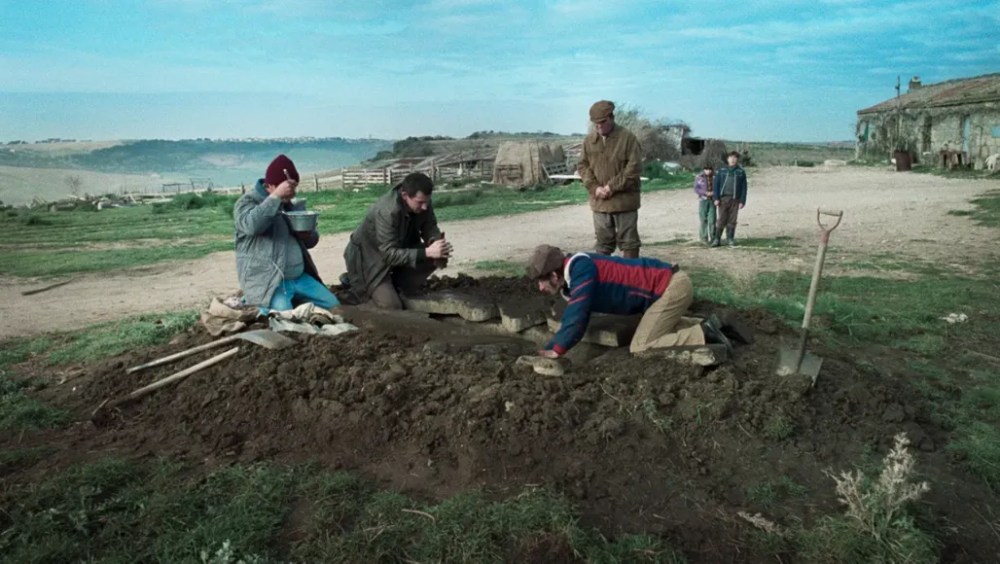
Rohrwacher, with her previous films but with this one in particular, is clearly indebted to Italian neorealism in both her style and subject matter; the rolling band of colorful grave robbers and the movie’s fantastical touches— a couple of interludes for an expository ballad, for instance— are particularly Fellini-esque, while Rossellini’s presence, sturdy and graceful, provides a tangible connection to her parents and to the movement’s origins. La Chimera is crucially shot on location, but it’s formally playful in other ways too: sped up sequences, an amusing fourth-wall break, flipping the frame to convey the move into more mystical spaces, and the changing aspect ratio. Rohrwacher’s regular cinematographer Hélène Louvart shoots in a combination of Super 16 mm, 16 mm, and 35 mm, lending the film further texture that alternates between documentary-like realism and the whimsical nostalgic of a vintage travelogue. The clash of aesthetics merged with the combination of disparate themes and characters may not be for everyone, but it’s a potent experience for those who are locked in to Rohrwacher’s singular vision. A sort of culmination of what she was exploring in her previous features (not counting her frothier Oscar-nominated short Le Pupille from last year), La Chimera is as sobering as it is enchanting, as romantic as it is cynical, formed of numerous layers that likely house more gems waiting to be uncovered by viewers on subsequent rewatches.
La Chimera screened at the St. Louis International Film Festival on November 18, and is being distributed for release in the U.S. by NEON. Runtime: 133 minutes. Not rated.

 Katie at the Movies