In a lengthy pre-film discussion and post-film Q&A with director Alexander Payne at a screening of his new film The Holdovers at the St. Louis International Film Festival, several films and filmmakers came up in reference to his work, from Billy Wilder to Leo McCarey’s devastating 1937 drama about aging, Make Way for Tomorrow. But two particular films perhaps share the most direct correlation to The Holdovers. The first is Merlusse, an obscure 1935 French comedy/drama from which Payne conceived of the premise for his movie: a curmudgeonly professor at an all-boys boarding school is tasked with looking after the students left at the school over the Christmas break, and comes to understand them better over that time. The second is The Last Detail, a 1973 comedy/drama from director Hal Ashby in which Jack Nicholson and Otis Young play Navy sailors tasked with escorting a young court-martialed fellow sailor (played by Randy Quaid) from Virginia to Maine, where he is to serve eight years in prison for stealing $40. Over the course of their journey, Nicholson and Young’s sailors come to befriend Quaid’s character and attempt to show him a good time before he is put away.
The Last Detail is comprised of a string of little excursions its core trio of characters embark on (ice-skating, bar-hopping, accepting a strange woman’s invitation to attend a house party), but it’s through these light moments that the inner lives of the characters and their fears and anxieties are revealed. The Holdovers is similar in both structure and tone; even the most sobering reveals, such as that Paul Hunham (Paul Giamatti), the uptight classics professor at Barton Academy, takes the same medication for depression as Angus Tully (Dominic Sessa), the intelligent yet anguished student who finds himself left at Barton for Christmas when his mom and new stepfather suddenly head off on a belated honeymoon, are played with a light touch. And yet, there isn’t a moment of The Holdovers, which was penned by David Hemingson, that isn’t deeply felt in a way that overcomes its myriad cliches.
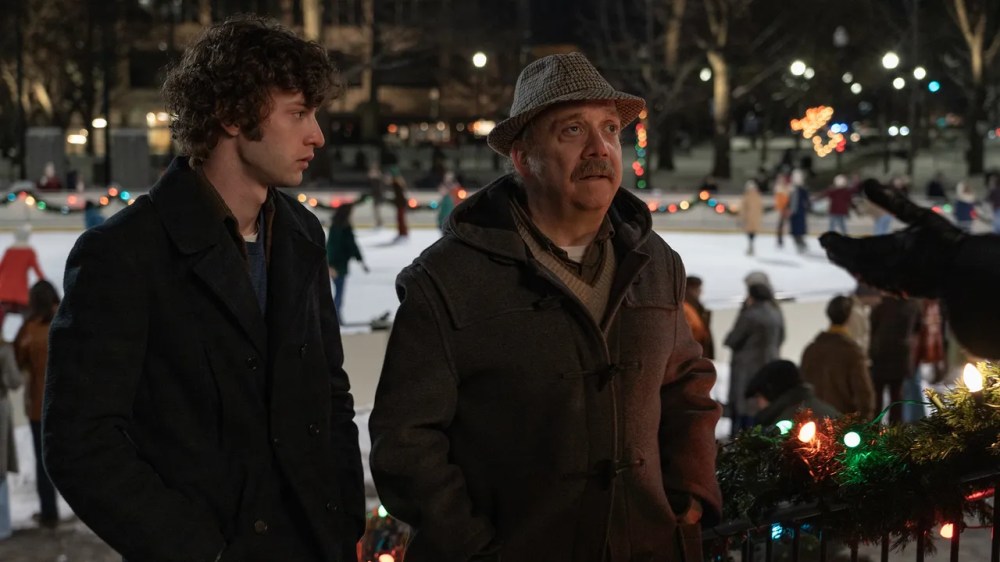
A lot of the film’s warmth can be attributed to its setting. It’s set over Christmas, in New England, where the seemingly perpetually-falling snow turns the grounds Barton Academy sits on into a blinding void, and through which the glow of neon signs in bars and Christmas lights in stores in town beckon welcomingly to passersby. The time period is equally as key: the story is set in 1970, and before it even gets going, Payne matches the aesthetic of the era with retro logos that run over the opening credits, while the soundtrack is peppered with songs from the likes of Cat Stevens and the Temptations, evoking nostalgic comfort with little of the decade’s political strife. Allusions to the Vietnam War don’t venture beyond the premature death of Mary Lamb’s (Da’Vine Joy Randolph) son Curtis, who went to fight overseas almost immediately after graduating from Barton. As one of the school’s cafeteria workers, Barton was the last place she and her son were together; Mary chooses to stay with the other holdovers over the holiday break in Curtis’s memory, rounding out the unlikely trio and serving as a sort of sympathetic go-between for Angus and Paul to bounce off of (fortunately, Mary, the film’s one Black character of note, is given a complete character arc and even a couple scenes divorced from Paul and Angus entirely, as opposed to serving as a mere prop in their stories. Unfortunately, the same can’t be said for a Korean student played by Jim Kaplan; the racist slurs directed at him by another white student are only present to give Angus something to react to and prove to the audience that in his defense of the other student he’s not such a bad kid after all).
At any rate, it’s not that The Holdovers necessarily would have benefited from wading into the waters of the era’s politics; it may be “just fine” cinema, but it is that subgenre operating at its peak— a subgenre that Payne, whose previous directing credits include Election, Sideways, and The Descendants, has not only specialized in, but excelled at. It’s an immaculately designed film, and I don’t just mean that in regard to its reproduction of period details. There’s intention in the styling of the characters and the objects placed within the frame, from the curled tube of hemorrhoid cream perched on the ledge of Paul’s dingy sink (his numerous supposed ailments reveal themselves over the course of the film) to the lipstick-stained teeth of his peppy colleague noticeable in the wide smile plastered across her face when she delivers a plate of Christmas cookies to his room to Paul’s wandering lazy eye. The film also makes effective use of locations, shooting not only in Boston proper (shout-out to the incredible Brattle Book Shop) but at five different schools across Massachusetts, and that lived-in oldness that’s inherent to New England contributes to its vintage trappings even further.

It helps, too, that the performances are so solid, making these people feel real even in the most absurd situations. Giamatti, reuniting with Payne for the first time since 2004’s Sideways, is so adept at portraying characters wrestling with discontent in their lives, and his performance in The Holdovers is no exception. His Paul is a man who attended Harvard, aspired to great academic heights— and has spent his entire life since college teaching at the school he once attended (the fact that the current headmaster of Barton was a student Paul taught in his first year says it all), hitting the whiskey to mask any evidence of unhappiness or loneliness. The Holdovers is as much about preparing Paul for the world as it is Angus, and Sessa is a delightful discovery as a mischievous young man who just needs some guidance. The rest of the cast is noteworthy as well, from Randolph (a real joy and in contention for one of the best supporting performances of the year) to Carrie Preston as a Barton faculty member Paul potentially has some interest in. Hemingson’s screenplay takes pleasure in the small moments as well as the large— setting off firecrackers in the kitchen on New Year’s, decorating a sad little tree in the dining hall, ordering a Miller Lite (“the champagne of beers”)— and is as funny as it is filled with pain and hope. The Holdovers may not be as cutting as many of its influences, but it is destined to cement its place in the pantheon of melancholy Christmas tales.
The Holdovers screened at the St. Louis International Film Festival on November 14, and is now playing in theaters. Runtime: 133 minutes. Rated R.

 Katie at the Movies
Hi Katie! Terrific review, as always. I really enjoyed this one, Giamatti is always solid but I’m impressed by Joy Randolph. Sessa is indeed a delightful discovery, curious to see what he’ll do next.
LikeLiked by 2 people
Thanks Ruth! I’m glad you enjoyed the movie too, I agree the cast was excellent!
LikeLiked by 1 person
I loved this one so, so much, my favorite of the year. Everything about it really connected with me. Great review.
LikeLiked by 1 person
Thanks! I’m so glad you liked the movie too!
LikeLiked by 1 person