Everything is perfect in Barbieland. Barbie wakes up in the pink plastic confection that is her dream house, greets her friends, showers, and selects a stylish ensemble from her expansive wardrobe. She eats breakfast (a perfectly toasted waffle washed down with a glass of milk) before she goes about her day, which includes attending political meetings headed by Barbieland’s all-female government and laying on the beach by the artificial blue waves. In the evening, she throws a splashy party complete with planned choreography before hosting girls’ night with her friends. In the morning she wakes up and does it all over again. Every day.
Yes, everything is perfect in Barbieland—that is, if you’re a Barbie. Especially if you are Stereotypical Barbie, embodied in Greta Gerwig’s film Barbie by Margot Robbie. Stereotypical Barbie is what most people picture when they think of Barbie, the iconic line of dolls first produced by Mattel in 1959. That first Barbie doll—who appears in Barbie’s opening scene, a delightful lampooning of the “Dawn of Man” sequence from Stanley Kubrick’s 2001: A Space Odyssey—was statuesque, blond, white, gorgeous, and clad in a swimsuit. Barbie has come to mean many different things over the years as she has (or in some cases, hasn’t) evolved, iterations of the doll representing various career paths for women, from doctor to astronaut, drawing encouragement from consumers and fans, while at the same time, her almost uncomfortably perfect appearance has provoked criticism for promoting unreasonable beauty standards. Barbie isn’t conscious of this though; in her mind, just being Barbie—living in a world run by women and being a woman who is capable of anything and looking flawless while doing it—is enough. Feminism, as she more or less states in the movie, is solved.
Of course, we the audience know that that is far from true in the real world; that’s part of Barbie’s cheeky humor which (in the screenplay penned by Gerwig and partner Noah Baumbach) when it works, works splendidly. And it isn’t true for the Kens living in Barbieland either. Ken’s (played by Ryan Gosling) entire existence revolves around being paired with Barbie, with Barbie noticing him, and as we glimpse in the film’s day-in-the-life opening, she doesn’t notice him enough. His lack of worth stirs up just enough simmering resentment that he’s quick to pick up on the general mechanics of a patriarchal society when it’s thrust in front of him, even if he doesn’t possess the language to express what that is yet.
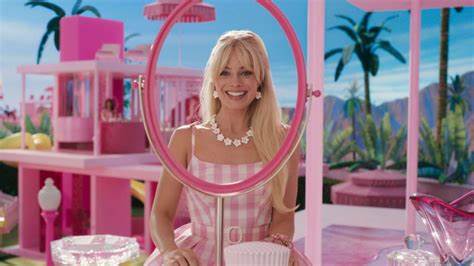
The conflict in Barbie gets rolling once Stereotypical Barbie’s perfect life suddenly becomes less-than-perfect. She wakes up groggy. Her shower doesn’t work. Her toast is burnt. She’s having thoughts of death (how does a doll even know what death is, anyway?). And, most disturbing of all, her feet—normally positioned so she steps around perpetually on tiptoe, an amusing nod to the doll’s ridiculous proportions—are flat. Her heels are touching the ground. The other Barbies suggest that she visit who they have dubbed Weird Barbie (Kate McKinnon), a doll who got a little wacky after she was played with too hard in the real world, for advice (I mean, who among us hasn’t tried to give one of our Barbies a haircut at least once?). Weird Barbie suggests that Barbie’s owner’s depressive thoughts are being passed along to her, and tells her she must pass through a portal to the real world, find her owner, and learn the truth for her life to go back to normal. Barbie, with Ken in tow, embarks on an odyssey across land and sea, ending up in Los Angeles, where she’s faced with sexism and ridicule and her positive perception of how women are treated and Barbie specifically is viewed is quickly shattered, and where Mattel’s all-male executive team led by their blundering CEO (Will Ferrell) scramble to put this life-size Barbie back in her box.
Barbie thankfully abstains from getting too mired in the technicalities of how all this works (this is a satire and needs to be neither subtle nor sensical), even though the fact that Mattel is very aware of Barbieland (they’ve had dolls break out like this before, they say) and the Barbies’ express their awareness of the real world and the fact that they are dolls being played with within it is a tad odd; if the Barbies know that they are just toys, wouldn’t they be experiencing an existential crisis every day? This is the film at its best, even if Barbie struggles to balance its critique of consumerism with its promotion of a consumer product (for instance, a portion of the conflict is resolved and quickly shoved to the side via the pitching and acceptance of a new Barbie doll that is, as the Mattel execs proclaim, sure to make money, while Barbie’s creator Ruth Handler is bizarrely brought in as a sort of God-like figure). When it’s operating primarily as a light comedy, Barbie revels in the hilarity of its sheer absurdity. The history of the doll is incorporated into the film, through appearances by discontinued versions of the dolls like Barbie’s pregnant friend Midge (played by Emerald Fennell) and Ken’s “buddy” Allan (played by Michael Cera; the real doll’s tagline proclaimed that he can wear Ken’s clothes), as is the actual act of playing with a doll. For instance, Barbie essentially mimics drinking and eating; there’s no real liquid in her glass. And because no one playing with dolls ever makes them use the stairs—they are merely picked up and placed where they are wanted—the Barbies simply float out of their dream houses to the ground below. The film doesn’t engage with the imagination of kids playing with toys much beyond that, but these clever little details are welcome accompaniments to the film’s vibrant and imaginative design. Gerwig’s list of cinematic influences includes the likes of 1930s screwball comedy and colorful musicals such as those from Michael Powell and Emeric Pressburger and Jacques Demy (although these movies serve mostly as an influence on the film’s aesthetic, not its content or themes; more on that below), and that’s evident in costume designer Jacqueline Durran and set designer and decorators Sarah Greenwood and Katie Spencer’s eye-popping work: the pastel, Mid-Century adjacent buildings and props, the artificial backgrounds, and the era-specific wardrobes (largely 50s/60s baby dolls dresses for the Barbies, and neon-bright 80s athletic gear for the Kens). Gerwig strategically places some splashy music numbers throughout the film as well, a clear homage to old-school MGM (one scene in particular evokes the dream ballets of Singin’ in the Rain and An American in Paris). It’s a mish-mash, but it plays to the strengths of the film’s expansive cast (which includes Issa Rae, Hari Nef, and Alexandra Shipp playing different Barbies, and Simu Liu and Kingsley Ben-Adir portraying versions of Ken), particularly its leads. Robbie was born to play Barbie, and not just because she looks the part. She radiates the earnestness the role requires, and she can utilize that quality to provoke laughs and tears in equal measure. She may be naïve about how the world works, and she may not have been as perfect as she thought she was, but we are left in little doubt that she is a good person who always manages to sift through the ugly to uncover some beauty. Gosling, meanwhile, flexes all of his comedy muscles as Ken; every line delivery and every physical gesture is played to the hilt, all in service of crafting the ultimate himbo. The fact that he essentially ends up less a supporting player and more a co-lead in Barbie’s story ends up being a bit of an issue, but he is such a hoot that it’s hard not to delight in his presence every time he’s on screen (even when Ken is indulging in disgusting and disturbing behavior).

However, that segment of the plot is only a small portion of the narrative, which fast evolves into an examination of power structures and gender politics (the estranged woman and her teenage daughter, played by America Ferrera and Ariana Greenblatt, who Barbie goes to the real world to meet are severely underwritten). Unfortunately, that probing of those issues is only skin deep. Much of the second half of the film is devoted to the characters furiously monologuing on the myriad contradictions inherent in the expectations society places on women: to be career women, but not too bossy, to be mothers, but not talk about your kids all the time, to be skinny, but not so skinny that you’re viewed as unhealthy. As dated as the phrasing of that feels in the movie, all of those things are true, and truly frustrating. And Barbie doesn’t need to solve those problems, or provide answers. But the script is devoid of the thoughtfulness required to prop up its incendiary language. Rather, it’s spoon-feeding the audience buzzwords that trick them into believing they are watching an important feminist work, when it’s really doing the bare minimum in that regard (you can also look to the amount of time and energy devoted to the uncalled for “what about the Kens?” storyline as confirmation that this isn’t a very feminist film). The film takes a generalized approach rather than an intersectional one, despite casting such a diverse array of performers as the Barbies and Kens, laying out the female experience in broad terms that serve little purpose beyond announcing themselves as Important Scenes. Even though much of the humor is of the rather dated “men be like that, women be like that” variety, it’s still frequently funny, such as Ken’s dissolution of patriarchy into simple ideas like horses and beer, or the meta jokes that are so unexpectedly savage it’s a marvel that Warner Brothers let this movie get away with them at all, but the tonal shift between wanting to be a bubbly popcorn comedy and wanting to contribute serious commentary on existentialist and feminist themes leaves a lot to be desired. I respect the unexpectedly strange direction Gerwig and Baumbach attempted to steer Barbie in; I’m always down for weird, and Barbie is nothing if not a deeply weird movie. It ends with confirmation that everything most certainly is not perfect, and the assurance that that’s okay. But it’s also guilty of just throwing out a lot of ideas and seeing what sticks. Sadly, most of it doesn’t, and no amount of pink paint can compensate for that.
Barbie opens in theaters on July 21. Runtime: 114 minutes. Rated PG-13.

 Katie at the Movies