Before we get into the review, I want to mention that I was able to safely see “Tenet” at a drive-in movie theater. If you do decide to go to a indoor movie theater to watch it, be sure to follow all of the theater’s safety protocols, and don’t go if you are feeling sick.
Now, on to the review:
It’s interesting that the first blockbuster film to be released in theaters since March, the movie intended to welcome moviegoers back to theaters reopening after a lengthy shutdown due to the COVID-19 pandemic, is going to be very inaccessible to a general audience. Writer and director Christopher Nolan’s work normally consists of complicated think pieces in the guise of a summer action blockbuster, and he has rarely shied away from challenging viewers of his work to really listen, look at, and consider what they are seeing on screen. But his new, highly-anticipated thriller “Tenet” is almost too convoluted to be entertaining—although the real problem lies in his story’s lack of humanity.
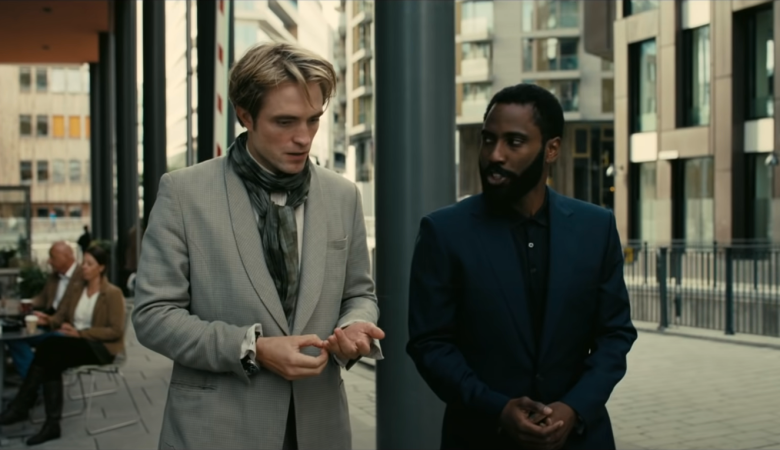
“Tenet” follows a lead character known only as the Protagonist (John David Washington), a CIA agent who is tasked with investigating a secret organization called Tenet. He learns from a scientist, Laura (Clémence Poésy), about bullets that have been inverted so that they move backwards through time. His investigation leads him to Andrei Sator (Kenneth Branagh), a Russian oligarch in tune with the future, and his estranged wife Kat (Elizabeth Debicki). Teaming up with Neil (Robert Pattinson), the Protagonist must prevent Andrei from activating an algorithm that could invert the whole world and start World War III.
The concept behind “Tenet”—the idea of time inversion, the “turnstiles” that characters pass through to invert and un-invert themselves—is fascinating. But the execution leaves a lot to be desired. Nolan relies too heavily on exposition to tell rather than show the audience what is going on. The dialogue—frequently coolly but quickly delivered to the Protagonist by a bevy of rotating supporting players—somehow makes the plot even harder to digest. The action scenes we get in this film are dazzling, and their complexity is fun to watch unravel, but there are actually a lot of long stretches without much action, and we don’t see the concept of time inversion used often or clearly enough to get a better grasp of it. There are a few great “aha” moments in the second half of the film, where you can feel some of the pieces starting to fit together, but frankly, the story is way too convoluted to be as entertaining as it should be. Will be it more fun to rewatch it and try to solve the puzzle having already had a sense of the story? Maybe, but the real issues with “Tenet” go beyond its time-bending antics.
Unlike Nolan’s previous films, whose characters, along with everything else, face deeply human, personal struggles, there is virtually no emotion behind “Tenet’s” cerebral plot and stunning visuals. The characters are so thinly drawn it is hard to get invested in their story, particularly the Protagonist. Washington is extremely charismatic and lends a sense of light humor to his performance. He also has good chemistry with Pattinson, who is equally charming in his role, but we never get a sense of what is really driving these characters throughout the film outside of preventing the next world war (which I suppose should be motivation enough, but even the characters don’t seem incredibly invested in that). The reverse-Casablanca ending between the Protagonist and Neil is one of the best and easily the most moving part of the movie, because it’s one of the few scenes in the film with real emotion behind it, and where the connection between the characters is really felt—even though that emotion doesn’t feel entirely earned.

Kat and Andrei are granted the most backstory in the film, but even that is fraught with complication. I like and even love much of Nolan’s filmography, but on recent rewatches of films like “The Dark Knight” and “Inception,” it’s clear that—as interesting as they may be on their own—the overall arc of the female characters primarily exists to motivate the male protagonist. Even though Debicki’s Kat has a bit of a role to play in the climax, the much the same can be said of her character in this film. And this has nothing to do with Debicki’s performance; she’s wonderful, and lends some much-needed humanity to a film that is largely missing that. One of the final shots of her in the movie, where she finally liberates herself from everything, is really very beautiful. But her character is frequently abused and manipulated for the sake of the larger story and to drive both the protagonist and antagonist to action, and it’s tiring to see that and not much else in a female lead in a major movie in 2020. On another note, Branagh’s Andrei makes for a truly vile villain. The film also includes Dimple Kapadia as arms dealer Priya; Aaron Taylor-Johnson as Ives, the commander of a group of Tenet operatives; Himesh Patel as fixer Mahir; and Nolan’s lucky charm Michael Caine, who shares a delightful scene with Washington early in the film.
Ludwig Göransson composed the score of “Tenet” in place of usual Nolan collaborator Hans Zimmer, and his pounding themes evoke the same feelings as Zimmer’s scores for much of Nolan’s previous work, while also placing his own stamp on it (even more impressive, Göransson reportedly recorded the musicians in their homes due to the pandemic). And as alluded to before, the special effects are impressive and the action scenes—which feel like they take place on a much smaller scale compared to some of Nolan’s previous work—are well-choreographed. It’s hard to watch “Tenet” and not think that Nolan is trying to repeat the success he had with 2010’s “Inception,” another thought-provoking, mind-bending thriller. There’s nothing wrong with a complicated plot or with asking the audience to put together some of the pieces on their own, but where “Inception” does this while maintaining a clear direction in the narrative and crafting rich characters, “Tenet” is nearly incomprehensible. The scientist Laura’s statement to the Protagonist early in the film, “Don’t try to understand it. Feel it,” feels like it could be directed to the audience, but it’s hard to feel much of anything when a movie lacks as much heart as this one does.
Runtime: 130 minutes. Rated PG-13. 2 out of 5 stars.

 Katie at the Movies
2 thoughts on “Review: “Tenet””