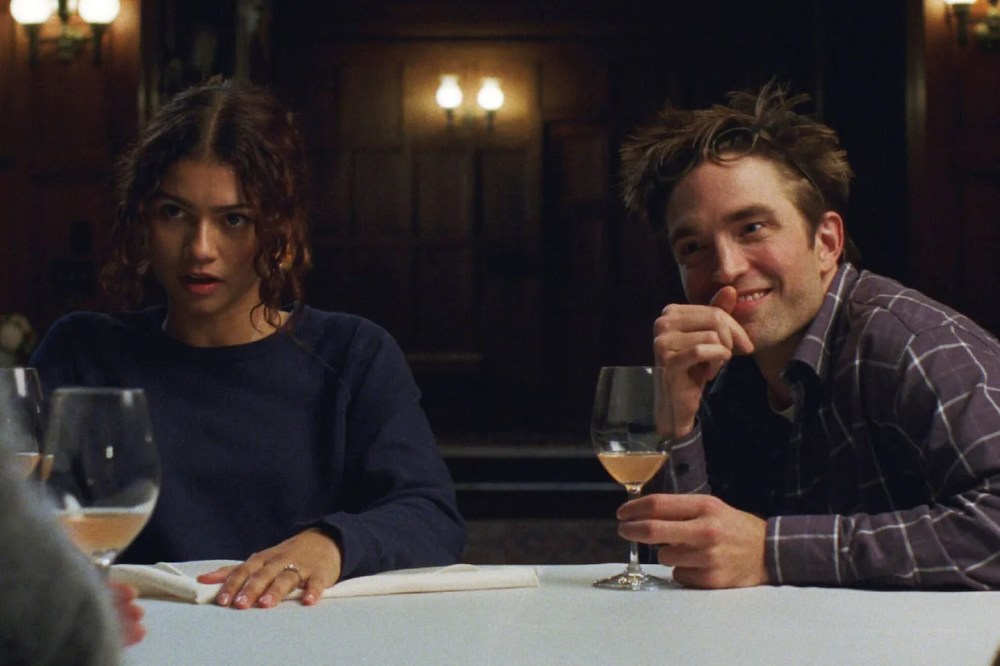
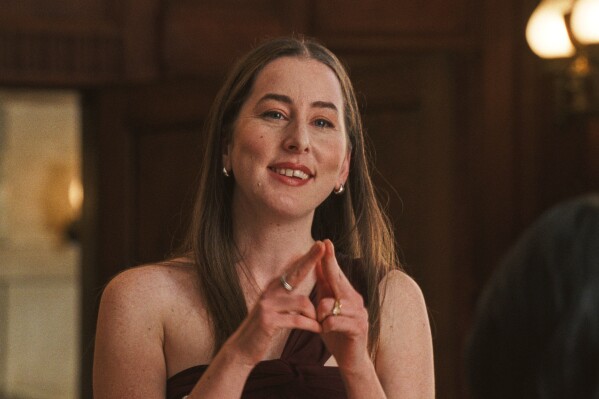
What did she do? That was the core question following the initial trailer for Kristoffer Borgli’s The Drama, the one driving the intrigue for this darkly funny, cringe-inducing film about a seemingly idyllic relationship that runs off the rails in the lead-up to a wedding. Gathered around a table in a dimly lit caterer’s dining room, taste-testing entrees and wines for their pending nuptials, Emma (Zendaya) and Charlie (Robert Pattinson) confess to their close friends Rachel (Alana Haim) and Mike (Mamoudou Athie) that they think they saw the woman they hired as the DJ for their wedding reception smoking heroin on a street corner. Is that grounds to fire her? Is what she did— or what they think she did— really all that bad? Tipsy on all that free wine, the discussion prompts them to play a sort of game where they all admit the worst thing they ever did. Mike used his ex-girlfriend as a human shield. Rachel locked her kid neighbor in a closet overnight. Charlie cyberbullied a classmate so severely, his family moved away. Emma’s confession, however, is so horrifying that it sends shockwaves through the group. Rachel is infuriated and offended. Charlie starts to question if he really knows the woman he’s on the precipice of committing to spending his entire life with.
The Drama falls neatly into a category of paranoid, male-centered storytelling that forces women to pick apart their flaws and question whether having them still makes them worthy of love. Granted, what Emma did— or contemplated doing— without wading into spoilers, is disturbing. And the film makes clear that Charlie, as his newfound fears and uncertainties about Emma and the wedding cause him to spiral, is no saint either. But the film exhibits little interesting in fleshing out these characters and giving them interior lives that allow us to understand who they are as people, independently and together.
It’s too bad, because Borgli’s filmmaking and approach to storytelling in some of the early scenes is rather incisive as he cuts between past and present. We get to know Emma and Charlie via Charlie spitballing his wedding speech with Mike. He wants to talk about the day they met, when the art museum curator spotted Emma reading in a coffee shop, and quickly googled the book she was reading so he’d have something to talk to her about. But she’s deaf in one ear, it turns out, and had an earbud in the other, so she couldn’t hear a word of his awkward fumbling. He wants to talk about their first kiss, when he tried to take her into the museum after hours, but his keycard wouldn’t work, locking them in the entryway and triggering the alarm. He wants to talk about her laugh, a sort of half-snort that he finds both cute and repulsive. This info-dump is tellingly less convincing at illustrating why they are a good couple than it is at illuminating the fractures in their relationship that were present from the jump. Charlie lied to Emma about the book when he introduced himself to her, a lie he doubled down on during their first date, until he could scrape by with it no longer. When telling Mike about that night of their first kiss, Mike dryly quips, “So you trapped her.”
Later, those quick cuts are employed less to fill in the gaps, and more to depict Charlie’s addled state of mind, as memories of little tics and things Emma has said and done that perhaps point to the act she confessed to resurface. But the jagged editing becomes more smug than stylish fast, when it becomes apparent that the fractured narrative is barely masking the fact that the film itself has little to say. In Emma making the claim that she did, it’s clear that Borgli’s aim with The Drama is to provoke. But rather than fully committing to the implications of her action, The Drama only tepidly engages with them, employing dreamy imagery that suggests the fetishization of violence, but failing to examine the complicating factors of gender and race, not to mention her severely depressed mental state, which the film broadly describes without granting the audience the space to sit with it. Some scenes spookily find characters suddenly drenched in blood. In one montage, Borgli depicts Charlie dreaming of the teenage Emma (played by Jordyn Curet), holding her as one would a romantic partner. It’s distasteful in a way that could have been effectively played either with a satirical edge or for dramatic impact or for some trenchant reveal about Charlie, if Borgli exhibited any sort of clear grasp of his themes. The Norwegian filmmaker’s previous movie, 2023’s Dream Scenario, was a decidedly more potent— if still very flawed— surrealist take on cancel-culture. The Drama very much possesses the air of a non-American artist struggling to impart some incendiary and timely take on America.
Maybe that’s unfair. After all, as much as The Drama’s marketing plays up the mystery of the big reveal, it isn’t so much explicitly about that as it is about moral hypocrisies, and the fallout from discovering something terrible about someone you care about. The film even struggles with that, however, thanks to the cardboard characterizations assigned to Emma and Charlie. Even as The Drama piles up enough absurdities to redden the face of the most stoic viewer with second-hand embarrassment— an amusingly cringe photoshoot, uncomfortable dinners, projectile vomiting, stammered conversations in which those involved fail to take half a second to think before they speak, tongues loosed by ten sips of liquor too many— it’s nearly impossible to feel invested in the couple finding some resolution and sticking together. That’s far from the fault of the performers; even the supporting members of the cast, like Hailey Gates, who plays Charlie’s prickly coworker Mischa, make memorable turns. Pattinson is adept at playing twitchy and off-kilter, but Zendaya gives arguably her best performance to date in a role that requires her to listen as much as it does to speak. Take, for instance, the dinner scene where they lay all their baggage out on the table. Emma doesn’t actively engage in the others’ enthusiasm for revealing their darkest secrets. Every time the camera cuts to her, the discomfort and concern of someone nervously anticipating a moment of truth is written all over her face. She’s similarly demonstrative throughout the remainder of the film, communicating insecurity while waiting for Charlie to return to their apartment the morning after, imagined conversations with his friends urging him to leave her permeating her thoughts, and fear and anger during the climatic wedding reception, the tension further cultivated by Daniel Pemberton’s anxiety-stirring score and a roving camera that tracks each key character’s movements. There is something rather thoughtful about the way the film slows down the morning after the reveal, with Charlie engaging Emma in a discussion about it that demonstrates a sincere desire to understand her past, as opposed to ignoring it or playing to extremes. But Borgli’s script, which skews decidedly more toward Charlie’s perspective, doesn’t interrogate the couple’s desires, backstories, family, or psychological any further. Perhaps that lack of specificity will work for some viewers, making it easier to apply the conflict to their own lives, and ask themselves what they would do in the same situation, and whether their conception of their lover or friend or family member or coworker has been altered. But that’s a difficult question to answer when even the creator of these people doesn’t appear to understand or know who they are in the first place.
The Drama is now playing in theaters. Runtime: 105 minutes. Rated R.

 Katie at the Movies