There are few greater pleasures in life than watching Elvis Presley when he’s completely in the zone. And while the singer’s earlier career appearances in Hollywood musicals, concert specials, and TV shows such as The Ed Sullivan Show certainly capture the seductive charisma and animalistic physicality that sent teenagers’ hearts thumping and older folks’ moral sensibilities into a tailspin, nothing really showcases his talent, his work ethic, and his playful spirit like his post-1960s concerts. In July 1969, Elvis debuted the first of what would turn in to a seven year run of sold out shows at Las Vegas’ newly opened International Hotel (cut short by his untimely death in 1977), marking his return to live performing after eight years. His rehearsals and the concert itself are documented in the 1970 film Elvis: That’s the Way It Is, while a 15-city concert tour serves as the basis for the 1972 documentary Elvis on Tour.
Both of those movies are high points of the concert film, showcasing the music and the performer in equally exhilarating measure. So while Baz Luhrmann’s EPiC: Elvis Presley in Concert is in many ways accomplishing the same goals, it’s no less thrilling to watch an icon, larger than life, working at the top of his game. The beats may be familiar to those who have seen the other Elvis concert films before, but the film is comprised primarily of never-before-seen outtakes discovered by researchers when Luhrmann was making his 2022 Elvis biopic. That story is riveting in and of itself: 59 hours of footage, sans audio, was recovered in the Warner Brothers archives kept in Kansas salt mines, along with a 45 minute audio recording of Elvis discussing his life story. It’s that footage that forms the basis of Luhrmann’s EPiC: Elvis Presley in Concert, which the filmmaker himself describes as neither a documentary or a concert film, but a “cinematic poem,” as if Elvis “came to you in a dreamscape.”
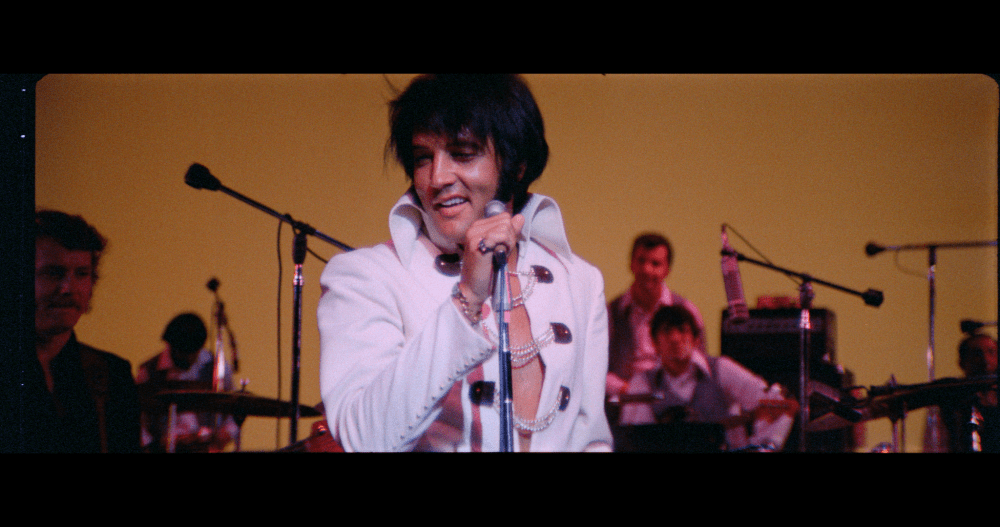
EPiC, which is comprised solely of archival footage, is effective in that regard, although Luhrmann, a director known for his bombast, can’t help but inject his own spin on it. That does make EPiC an intriguing exercise in that it provides further insight into the things that most informed Luhrmann’s 2022 film, a movie that idolizes a complicated figure far too much (sidelining his young bride Priscilla for one, and gesturing toward without reckoning with his adoption of Black music for another). Luhrmann’s editorializing of Elvis’ story is most evident in the editing and employment of a heavy dramatic score, particularly in the first part of the movie, which quickly recaps Elvis’ career prior to taking on the Vegas residency. For example, EPiC characterizes Elvis’ being drafted at the height of his stardom— which saw him serving as an active duty solider in West Germany between 1958 and 1960— as a negative incident that disrupted the foothold he was beginning to gain in Hollywood playing rebellious heroes rendered in stark black-and-white in such movies as King Creole and Jailhouse Rock. A montage of movie clips points to the sameness of the fluffier roles, primarily in colorful musical comedies, he became shoehorned into after he returned, although the implied assertion that these films— which are surprisingly varied even within the same broad formula, ranging from the tropical and frothy Blue Hawaii to the western Charro! to the socially-conscious drama Change of Habit— are without merit is frustrating. During the concert, Luhrmann cuts to copious amounts of footage of women in the audience screaming and trembling on the verge of hysterics at merely being in the same room as the King, in addition to a montage of female fans of all ages being pulled in for a smooth from Elvis either while he’s on stage or navigating the crowd. That he appears more than happy to oblige— or at the very least, bemused— and that Luhrmann, just like in Elvis (a film that swerves from reckoning with the man’s personal failings, foisting the blame for his bad traits on those around him), relegates Priscilla and the allure of family and home life to a footnote, illustrates a fascination with Elvis’ ability to play a crowd like an instrument, and his not just comfortableness with, but enjoyment of, that power and his fame. When asked by an interviewer late in the film about his celebrity, Elvis voices that he would likely miss it if he didn’t have it anymore.
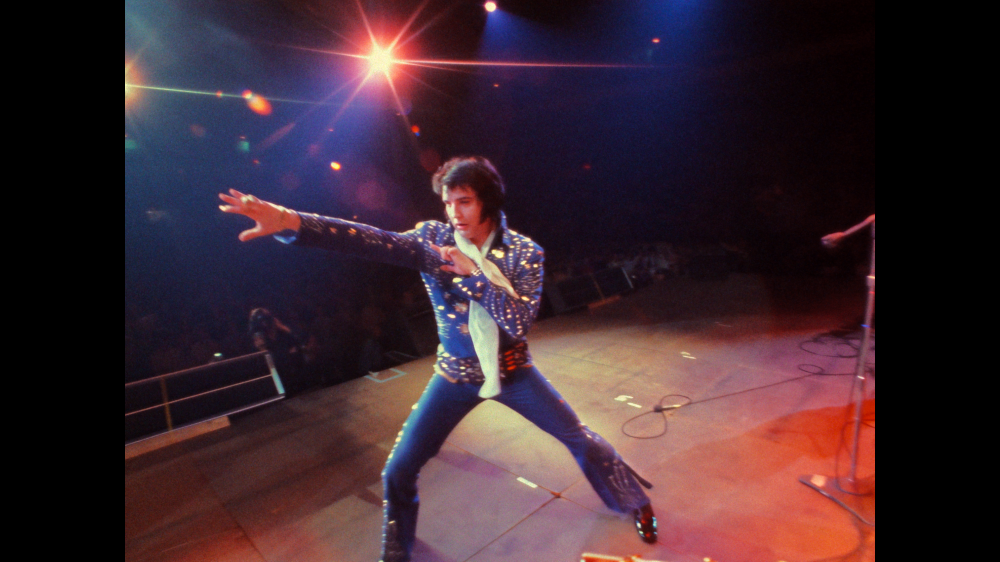
And really, while Luhrmann’s own opinions can be drawn out of the actual filmmaking, he does allow Elvis to speak for himself. Those audio recordings of Elvis speaking about his life and answering journalists’ questions serve as intermittent narration, providing a loose framework that joins together the footage and provides some insight into his thoughts about his life and career. He demurs from answering a political question with the response that he’s “just an entertainer,” but looks back on other aspects of his career— the Ed Sullivan appearance that caused his fame to skyrocket, for one— with a sense of humor. The latter is particularly evident in the ease with which he interacts with the audience and his band during the concert and rehearsal footage, which is EPiC’s real showstopper. Luhrmann, working with editor and executive producer Jonathan Redmond, frequently cuts between different rehearsals and the final onstage performance of the same song. The edit is so seamless that the rhythm of the music is never disrupted, but it works to provide a riveting peek into Elvis’ creative process, the way that he is so in tune with his musicians that they can try out different arrangements and pick up and put down songs with— to a layman’s eyes and ears, anyway— virtually no challenge, and how that work behind the scenes translates to the stage. The footage has been restored to such blinding clarity, that the lighting that bathes the theater in a rainbow of colors, and the sparkling adornments of Elvis’ jumpsuits, and the sweat that gathers on his face, pasting his hair to his forehead, provide a vivid and immersive experience that almost feels like you’re in the International Hotel, circa 1970, not a movie theater in 2026. Most of all, it’s thrilling to witness Elvis on a giant screen, bigger than life, and remember that behind the controversies and his untimely death and his larger-than-life icon status— things that often overshadow his memory— there was a singular talent, and a regular human.
EPiC: Elvis Presley in Concert is now playing in theaters. Runtime: 90 minutes. Rated PG-13.

 Katie at the Movies