Journeys of self-discovery are always ripe material for children’s fare (and can be enjoyed by adults who feel similarly lost and confused). The following three films that premiered at this year’s Berlinale— the animated Papaya and Chimney Town: Frozen in Time from the youth-geared Generation sidebar and the impressive debut The River Train from the Perspectives section– feature kids or young creatures at their center experiencing a sort of coming-of-age and learning lessons about life, love, and time.
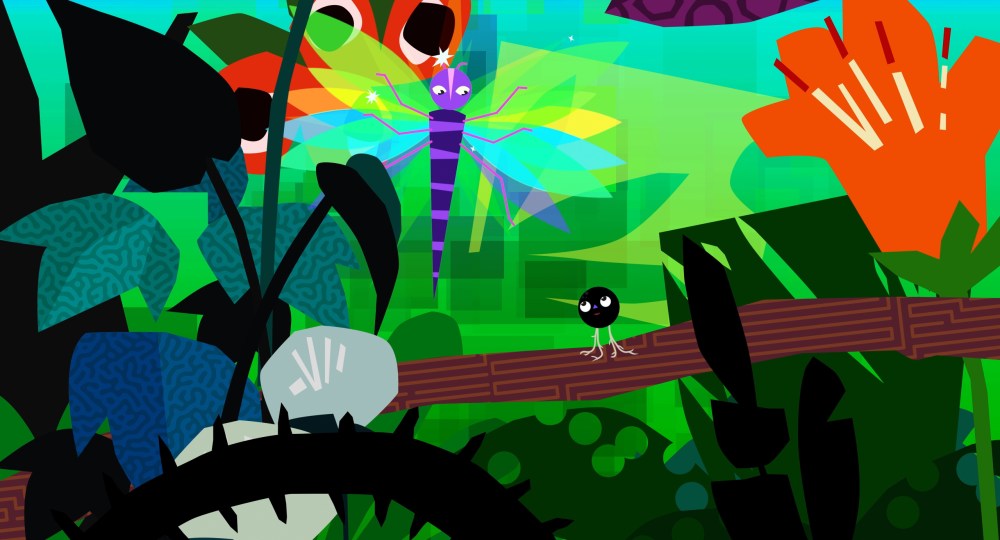
The journey of a simple papaya seed becomes a vibrant and surprisingly moving work of art in Papaya, an animated Brazilian film that’s the feature directorial debut of Priscilla Keen. Just one of many seeds born to a larger tree in the Amazon, it’s established that the seed at the heart of this story doesn’t want to follow its intended trajectory and put down roots. Rather, it dreams of taking flight, like the birds or winged insects that populate its surroundings. So, the papaya rolls off on an adventure of its own, bouncing through forests and across riverbeds and roads, down deep into sewers and factories and cities where— despite the film’s visual approach to storytelling— humans’ devastatingly impact on the natural environment is made abundantly clear.
That Papaya is so engaging sans dialogue is a credit to the effectiveness of its design. The titular papaya seed is merely a small black ball, but it’s given an expressive mouth and eyes that convey its emotions as it encounters each new character or place— whether horrified or exuberant— with clarity, while granting movement to a character that can’t really move. Talita Del Collado’s score, which is influenced by popular Brazilian music as well as natural soundscapes, further enriches the narrative arc and the visuals, which are the real star of the show. The backgrounds and characters throughout Papaya are solely composed of boldly colored geometric shapes, but an intricacy emerges from these deceptively simple compositions, whether it’s the kaleidoscopic patterns of a psychedelic detour, or the incandescent wings of a dragonfly it encounters. Every frame is gorgeous to behold, and in and of themselves subtly advocate for the preservation of the Amazon’s natural beauty. It’s a message that’s more effective than the finale of the story, which makes the papaya seed’s dreams literal in a manner that’s too perplexing to be wholly impactful.

The finale of Poupelle of Chimney Town, the 2020 animated movie directed by Yusuke Hirota and based on an original story by writer and producer Akihiro Nishino, wrapped up its story with a neat little bow. A young boy named Lubicchi befriended a man made of trash who he named Poupelle, and together they fulfilled a mission to clear the smoke-stained skies of Chimney Town and reveal the starry sky to its citizens. But the film, in addition to the larger world of Poupelle— which includes everything from picture books to stage musicals— was a smash in Japan, making a sequel inevitable. But Chimney Town: Frozen in Time is the sort of second installment that improves on its predecessor in almost every regard, giving its characters new challenges as they navigate a more complex narrative whose humor and heart will appeal to all ages.
Lubicchi (now voiced by Yuzuna Nagase) is back, but now he’s alone, Poupelle having disappeared in the aftermath of their clearing the sky. Isolated but trying to move forward, Lubicchi stumbles into a pool that leads to another world. Almost immediately uniting with an acid-tongued talking cat called Fluff (MEGUMI), Lubicchi learns that this placed is known as the Millennium Fortress and is a realm that governs time— although one clock has stopped, the clockmaker who runs the tower, Gus (Yoshihara Mitsuo) having long since lost his mind. In order to return to his own world, Lubicchi is tasked with restarting the clock that has been stuck at 11:59 PM for 100 years.
The importance of time to this story and its role in the relationships of the characters within it— characters who are always either running out of time, or racing against it, or waiting for it to pass— is immediately established, with Lubicchi informing the viewer that a clock has two hands that repeat their hellos and goodbyes every hour— except during the 11th hour. His words eloquently foreshadow what’s to come, as Lubicchi’s search for Poupelle runs parallel to a flashback detailing how Gus became the wizened and reclusive man he is in the present day. The star-crossed romance that developed between him and Nagi (Koshiba Fuka), who he first encounters singing a gorgeous ballad at the bar where she works, is rather rushed, but the well-worn formula of sweet young woman instigating positive change in a powerful but grudging man still hits.
The art design, particularly regarding the character models, isn’t consistently the same style, but that’s part of Chimney Town’s charm. A menagerie of characters whose ability to inhabit the same world at the same time defies explanation— chatty felines and rat queens and pig-like orphans and energetic twin inventors and tree spirits who long to be human— play against both 2D and 3D backgrounds, whose watercolor-like palette renders the environments of this cleverly-thought-out world in soft jewel tones that lend themselves to well to fantasy. As overly expository as much of the film’s dialogue is, particularly in the final act (there’s a lot of telling the audience what is going on as opposed to just showing them, especially in Lubicchi’s narration), it’s quite moving when the resolutions of the concurrent stories finally click into place, and the message that everyone experiences a time of uncertainty and loneliness in their life— their own 11th hour— manifests itself with a clarity that pierces right to the heart.
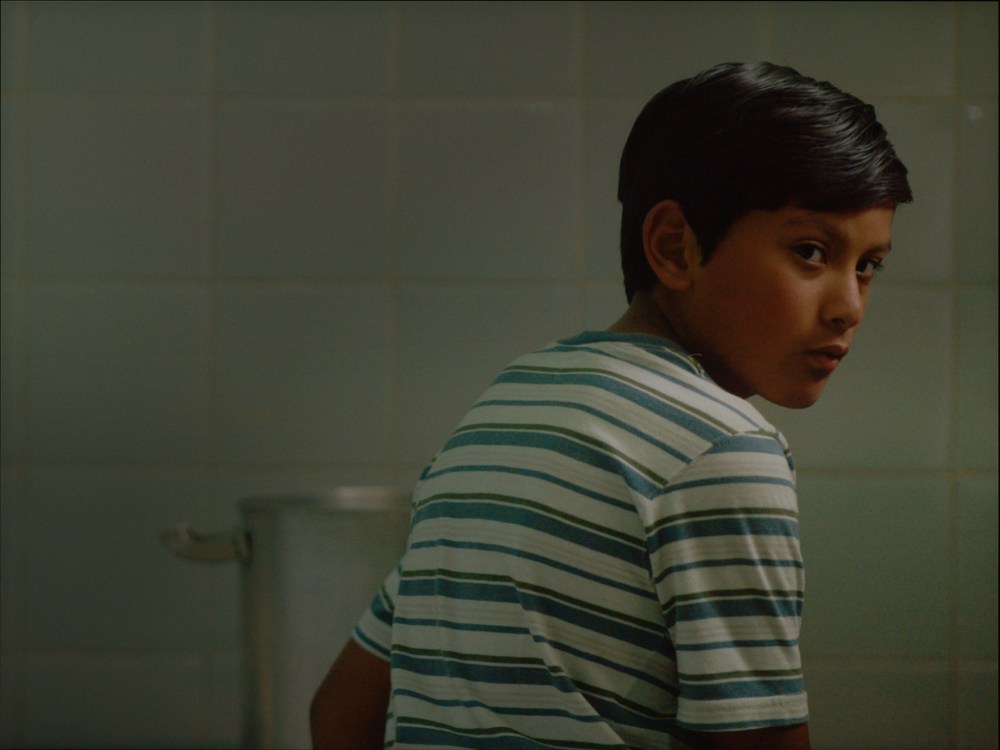
Train travel inherently contains a promise: the promise of new places, new opportunities, new people, or, conversely, the promise of returns and reunions. Maybe that’s why trains are often such a source of fixation for children. And surely that’s why a train is the impetus for both narrative momentum and character growth in writing and directing duo Lorenzo Ferro and Lucas A. Vignale’s spirited debut feature film The River Train, in which a nine-year-old boy from a remote Argentinian village, Milo (Milo Barría), acts on his dream of journeying to Buenos Aires, a city he’s only seen in the movies.
The rigid structure of Milo’s life is established in the opening scene. He’s training to be a malambo dancer, a skill that requires discipline, instilled in him by his father, who also happens to be his coach. His father paces in front of him, firmly repeating over and over again the phrase, “Do not think, speak,” to which Milo responds with immediate, one word answers that reflect the mindset of a child being finagled into behaving mature beyond their years; regimented mantras like “resilience” are repeated between more frivolous terms like “watermelon” that are indicative of the sweeter things in life. This opening stands in stark contrast to the loose narrative that follows once Milo boards the train to Buenos Aires, the heightened situations he becomes involved in— starting with his escape, when he drugs his family’s dinner, leaving them snoring, heads lolled to the side, at the kitchen table— coloring his fish-out-of-water adventure with a tinge of fantasy. It’s in the city where Milo ends up rooming with an odd pair of older actors who encourage him to audition for the lead in a play they saw advertised, leading Milo to pursue his own artistic endeavors.
It comes as little surprise that Barría is a non-professional actor Ferro and Vignale initially met while filming short in his hometown. He plays Milo with a compelling naturalism but a disarming thoughtfulness that sometimes makes him difficult to read as he keeps his expression. The River Train is also shot in vivid, warm tones that make it gorgeous to look at, with the exception of some scenes of Milo shot through the grainy lens of an old camcorder, an aesthetic flourish that is more distracting than necessary. Ferro and Vignale deftly contrast the hustle and bustle of Buenos Aires— all flashy electronic signs and imposing buildings— with the natural beauty of Milo’s hometown through exteriors, but much of the story is set in interiors, turning the focus toward the characters and Milo’s inner journey as he not only learns about other people and cultures, but— in his memorable audition scene for the play’s director— dispenses the knowledge he already possessed from his father’s lessons. Like the train that’s always chugging along, the verdant landscape passing by visible through dew-soaked windows, Milo exemplifies the act of growing up: always moving, always evolving, always learning and experiencing new places and people and things, but always carrying your upbringing and what you’ve already know with you.

 Katie at the Movies