Almost every entry in director James Cameron’s filmography marks a massive technological leap forward for cinema. Terminator 2: Judgement Day contains the first entirely computer-generated character. Titanic— the most expensive film ever made at the time of its release— merges old school epic storytelling and practical effects with computerized visuals to great impact. Avatar broke new ground in its extensive use of motion capture and 3D, while its sequel, Avatar: The Way of Water took that technology further by developing methods of underwater performance capture. But Avatar: Fire and Ash, the third installment in the Avatar series that still has two more potential entries underway, is arguably the first Cameron movie since his early works that doesn’t serve as a showcase for ground-breaking new tech, rendering its cliched, repetitive storytelling all the more noticeable— and frustrating.
That’s not to say that Fire and Ash isn’t gob-smacking to behold. The world of Pandora is brought to vivid life with clarity and color, from the cosmic purples and blue jewel tones of its underwater scenes to the lush greens of its forests, from its occasional psychedelic segues into the spirit world and its awe-inspiring creatures, whales and squids and flying beings that are just divorced from their Earth-bound equivalents, all standing in stark contrast to the clinical, mechanical human-run military base. But as impressive as its visual effects are, there’s also never a point in Fire and Ash where it feels like we are seeing something we’ve never seen before, and that’s perhaps the most disappointing thing of all.
That statement can also be applied to the narrative, which Cameron and co-writers Rick Jaffa and Amanda Silver (with additional story by Josh Friedman and Shane Salerno) reportedly spun off from the initial Way of Water screenplay, which packed too much lore into one movie. Fire and Ash does put in some work toward expanding the world-building. Humans attempting to colonize Pandora are no long the primary threat to Jake (Sam Worthington), Neytiri (Zoe Saldaña), and their family, who are still mourning the loss of their son at the start of the movie— a loss that has prompted Neytiri to feel nothing but hatred toward all humans, including Spider (Jack Champion), the human son of military commander Miles Quadritch (Stephen Lang) who she and Jake adopted. The couple decide that it is no longer safe for Spider or for the aquatic Metkayina clan they’ve joined to remain with them, and force him to leave on a convoy of Wind Traders. But the ships are brutally attacked by the Mangkwan clan, a tribe of aggressive Na’vi also known as Ash People, led by the sadistic and seductive Varang (Oona Chaplin), who is interested in using human methods (namely, guns) to rule over Pandora’s other tribes.
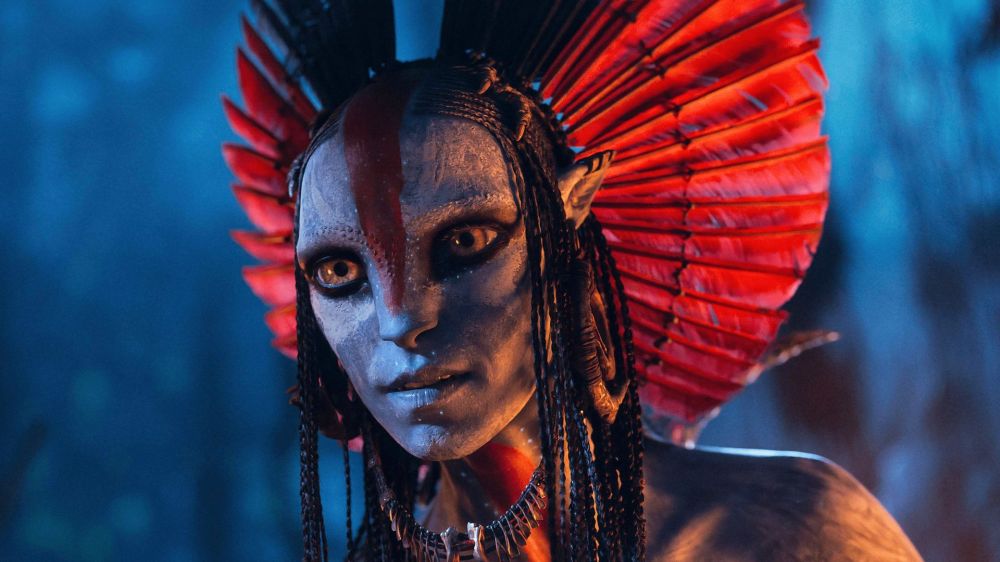
That’s where the action kicks into gear, but where is it all headed? There was never a point during Fire and Ash’s sprawling, over-three-hour runtime where I felt like I had a sense of what the endgame was, or what point Cameron was grasping for. I can’t help but imagine the murkiness, in conjunction with the over-reliance on numerous character threads and relationships and bits of lore established years ago in the other movies, is rough to endure for people like me— who I imagine the bulk of the film’s audience will consist of— who watched the previous two films once or twice in theaters and hasn’t revisited them since. Certainly, conservation is still on Cameron’s mind; a subplot involving Spider (who’s given more screen time in Fire and Ash than the majority of the Na’vi characters) and his biology adapting to life on Pandora, and the ramifications that could have on humanity’s ability to enter the world and destroy it the same way they destroyed Earth, will surely be circled back to in a big way in the fourth and fifth films, but it’s really only gestured toward here in a story that’s thematically as well as dramatically light. Cameron’s penchant for straightforward, classical storytelling gets a little lost in all the characters and subplots here, and the occasional swings toward big, emotional moments— between parents and children, enemies and lovers— largely ring hollow. And his shameless culling from indigenous cultures for his inspirations for the Na’vi— in this case, the Baining people of Papa New Guinea, whose culture is most notable for their fire dances, are credited as the primary source for the Ash People— makes for an uneasy sit.
At least there are plenty of eye-popping action sequences to break up the repetitive story beats, although Fire and Ash’s length really starts to be felt in its final hour. On the off chance that Cameron doesn’t make any more of these, the film does conclude on a satisfying end point that brings all the characters together in one place. But that also prompts me to wonder, where does he go from here, narratively and technologically? If Avatar is neither pushing boundaries or working as entertaining popcorn fare, then what is the point?
Avatar: Fire and Ash is now playing in theaters. Runtime: 197 minutes. Rated PG-13.

 Katie at the Movies