Astonishing, incendiary, and eerily prescient, Ian Bell’s documentary WTO/99 may depict one single event in American history, but does so in manner that reveals the ripple effects that globalization and anti-environmental, anti-labor practices— far from mainstream, hot button issues at the brink of the new millennium— have had on our current climate, economic, and human rights crisis, and how rampant police militarization in the face of opposition escalates peaceful situations, placing human lives and First Amendment rights in danger. That event was the 1999 Seattle WTO Protests, sometimes referred to as the Battle for Seattle, in which no less than 40,000 demonstrators gathered in the vicinity of the World Trade Organization Ministerial Conference of 1999 to protest U.S. involvement in the fledging organization, whose undemocratic nature is reflected in its membership built from non-elected leaders harnessing their authority to enact free trade. Bell, a Seattle native, constructs his film exclusively from over 1000 hours of archival footage culled from news broadcasts, press conferences, home movies, and more, providing a thorough and immersive look at the event from its lead-up, the duration of the four day conference (which occurred between November 30 and December 3), and its aftermath.
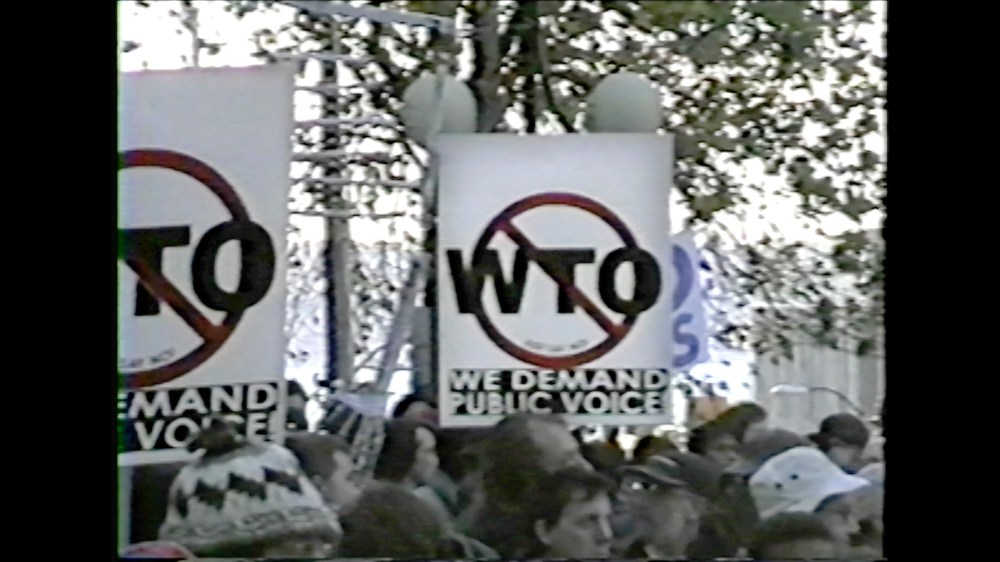
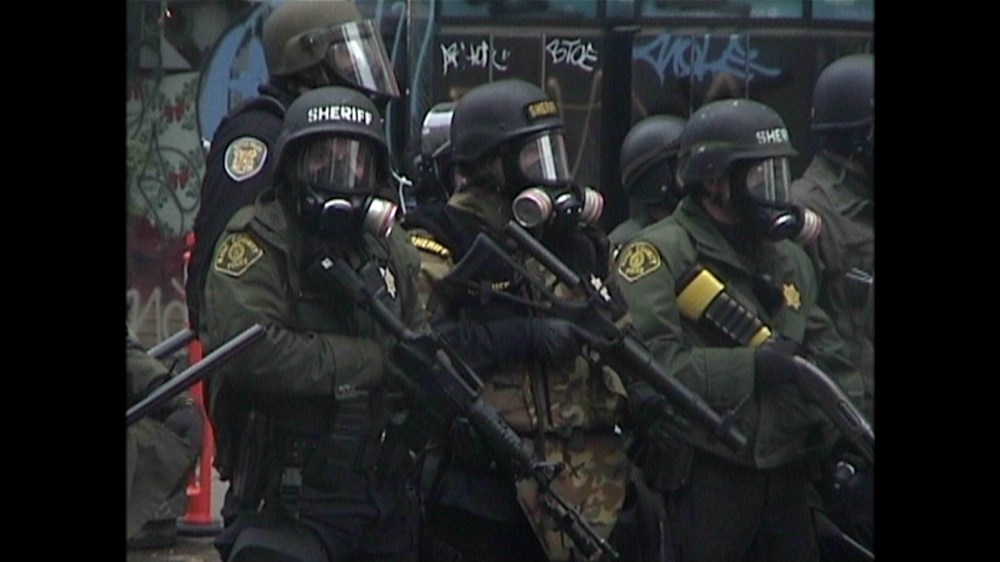
The demonstrations begin easily enough, with protesters blocking the entrance to the conference to delegates and delaying its opening ceremony. Interviews with protesters reflect their diverse backgrounds (everyone from college students to Republican politicians) and varying reasons for participating in what would become the largest demonstration of its type at the time, from fighting for a better future for their kids to taking back power from big bureaucracies and putting it back into the hands of the people. One of them, while traveling to Seattle, is asked if she thinks the police will use tear gas on the protesters. She responds no, that they would only do that if there was a need to, and she didn’t think there would be a need to. Watching WTO/99 with the hindsight of not only that event, but other large demonstrations in recent years during which police overextended their authority and met non-violent protesters with violence— the Black Lives Matter protests of 2020, for one— her optimism and faith in the system is, regrettably, almost laughable. It isn’t long into the first full day of protests that police arrive on the scene, batons and shields in hand, and begin firing pepper spray and tear gas onto the demonstrators.
The sheer breadth of footage at his disposal, along with some smart editing that creates some sly commentary on the proceedings courtesy of Bell and producer Alex Magaro, permits the film to speak for itself— no external narration or talking heads required, just the occasional title card to orient the viewer in time and space. Now, anyone can— and frequently do— take out their cell phone and film their surroundings, even live stream or upload the footage to social media immediately for the whole world to see and react to in real time. Here, there’s enough footage, even in the pre-cell phone age, in fact, that Bell is often able to view one scene from various angles utilizing video from different sources, many of them first-hand accounts that place the viewer directly in the middle of the action. A scene early in the movie impressively and amusingly illustrates this, as a man taking a video of a group of police officers comments to his friend, “Hey, that cop is filming me”— only for the film to cut to the video the officer is taking of the man. Around the middle of WTO/99, the filmmakers cross-cut between a press conference with the mayor of Seattle and the city’s chief of police, skirting the direct questions from an offscreen interviewer about the violence (specifically the use of rubber bullets) purportedly being exercised by police on unarmed protesters while assuring the media of the city’s safety, and on-the-ground footage of the chaos wrought by the police’s militant tactics, and protesters injured by rubber bullets to the face. Other sequences illustrate the media’s role in sensationalizing events and villainizing those pushing for positive change as disruptors of law and order, with reports of a few vandals smashing the windows of downtown businesses and looters breaking into a Starbucks overtaking the coverage of the non-violent protesters and police brutality.
WTO/99 is as thrillingly paced as a narrative feature, with a clear arc that builds in tension to an victorious conclusion, even if its a more symbolic short-term win than a tangible long-term one. The delegates may have left the conference having not been able to complete their negotiations, but the WTO endures as a massive force governing over of international trade with 166 member countries, even as climate change and inequality caused by lack of protections for underdeveloped countries and individual citizens have only become more pressing issues in the over 25 years since the 1999 protests raised them. WTO/99 further draws perhaps a too literal direct line between then and now, concluding with a montage of footage of subsequent large-scale demonstrations occurring throughout the world, ending in 2020. But it’s the act of witnessing so many people uniting from across political spectrums and class divides— a concept that feels unfathomable in today’s intensely divisive political atmosphere— to stand up against a body that violates human rights in favor of growing big business that’s truly galvanizing. WTO/99 further serves as a searing historical document, made possible by those who had the foresight to film the event as it unfolded. One participant, speaking at the hearings that explored the city’s response to the incident in its aftermath, sums it up the best: “I think we have to thank the inventor of the video camera.”
WTO/99 is now playing in select theaters. It screens locally at the Arkadin Cinema & Bar on December 5 and 6. Runtime: 102 minutes.

 Katie at the Movies