When I reviewed Jon M. Chu’s big-screen adaptation of the first half of the hit Broadway musical Wicked around this same time last year, I was surprised to find that it had some merit— in its performances, and its translation, and its broadening of the source material— given my distaste for both the show and the Gregory Maguire novel it was based on, and the film’s many poor directorial choices and visual flourishes. Much of my goodwill has flown out the window like Elphaba whizzing on her broom with the story’s second half, titled Wicked: For Good after the penultimate duet between Elphaba (Cynthia Erivo) and Glinda (Ariana Grande) that cements the narrative’s core relationship. Lacking on almost every front, Wicked: For Good feels not only less like a self-contained feature than its predecessor, but also more like an afterthought, running parallel to the events of The Wizard of Oz (resulting in one too many self-serving winks and nods) and tying up the story’s remaining threads with as little fuss as possible. In other words, it’s the cinematic equivalent of “this could have been an email.”
Set some time after the events of Wicked, Wicked: For Good finds the powerful Elphaba living in exile as she works to expose the Wizard (Jeff Goldblum) for the fraud that he is, while her old school friend Glinda has been propped up by the Wizard and Shiz University headmistress Madame Morrible (Michelle Yeoh) as “Glinda the Good,” granting her everything from a fancy but useless wand and a mechanized floating bubble for transportation to make her appear as if she has magic powers she doesn’t actually possess. She’s engaged to Fiyero (Jonathan Bailey), the Winkie prince who’s now captain of the Wizard’s guard but holding on to lingering feelings for Elphaba even as he’s tasked with hunting her down, while Elphaba’s sister Nessarose (Marissa Bode) steps into the role of Governor of Munchkinland after their father suddenly passes away. In the meantime, the Animals (that would be animals possessing the ability to speak as humans do) are driven underground, fighting a losing battle for their civil rights that only Elphaba seems to be comfortable speaking up publicly for.
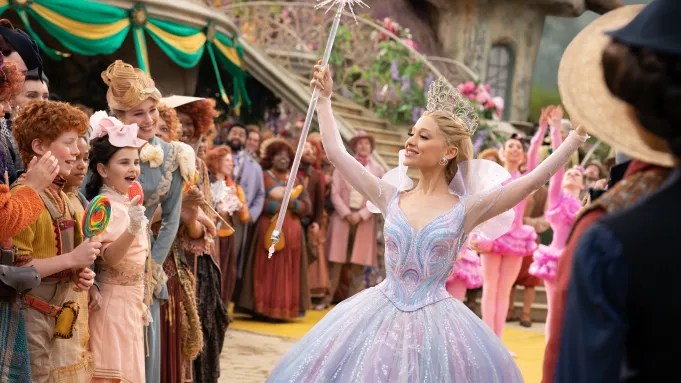
That latter issue in particular played a key role in Wicked, serving to radicalize Elphaba and reveal the Wizard for the oppressive ruler that he is. It’s all but absent in Wicked: For Good, however, which exhibits virtually no handle on its politics at all, despite containing plenty of potentially thematically invigorating and timely material, from the employment of a charismatic yet talentless individual as a crowd-pleasing leader to distract the masses from their rights being stripped away under their noses, to the use of fiery propaganda to conjure dangerous enemies out of activists, to a politician who chooses to side with the majority even when she knows that it isn’t right. The script, penned again by Dana Fox and Winnie Holzman (who wrote the book for the Broadway musical), plays it safe, toning down the story’s content across the board (not just politics, but sex and violence) in a plea for broader appeal and a PG rating. If the key question underlining Maguire’s book contemplates the nature of evil and whether people are born wicked or have wickedness thrust upon them, Wicked: For Good expresses little interest in answering that, opting for a black-and-white narrative populated by characters who are clearly either good or bad. Any shades of gray involve playing with audience’s expectations of specific characters familiar from The Wizard of Oz; sympathies for Dorothy (who is tangentially present in the film, although her face is never actually seen) and her new friends, like the Tin Man and the Cowardly Lion, are cast in different directions after learning the origins of how they got how they are, and the intricacies of the tangled political conflict they’ve inadvertently become involved in.
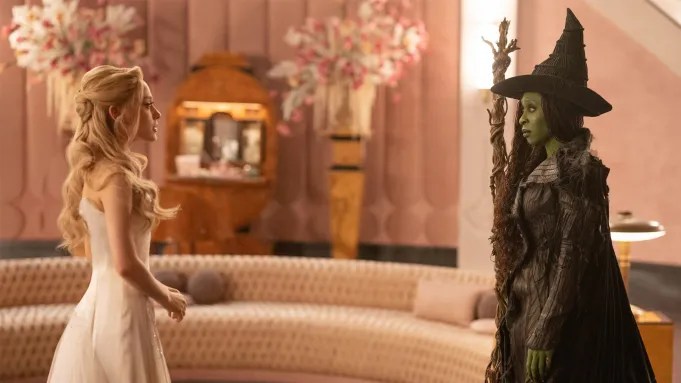
That flatness carries over to every other aspect of the film, which is almost shockingly lifeless and dull and— like many sequels— much darker than the first installment. It isn’t Erivo and Grande’s fault; they are powerhouses, but their lack of shared screen time deprives the film of the humor and heart that their enemies-to-friends relationship brought to Wicked (gone also are the first half’s messaging of accepting yourself and others, and taking pride in being different). There’s also the simple fact that almost all of the musical’s great songs are in the first act of the show. Erivo’s show-stopping rendition of “No Good Deed” is a much-needed wake-up call in the middle of the movie, but most of the other songs are just sort of there, particularly the two new songs written for the movie, “No Place Like Home” (a solo for Elphaba) and “The Girl in the Bubble” (a solo for Glinda intended to serve as a sort of awakening for the character). All of that just serves to make the poor blocking and shot compositions of the musical numbers that plagued Wicked even more evident. Chu is so averse so pulling the camera back to showcase the choreography, and the scores of dancers backing up his leads, and the physicality of his cast, opting instead for choppy edits and medium shots that find the characters awkwardly placed in frames where its difficult to know where to look. Visually, Wicked: For Good is even less vibrant than its predecessor, and many of the scenes are still weirdly backlit, washing out any color in the production design.
Whereas Wicked— while overly long— moved at a decent pace, Wicked: For Good somehow manages to move sluggishly while rushing through plot points that fail to fill out the characters’ relationships or grant the story any thematic depth, causing it struggle to justify its existence. Maybe splitting the Broadway show into two films (clocking in at over five hours long altogether) was a mistake. Maybe, with this crew behind the camera, it wouldn’t have made much difference. I’m just going to content myself with the promise this movie’s subtitle offers: that this series is over and done with, for good.
Wicked: For Good opens in theaters on November 21. Runtime: 137 minutes. Rated PG.

 Katie at the Movies