What more can you say about a movie so iconic that there’s seemingly nothing new to be said? That sentiment doesn’t deter Alexandre O. Philippe, whose essay films encompass cinematic topics ranging from the obvious (David Lynch’s obsession with The Wizard of Oz, Kim Novak’s role in Vertigo) to the niche (the iconography of Monument Valley in American westerns and history in The Taking). His film Chain Reactions, which won the Best Documentary on Cinema award at the 2024 Venice Film Festival, takes a smart approach to its subject: Tobe Hooper’s 1974 horror film The Texas Chain Saw Massacre, about a group of young people who fall victim to a house of cannibals they stumble upon on a road trip, and which was largely met with shrugs from critics but was a box office sensation on its initial release, and in the decades since has been held up as one of the scariest and most influential American movies, establishing the genre beats that the grimy grindhouse horror films of the 70s and 80s would largely follow, not to mention a franchise of numerous sequels (the Library of Congress inducted it into their National Film Registry last year, marking the movie’s 50th anniversary).
In other words, The Texas Chain Saw Massacre has been talked about. A lot. But the aptly-titled Chain Reactions eschews boring the viewer with that basic context that even those who have never watched the movie are likely at least tangentially aware of. It’s divided into five chapters, each devoted to a different artist: actor and comedian Patton Oswalt, Japanese director Takashi Miike, Australian film historian Alexandra Heller-Nicholas, author Stephen King, and director Karyn Kusama. The surroundings in which they are interviewed, matching Texas Chain Saw’s grubby aestheticand shot with a soft focus that centers the subjects in the frame, are spare, and no one else’s voices are heard, off-screen or on. It’s just them, and their memories and thoughts and feelings and analysis of Texas Chain Saw, intercut with footage from the subject film, but also their own works and other movies that come up in the conversation.
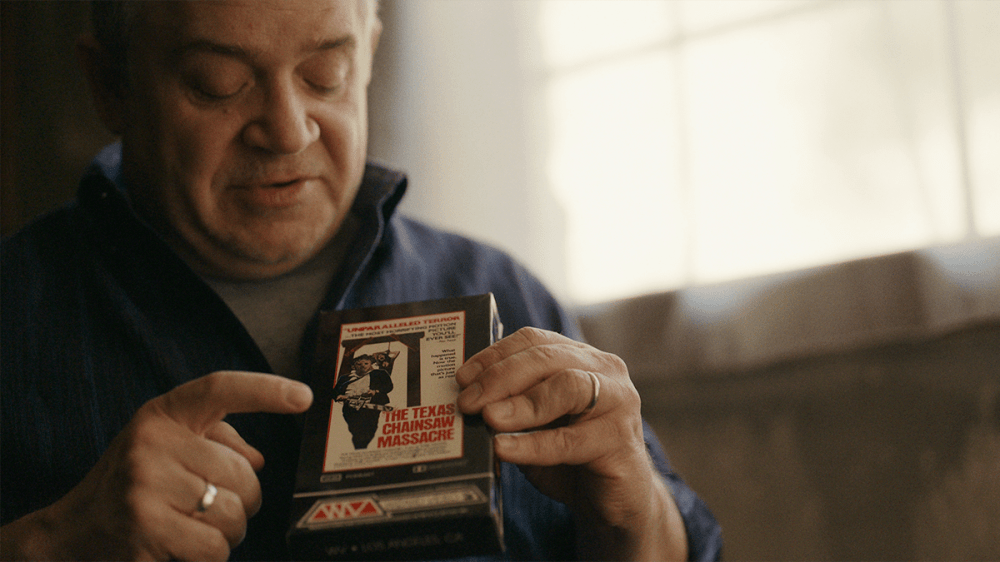
Their observations range from the sharp to the mundane. That’s unsurprising for a film that’s segmented in such a manner between talking heads possessing such wildly different experiences and backgrounds. On that note, it is funny to see what tidbits they repeat independently of each other; both Oswalt and Heller-Nicholas equate Texas Chain Saw’s look (grindhouse meets art house) with the work of legendary experimental filmmaker Stan Brakhage, Oswalt mentioning his observational autopsy movie The Act of Seeing with One’s Own Eyes, while Heller-Nicholas says it’s like Mothlight, a four-minute up-close smattering of moth wings on film. David Lawrence’s editing helps visualize the conclusions the subjects draw, some of which sound like stretches on paper, but make perfect sense when lined up to the corresponding scenes in Texas Chain Saw. Oswalt compares the artfully composed shot of one of the members of the group, Pam (Teri McMinn), approaching the house where the cannibals reside and have already begun murdering her friends, with that of the ship approaching the harbor in the 1922 silent horror film Nosferatu, the movie he attributes to being his first terrifying screening experience as a child; on the surface, both scenes are beautiful and peaceful, but the audience is aware of the pending danger that the characters on screen are not. He further compares the roughness of the bridal carry when Leatherface (the film’s central killer) captures Pam to the scene in Gone with the Wind when Rhett Butler snatches up Scarlett O’Hara and carries her up the stairs; both flip the expected visual language of romance, and seeing the scenes play out side-by-side effectively communicates that. Chain Reactions also strategically cuts together clips from movies significant to the subjects’ memories and careers alongside Texas Chain Saw, further illuminating the movie’s role from their origins up to now. Miike— whose filmography most notably features the graphically violent Audition and Ichi the Killer— shares some of the film’s most tender sentiments, starting with a sweetly amusing story of pivoting to watch Texas Chain Saw in the theater on its initial release in Japan after the screening of Charlie Chaplin’s 1931 silent comedy City Lights he had been planning to attend was sold out; comparable scenes from each movie play out side-by-side, revealing how similar actions can be applied to wildly different tones. It’s catnip for cinephiles, regardless of their level of interest in Texas Chain Saw itself.
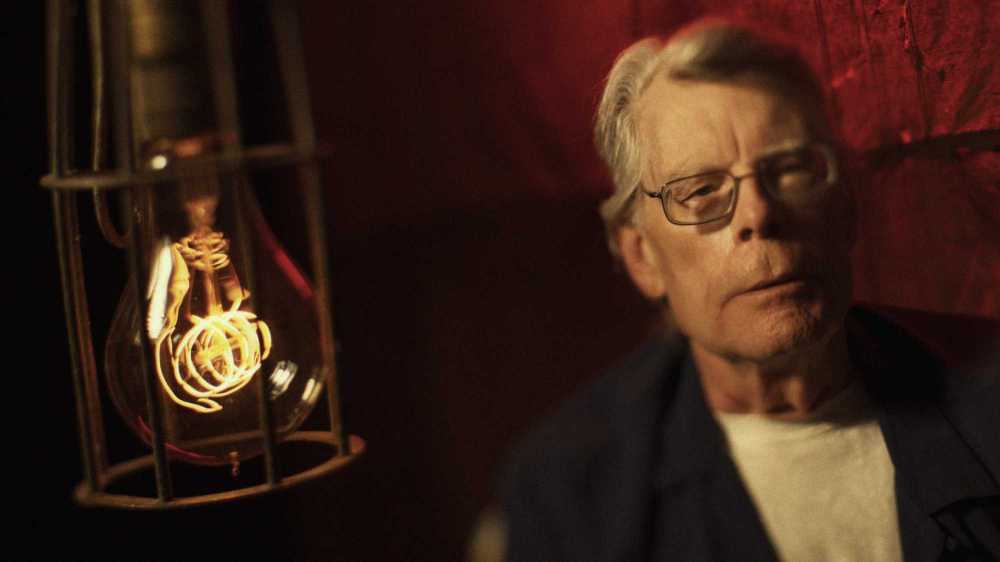
It’s difficult not to feel like Chain Reactions could be slimmed down a bit, however, especially when one of the five segments is so much more dominated by surface level observations than the others. King’s presence seems to be solely due to the fact that he wears the “King of Horror” crown, but he doesn’t impart either the deeply personal memories or cutting analysis of his colleagues. Fortunately, his smugness is followed by the clear-eyed Kusama, who concludes the film with a concise statement that boils down what Hooper accomplishes with Texas Chain Saw— and the reason why, decades later, it is just as riveting and frightening as it was the day it was released: “America is a madness, and I want you to look at it.”
Chain Reactions is now playing in select theaters and will be released on all digital platforms on October 21. Runtime: 103 minutes.

 Katie at the Movies