“I built my career following Francis,” George Lucas states in new interviews conducted by Mike Figgis for his documentary Megadoc, a fly-on-the-wall chronicle of director Francis Ford Coppola’s epic Megalopolis, his decades-gestating, self-financed dream project that— following a lengthy and fraught production— finally premiered at Cannes last year to largely critical pans and mass confusion. It’s a journey that Lucas, who has helmed similarly massive (and massively derided) projects, undeniably understands. Lifelong friends and occasional collaborators ever since Lucas shadowed Coppola on his third directorial feature— a 1968 adaptation of the musical Finian’s Rainbow— the former filmmaker provides a succinct distillation of the traits that not only set him apart from the latter, but that prompted Coppola to embark on a project that on paper (and to everyone around him) sounds insane. He describes Coppola as a “jump-off-the-cliff” guy. Whereas Lucas, in constructing his own creative empire (one that continues to thrive under new guidance) took his time to discover ways to scale the brick walls standing in his way, Coppola barrels right through them.
Figgis, who Coppola invited to film the making of Megalopolis a mere three weeks before pre-production began, granting him nearly complete access to the set, is sort of the perfect director to helm this chronicle, because he is cut from a similar cloth to Coppola, Lucas, and many of the New Hollywood filmmakers who rose to prominence in the 1960s and 70s, the crumbling of the old studio system creating space for more individual authorship over projects. Nabbing attention with his low-budget 1988 debut Stormy Monday, losing faith in the Hollywood machine following studio mangling of his 1993 drama Mr. Jones, being nominated for Best Director and Best Screenplay Oscars a mere two years later with Leaving Las Vegas (that being the film in which he got to meet Coppola, it starring his nephew, actor Nicolas Cage), only for his subsequent features to be met with a shrug, his career is marked by peaks and valleys, not unlike Coppola, whose four-film run in the 70s of The Godfather, The Conversation, The Godfather Part II, and Apocalypse Now is widely considered the greatest directorial streak ever. But he never hit those highs again, his subsequent movies such as the 1982 Las Vegas-set musical One from the Heart and the 1983 teen gang drama Rumble Fish frequently being technically as well as narratively daring, but failing to strike a chord with critics and audiences. Perhaps the biggest difference between Coppola and Figgis, however, is that one accumulated almost unfathomable amounts of money not only from the success of his movies, but from other ventures; the other did not. Coppola sold a stake in his wine company to set the budget for Megalopolis at $120 million, a number that Figgis, both in interviews with Coppola and the cast and crew and in his own asides to the camera, can’t seem to wrap his head around. Throughout Megadoc, he includes on-screen text breaking down how the budget is being distributed between costumes, visual effects, and the All-Movie Hotel, an old Days Inn that Coppola purchased near where filming took place just outside of Atlanta, Georgia and renovated not only to house cast and crew members, but to serve as a workspace, complete with a screening room.
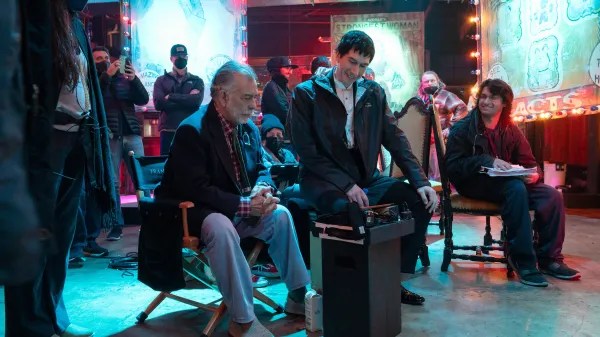
You need only bring with you a love for film and a desire to see how all the gears click together behind-the-scenes to follow and enjoy Megadoc. Megalopolis itself is rather incomprehensible, even for those like me who not only watched it, but enjoyed it. The sci-fi epic is set in a future where New York City and Rome have fused to become New Rome, and centers around the clash between an architect (played by Adam Driver) with ambitious plans to revitalize the city, and its corrupt mayor (Giancarlo Esposito). It’s an exuberant swirl of excess, romance, and political intrigue, buoyed by an underlying message of— as Coppola iterates in the documentary— hope.
Megadoc is much more straightforward in comparison, even doing the audience the courtesy of including title cards reintroducing each character and the actor who plays them. It’s no Hearts of Darkness: A Filmmaker’s Apocalypse— the 1991 documentary chronicling the notoriously difficult production of Coppola’s 1979 Vietnam War movie Apocalypse Now, whose production on location in the Philippines stretched over a year and encompassed everything from severe weather to health issues, is a more well-rounded blend of on-the-ground footage (shot by Coppola’s wife Eleanor, who shares a directing credit) and contemporary interviews with those involved, the break of over a decade between production of the feature and production of the documentary allowing space for more introspection. Megadoc begins with the actors’ early rehearsals, and ends with the film’s premiere at the Cannes Film Festival last year, neatly sidestepping any sort of reckoning with the actual critical and financial response to the film (spoiler alert: it was a flop) and painting the mere completion of the project as a victory in and of itself. But whether or not Figgis’ closeness to much of the cast and crew (and Coppola) allows for an unbiased portrait of the production is questionable; there’s only a quick allusion to the tabloid fodder that followed a mid-production crew turnover, while Figgis makes a glaring notable omission in not discussing the accusations of sexual harassment female extras made again Coppola.

However, like Hearts of Darkness, Megadoc is a movie that loves mess. The filmquickly finds its key players in those who open up to Figgis’ camera the most. Clutching an enormous goblet of some substance, Plaza (who plays TV personality Wow Platinum in the movie) hilariously sneers about first reading the script— “This is a disaster”— and her awkward first Zoom meeting with Coppola. Jon Voight and Dustin Hoffman bring both the gravitas and insight of those who have worked in the industry for decades, as does Laurence Fishburne as the sole returning member of Coppola’s early attempts to mount the script he first started writing in 1983. Footage of these table reads, which feature the likes of Uma Thurman and Robert De Niro, as well as a green-screened sequence starring Ryan Gosling, are sprinkled throughout the documentary and provide not only fascinating insight into what the cast could have been, but also serve as tangible evidence as to the length of time Megalopolis has been meandering through development hell. But it’s Shia LaBeouf who appears most consistently, emerging not only as an antagonist of Driver’s character in Megalopolis but an antagonist of Coppola in Megadoc, his eagerness to understand his character and experiment in his scenes butting up against Coppola’s vision. Their verbal sparring, which frequently culminates in Coppola just getting up and walking away to go direct remotely from his converted airstream, is hysterical to watch from the outside looking in, namely because the animosity between them isn’t indicating any deep-seated hatred. There’s too much respect between them for that. It’s more that LaBeouf is the young upstart constantly pestering Coppola for attention, and Coppola, in his mid-80s, is simply tired.
If there’s one narrative that emerges from the many threads Megadoc attempts to untangle, it’s that. It isn’t Figgis’ efforts to occasionally document the roadblocks in making the documentary, which don’t offer enough trenchant insight to merit the distraction from the film’s fly-on-the-wall approach, beyond the practical explanation as to why the movie’s two leads typically only appear in distant long shots (Driver doesn’t like to be filmed while he’s working, while Nathalie Emmanuel’s agent warned Figgis not to film her while she’s eating). Rather, this is a movie about an elder visionary (whose last movie, Twixt, was released well over a decade ago) contending with an industry that’s morphed beyond his preferred manner of working. Coppola likes to do as much practically on set as possible; at one point, Figgis documents the crew spending the better part of a day tinkering with a method of realistically projecting a shimmering prosthetic onto Driver’s face. Coppola’s hires, who include the likes of a production designer just coming off of one of Marvel’s Guardians of the Galaxy sequels, are initially thrilled to work with the director of The Godfather, only to find that they don’t know how to give him what he wants, while the director himself appears mildly flummoxed that it seems to take so many people so much longer to get what he needs. But his joy in creating is evident in through the rough patches. It’s in how involved he is in working with his actors. It’s in how elated he is after viewing some of the film’s first rough edits. It’s in his initial response to his wife as she informally interviews him from behind a camera, a mixture of excitement and trepidation and perhaps a tinge of disbelief that the project is actually, finally moving forward written all over his face. Not having Eleanor, a storied filmmaker and artist in her own right who passed away just week’s before Megalopolis’ Cannes premiere, present as more of a grounding force (she provides Figgis with some winking advice about working with her husband) either throughout, or at the very least, bookending the documentary is likely the practical result of her not being physically on set a whole lot, although the tribute to her that immediately follows footage of the couple’s 60th anniversary celebration feels awkwardly shoehorned into the middle of the film. The arbitrary structure and the selective nature of what footage is included and what is not may make Megadoc theless sloppy cousin of the movie it’s documenting, but— as with viewing Megalopolis— the pleasure is in watching, like the mad Dr. Frankenstein assembling his monster, a one-of-a-kind auteur at work, fulfilling his vision without outside funding and without distributors, mainstream Hollywood be damned.
Megadoc is now playing in theaters. Runtime: 107 minutes. Not rated.

 Katie at the Movies