Fifteen years, six seasons, 52 episodes, and 3 feature films later, change has finally arrived at Downton Abbey. It’s an inevitable fact of existence that the series, which opened with the 1912 sinking of the Titanic and now concludes (presumably) in 1930, the start of a decade rife with worldwide turmoil, has acknowledged while nonetheless fighting against it, the have-it-both-ways-ness of the Masterpiece Theatre equivalent of chicken noodle soup unable and unwilling to relinquish, let alone critique, the dated and oppressive aristocratic systems at its center. In both of the theatrically-released films that followed the series’ 2015 conclusion— 2018’s Downton Abbey and 2022’s Downton Abbey: A New Era— the existence of the old way of life at the titular grand home, in which the downstairs servants maintain the lavish lifestyle of the upstairs residents and their high society guests, was always verbally threatened, but never physically acted on. Time may be marching on— in A New Era’s pseudo Singin’ in the Rain remake, for instance, a silent movie being filmed on location at Downton is thrown into chaos with the arrival of talking pictures— but in this insular world, at the end of the day, life goes on as usual.
But with Downton Abbey: The Grand Finale, series creator and scribe Julian Fellowes finally shakes things up as he puts a bow on each of his many, many characters’ storylines. Helmed by returning A New Era director Simon Curtis, it’s a movie whose narrative beats hew much closer to the TV series than the previous films, which attempted to broaden their scope by venturing to new locales and perhaps introducing a few too many new characters. That also means that The Grand Finale plays with less cinematic bombast; in its flatly-rendered, largely contained, dialogue-heavy settings, it both looks and feels like a really, really long episode of television. It’s unnecessary, it barely meets the criteria to be considered a movie, but that’s okay. This isn’t for people who don’t know their Granthams from their Hexhams. For longtime fans of the series, it’s more about the comfort of watching people who have become old friends move into the next phase of their lives, and that is an achievement that Fellowes and Curtis pull off with aplomb, even if the loss of the fan favorite Dowager Countess at the end of A New Era (played by Maggie Smith a mere couple of years before she passed away) would have made for a more eloquent series conclusion.
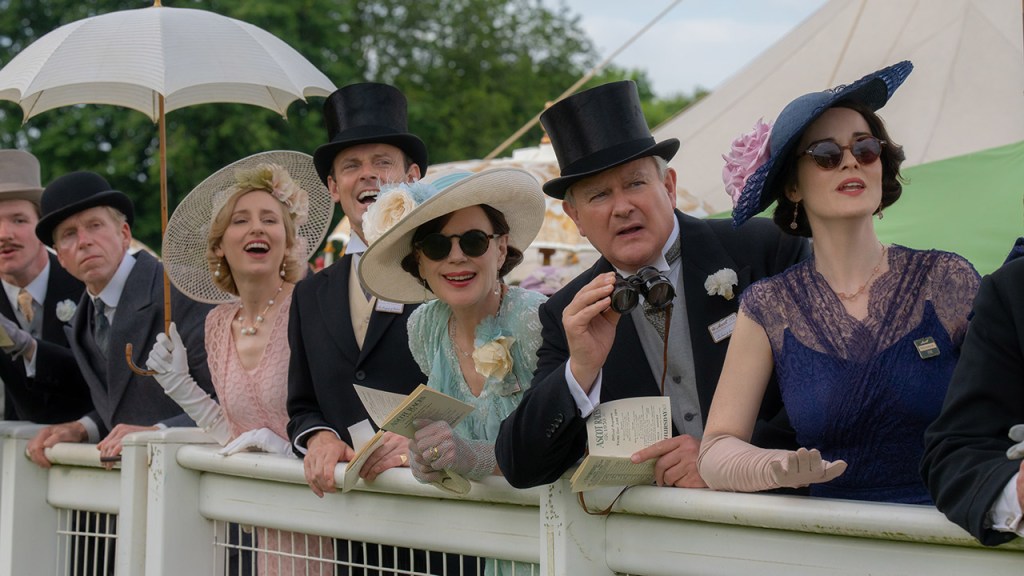
In fact, Downton Abbey has stretched on for so long now that for the second time the spouse of Michelle Dockery’s Lady Mary had to be written out because the leading man no longer wanted to be involved. The Grand Finale opens while the Granthams’ and a handful of their servants are in London for the season, and Mary has just received a clandestine divorce from her oft-absent race car-driver husband Henry. While over in the States, Reno was a year away from openly advertising itself as “the divorce capital of the world” thanks to its increasingly lax laws regarding the procedure, in the U.K.— and especially among the upper crust— being a divorcee effectively rendered one as a social pariah. That’s exactly what happens to Mary when the newspapers catch wind of her marital woes; she’s immediately kicked out of an elegant London party, deemed unfit to share the same space with royal guests, and even after returning to Downton, friends and neighbors who have known her all her life shun her, calling into question her ability to run the grand house in lieu of her father, Robert Crawley (Hugh Bonneville).
If The Grand Finale has a main throughline, it’s that, exacerbated by the arrival of Cora’s (Elizabeth McGovern) American businessman brother Harold (Paul Giamatti, reprising his recurring role on the series), who reveals he’s lost most of their family’s fortune. Exactly how is unclear, although it likely has something to do with Gus Sambrook (Alessandro Nivola), the shifty advisor he arrives with. Other minor conflicts shift in and out of focus, like the ascension of Daisy (Sophie McShera) and Andy (Michael Fox) to head cook and butler, respectively, following the retirement of Ms. Patmore (Lesley Nicol) and Mr. Carson (Jim Carter), or former footman and newly-minted screenwriter Molesley’s (Kevin Doyle) efforts to get famous playwright and Downton guest Noël Coward (Arty Froushan, whose presence inspires one too many cringe and overly niche Easter eggs alluding to the creation of some of his most noted works) to notice him. Some once major players, like Allen Leech’s Tom Branson and Laura Carmichael’s Edith are present for the ride but largely given the short stick (although the latter is granted a punchy one-off scene that showcases the force of will the character has acquired over the course of the franchise).
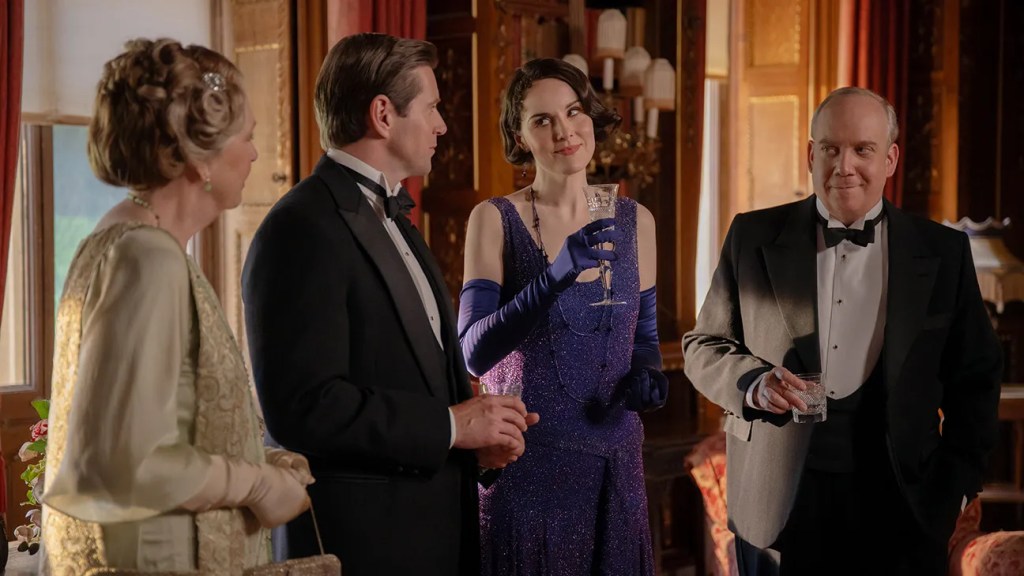
All of them comfortably sink into their roles like a second skin, and Smith’s wisecracks are dearly missed, but Bonneville and Dockery are the clear stand-outs. It’s through them— Mary’s challenging social norms and Robert’s stubborn resistance to change— that The Grand Finale takes the series’ most incisive steps toward dismantling the outmoded institutions at its heart to date (even if witnessing the inner workings and occasional petty drama of those institutions is a major reason why watching Downton is so pleasurable). Lady Merton’s (Penelope Wilton) brief presence in this movie works to this end as well. In organizing the county’s annual fair, she takes strides to diversify the snobby committee’s makeup by inviting Daisy to join, to the ire of its conservative chairman.
Perhaps those changes all come too little too late. By the movie’s— and by extension, the series’— conclusion, it looks back on everyone and everything that came before with a chokingly cloying gaze, while failing to situate the present in the necessary historical context (there are vague references to the stock market crash in America, and it’s difficult to imagine how a story so geared for comfort viewing would tackle the imminent rise of Nazism and World War II). But they come all the same, the transition of power at Downton marking the biggest shake-up in the series in a long time. They’re welcome, and delivered with such charm and grace that— for a series that has somehow managed to just justify its existence despite lingering for far longer than it ought to— I can’t help but yearn for more.
Downton Abbey: The Grand Finale is now playing in theaters. Runtime: 123 minutes. Rated PG.

 Katie at the Movies