The enigmatic black-and-white portrait of its subject that Kim Novak’s Vertigo opens with speaks louder than words. Its date is uncertain, but based on her appearance, the footage originates from somewhere in the vicinity of the peak of her success in Hollywood, the girl who made a detour to Tinsel Town for fun while touring as a refrigerator model in 1953 (she was dubbed Miss Deepfreeze) and lucked into a screen test becoming one of the biggest box office stars in the world by 1957. She’s beautiful and beguiling, but there’s also something swirling behind her eyes that’s a little sad.
It’s a perfect opener for Alexandre O. Philippe’s documentary about the star (receiving a Golden Lion for Lifetime Achievement from the Venice Film Festival in conjuction with its premiere), who breaks free from her longtime seclusion to not only appear in front of the camera, but also discuss her thoughts and feelings about her life and career with such candor. That initial footage of her is followed by audio of a voice memo she recorded in November 2024, in which the 92-year-old star comes across as achingly vulnerable. But Philippe is so selective and idolatrous, there’s always a sense that everyone— especially Novak— is holding back. It’s perhaps too personal a project for the Swiss director, known primarily for his essay films on cinema ranging from such topics as George Lucas, Monument Valley, and David Lynch and The Wizard of Oz. Inserting himself in front of the camera, a generous slice of the film’s slight runtime is devoted to his explaining to Novak how Vertigo is his favorite movie, and one of his earliest memories is watching the film, in the living room of the house where he grew up that had nearly identical red damask wallpaper to that in the restaurant where Novak’s character is introduced, and Novak strolling toward the camera in a magnificent black and green evening gown.
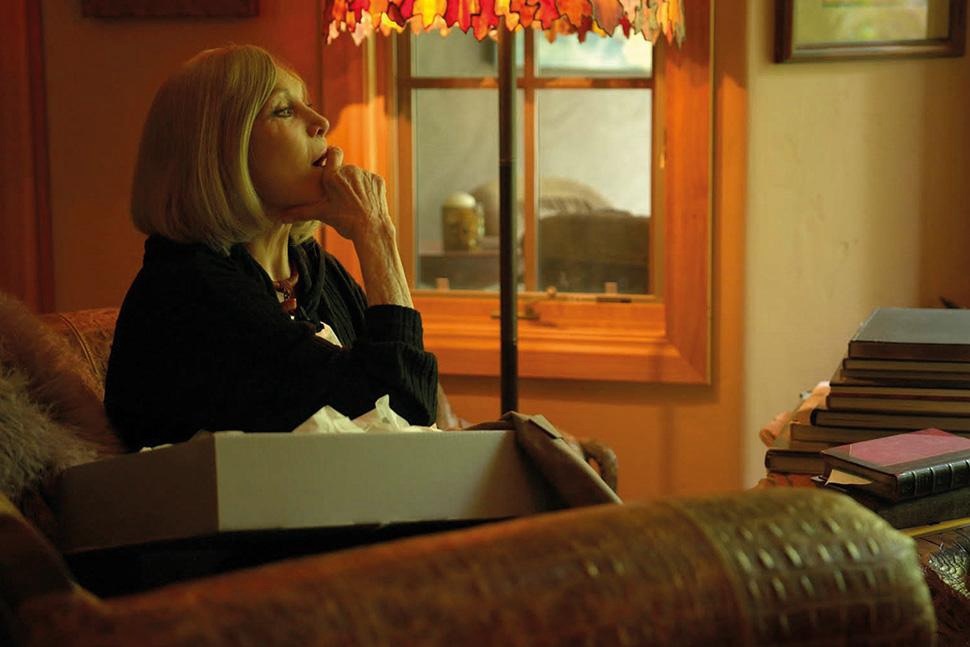
Novak now lives in Oregon, dividing her time between painting and her menagerie of animals. Kim Novak’s Vertigo doesn’t exactly delve into the production of Alfred Hitchcock’s 1958 thriller— which was initially released to a lukewarm reception but is now considered one of the greatest movies ever made— but rather attempts to draw a parallel between the dual role Novak played in her most famous film, and the two sides of her she wrestled with in real life: the glamorous sex symbol versus the insecure woman. Much is made of how Novak purportedly walked away from her acting career at the height of her fame to find herself, but it reads more as “eat, pray, love” when it could have swung for some incisive criticism of the Hollywood studio system’s trenchant sexism and racism. There’s only a brief allusion to Novak’s side-stepping the advances of famously feral Columbia Pictures president Harry Cohn, and the doc doesn’t even touch his interference in Novak’s romance with Black performer Sammy Davis Jr.
On the one hand, that’s fine; Kim Novak’s Vertigo is more focused on the actor’s journey of self-discovery and reconnecting with the life she left behind long ago than dredging up old affairs and tabloid gossip. She fondly recalls working with her Vertigo costar Jimmy Stewart, and how she idolized Greta Garbo as a child. Novak’s contact with physical objects and spaces— visiting the Mission San Juan Bautista where the key scene of Novak’s character Madeleine’s death was filmed, cleaning out her attic and paging through albums of old photos and ads, unpacking the iconic gray suit Madeleine wears in Vertigo— sets the stage for her reminiscences, but it’s all too stagey, these on-camera interviews shot with an intensely hazy soft-focus lens that contributes to the film’s overly nostalgic sheen. And Philippe’s manner of cherry-picking what to include and what not to paints a slanted picture of her life and career. He makes liberal use of clips from Novak’s other movies, effectively demonstrating her range for those who maybe only know her from her association with Hitchcock (a bright-eyed ingenue in the 1955 drama Picnic, a sex kitten in Billy Wilder’s 1964 comedy Kiss Me, Stupid), but he doesn’t utilize any clips from her filmography after 1968’s The Legend of Lylah Clare, Robert Aldrich’s drama in which she plays— guess what— an unknown actress who’s molded in the image of a male creator’s desires. It’s like her career ended there— and it would have been an appropriately meta ending at that— but it didn’t. Philippe skips her 1980 turn opposite Angela Lansbury’s Miss Marple in The Mirror Crack’d, skips her final feature, 1991’s Liebestraum, during the making of which she viciously butted heads with director Mike Figgis, skips a whole chunk of her life. It’s not that his film needs to be comprehensive, but Novak’s complex life and career, in all its triumphs and hardships, deserves more than a feature-length fan letter. At least, it’s lovely to see Novak gracing the screen again, still gorgeous, still vibrant, and by all appearances, content in the life she has chosen to lead, just outside of the spotlight.
Kim Novak’s Vertigo premiered out of competition at the 2025 Venice Film Festival. Runtime: 77 minutes.

 Katie at the Movies