Rarely does anyone, when discussing Mary Shelley’s novel Frankenstein, refer to it by its unabbreviated title: Frankenstein; or, The Modern Prometheus. In Greek mythology, Prometheus is a Titan sent to Earth early in its creation to help humanity. But he gives them fire, a tool that begets knowledge, more civilized technology— and destruction. His defiance of the Olympic gods condemns him to eternal torment. Variations on the tale shift with time and across different cultures. Most often, he was said to be chained to a rock, where an eagle would visit him and eat out his liver, which would grow back overnight, only for the eagle to return the next day in a never-ending cycle of misery. Either way, its implications remain the same: it’s a cautionary story of the dire consequences of human striving, of stepping over boundaries that were never meant to be pushed at, let alone crossed.
That remains true of most reworkings of Frankenstein as well, although every Frankenstein adaptation is a Frankenstein in and of itself. In the over 200 years since Shelley’s novel was first published, few creators have translated it literally, in any media. They draw from the original source, sure, but also other versions that have become just as synonymous with the novelist’s tale of hubris, and what constitutes a monster or a man— James Whale’s 1931 film for Universal Studios, for instance, which made Boris Karloff’s boxy, stilted monster, bolts jutting out of the sides of his neck, unable to modulate his voice beyond varying tones of grunts and groans, pop culture’s de facto image of Frankenstein’s creation. A dash of this, a little of that, and a dollop of their own voice. At the Sundance Film Festival just this year, Grace Glowicki debuted her startling original Frankenstein take, Dead Lover, a film that takes the basic concept and underlying themes of Shelley’s story and applies them to a work that’s entirely new.
“Startling original” isn’t exactly the phrase I’d apply to Guillermo Del Toro’s Frankenstein, although the filmmaker’s affection for Shelley’s novel and Whale’s adaptation (a film he cites as having a massive impact on him as a child) as well as monsters fantastical and horrible, misunderstood and wretched, is writ large across his sprawling tale. But Frankenstein’s gruesome, limb-tearing prologue, which provides the narrative with its framing device, is pure Del Toro. It begins where the novel ends, in the Arctic tundra, where a ship bound for an expedition to the North Pole that’s been stuck frozen in the ice comes across an exhausted and hypothermic Victor Frankenstein (Oscar Isaac), running for his life from a hulking creature wrapped in furs (Jacob Elordi), who tears through the ship’s crew with superhuman strength and unrelenting violence. The remainder of the story is divided into two chapters, as Victor and then his monster, holed up in the ship’s cabin with the captain (Lars Mikkelsen), relay their experiences.
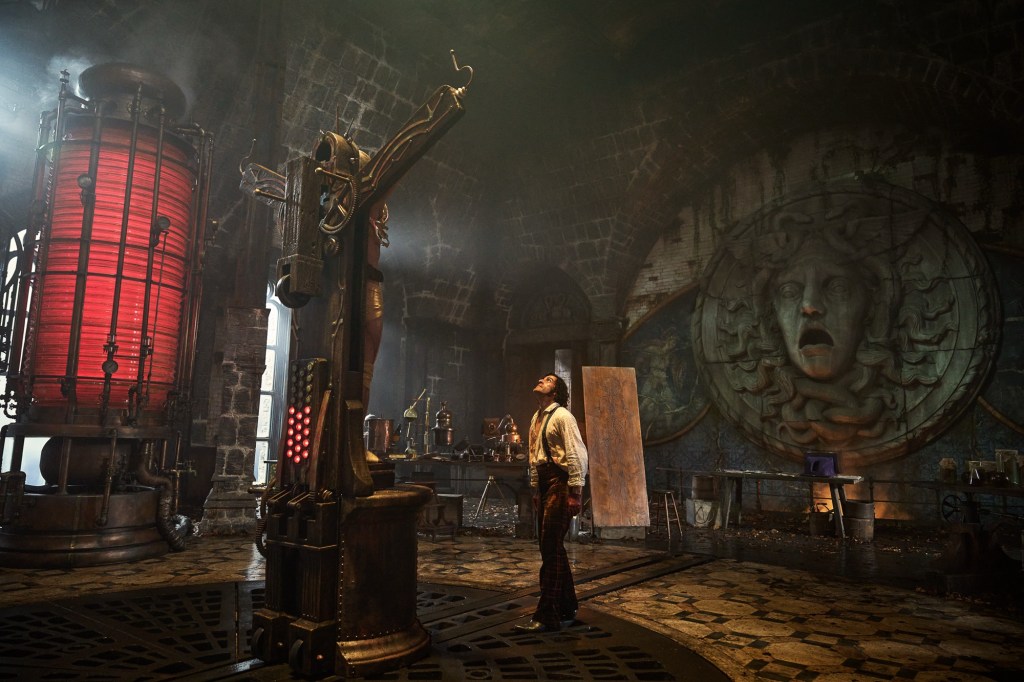
In spite of this action-packed opener, the rest of Frankenstein unfolds less like a horror movie and more with the whimsy of a storybook fairytale. Isaac, with his hunky features and shaggy hair, always a bit disheveled, decked out in pants and jackets with clean lines that I suspect may not be entirely period accurate but conjure an image of the man not as a mad scientist locked in a tower but someone’s who’s a little rock and roll, someone who revels in rebellion, has the range to tug sympathies toward him, or push them away, even as he over-extends that range into a performance that teeters on exaggeration. Del Toro’s twist on Victor’s motivations, however, begins to unravel the tale when it’s only barely begun. In the sprawling lead-up to Victor building his lab and executing his experiment, he reads less as a man obsessed with playing God, and more as a man with mommy issues. The big plot points don’t deviate drastically from the novel; Del Toro just shakes them up a bit, rearranging and expanding and subtracting. Here, his beloved mother dies when he is a child, but while giving birth to his brother William, the wealthy doctor she married unable to save her. He gets the chance for creative fulfillment not from official channels, but from a wealthy benefactor, Herr Harlander (Christoph Waltz, right at home being a little eccentric, a little skeevy, a little unpredictable), although that arc does little beyond unnecessarily bloating the first act, fizzling out into nothing. As an adult, the drive toward creation is stalled when Victor begins to covet William’s (Felix Kammerer) fiancée Elizabeth (a perfectly ethereal Mia Goth), a woman who closely resembles his dead mother, whose sharp wit, adoration of insects, and fascination, as opposed to revulsion, with the human form and all its squishy skin and slimy sinews, prompts Victor to imagine a kinship that may not actually exist. But here, Elizabeth serves as more than a mere object of Victor’s affection and later torment. She’s the vital demonstration of Victor’s failings, because she views living creatures with affection, and Victor views them as a stepping stone to greatness, to earning respect from the colleagues and medical societies who once dismissed his work reanimating corpses as carnival sideshow bullshit.
Del Toro can’t help but imbue his Frankenstein with his familiar touches, visual and thematic: splashes of red on black and white (that Victor is virtually the only person who wears the color throughout the film points to the blood on his hands), amber-toned environments and Gothic set pieces, intricately crafted practical effects, and a dose of Catholic guilt (Victor is visited in his dreams by a crimson angel, whose arrival may signal either a godsend or an omen). But there’s a failure to reckon with the moral and ethical quandary Victor becomes mired in with the introspection it requires. Those themes that make Shelley’s novel such an enduring masterpiece are absent here. Victor leaps from joy and pride in his creation to revulsion at what he has wrought because the script requires it. For all the operatic spectacle that accompanies it, those emotions aren’t deeply felt.

But there’s a delicacy to Elordi’s monster that lovely, his body pieced today not by garish stitches and screws, but like a puzzle; the Crimean War looming in the background, he’s cobbled together from the corpses of soldiers Victor pulled straight from the battlefield. Thanks to Elordi’s height, he still cuts an imposing figure, but there’s an vulnerability in his eyes and voice that— along with some twists on the proceedings that place more blame squarely on Victor— paint him as even more of a tragic, even romantic, figure.
Whale’s aforementioned 1931 Frankenstein had more than just an impact on the monster’s perceived physical appearance. Its finale stringently acknowledges humanity’s cruelty, the reason why Prometheus was punished for his deeds, why Victor faces his comeuppance for trying to play God, a concept so objectionable in early 1930s America that state censor boards across the country demanded that the doctor’s line, “Now I know what it feels like to be God!” be excised from the picture. The monster is chased by a pitchfork-toting mob before presumably perishing in a fire (fear not, there were sequels). Del Toro adheres closely to Shelley, however; mournful, but accepting, with a tinge of hopefulness. Maybe Del Toro was a little too obsessed with the idea of making Frankenstein to really consider the weight of the subject matter. But for a man who loves monsters, that elegiac finale couldn’t be more fitting.
Frankenstein had its world premiere in competition at the 2025 Venice Film Festival. It will be released in select theaters on October 17, and be available to stream on Netflix on November 7. Runtime: 149 minutes.

 Katie at the Movies