Who owns our days? That question is posed by Dorotea (Anna Ferzetti) to her father, Mariano De Santis, the President of the Italian Republic (Toni Servillo), about a quarter of the way through Paolo Sorrentino’s La Grazia, and— following the Italian filmmaker’s established pattern— is repeated several more times throughout the film’s runtime. Sorrentino has never been one for subtlety. La Grazia opens with a recitation of Article 87 of the Italian Constitution, which outlines the President’s powers and duties. The wording is plain and technical, with all the coldness you’d anticipate from a government document, the responsibilities outlined therein equally as expected: issuing decrees, appointing state officials, receiving diplomats, and the like. But they’re given a new rhythm here, pulsing to the beat of the electronic score as it climbs uptempo, accompanied by the sight of a trio of fighter jets soaring across the sky, spewing smoke in red, white, and green streaks— Italy’s colors. Again, no lack of subtlety. But even moments where Sorrentino’s overworked compositions and heavy symbolism read as blunt and annoyingly pompous— a sticking point with his previous films, which I typically find technically admirable but emotionally distant— are buoyed by the sincerity of this old man movie, and the unfathomable depths of Servillo’s sad eyes.
Mariano, you see, is chugging toward the end of his term as President. With only six months to go, he’s existing in a sort of limbo, where he has both everything to do, and nothing. Politically, there are a couple of large topics looming over him, tasks he could demur from and delegate to his successor. Two individuals serving time for murder are seeking pardons: a young woman who killed her abusive husband, and a retired teacher who strangled his wife of 35 years, neither of them able to cope with her late stage Alzheimer’s. There’s also the matter of signing a law that would make euthanasia legal in Italy, although both his detractors and supporters seem to believe he’s too balanced a leader to actually sign it.
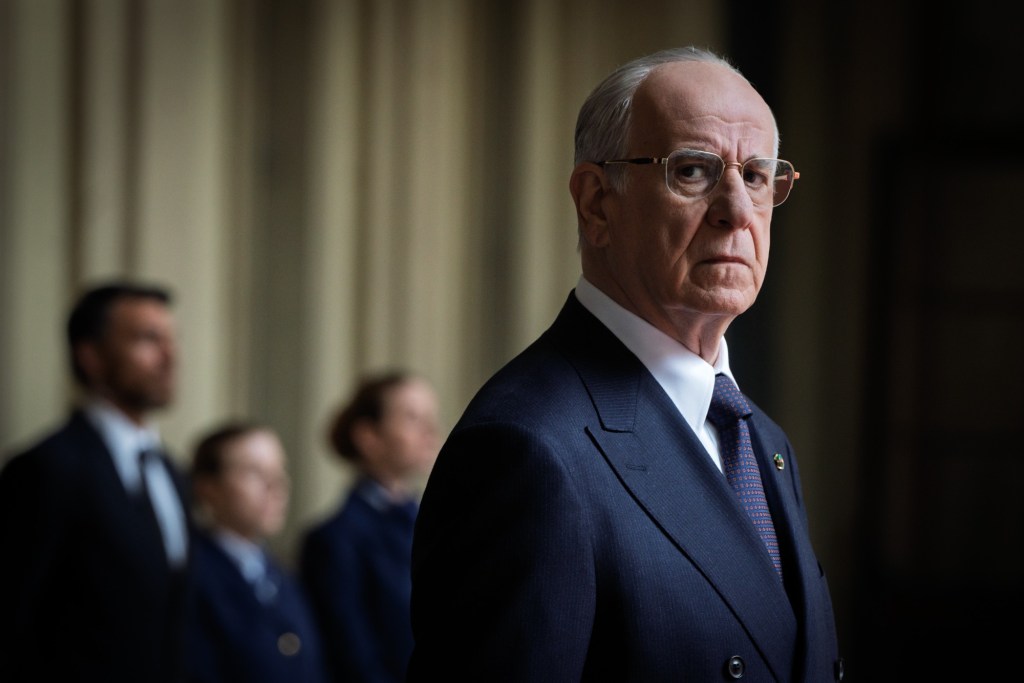
La Grazia isn’t concerned with the thorny nature of policy-making, however. In one respect, that’s to the movie’s detriment; there’s something almost cloying about how both Mariano’s colleagues and the public uniformly idolize and respect him, the script making only vague allusions to the numerous political crisis he averted during his term (then again, maybe it’s just that I’m an American in the year 2025). What Sorrentino does instead, rather, is so much more deeply human, veering from the themes of the vapidity of beauty and wealth that dominate much of his filmography (from his Oscar-winning The Great Beauty to last year’s Parthenope) to a moving treatise on mortality. Because personally, Mariano is going through it. Everything and everyone reminds him of the fact that he’s in the final phase of his life, from his sick horse, Elvis, who he refuses to have put down even though he’s in agony, to an elderly visiting ambassador, whose gaunt visage visibly shakes Mariano. And then there’s his deceased wife, Aurora, whose foggy memory haunts him— because he still loves her, because he still thinks about the lightness with which she walked and the vibrancy with which she described her dreams to him, and because he’s still seeking the answer to who who she cheated on him with some 40 years ago, and why.
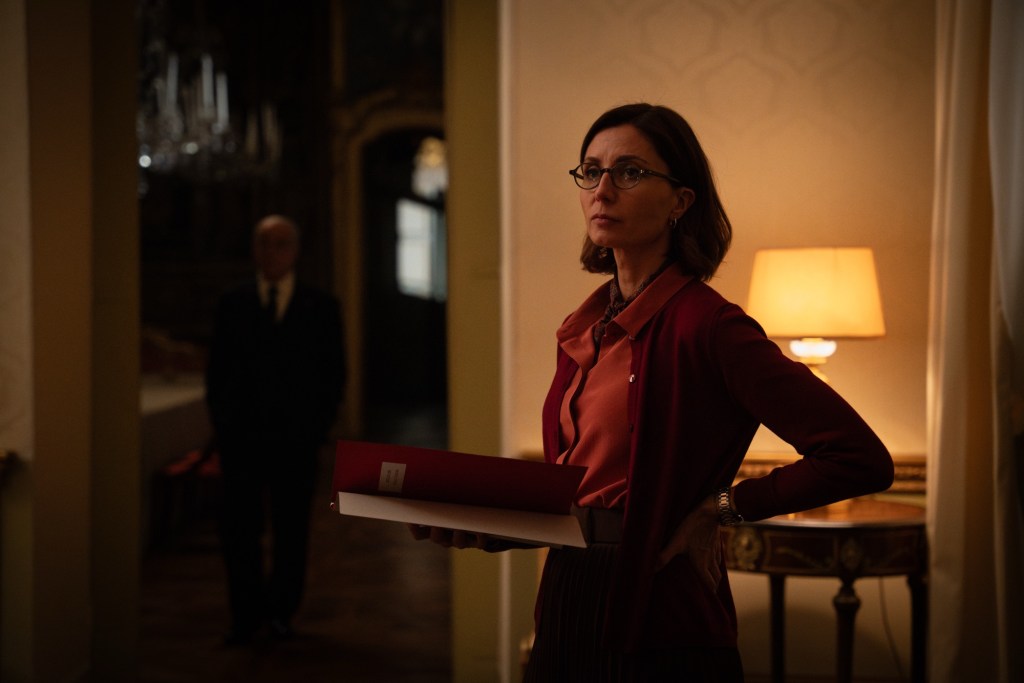
Set, as with many of Sorrentino’s films, against the backdrop of Rome, cinematographer Daria D’Antonio’s work highlighting both the Eternal City’s decay and grandeur, past and present and future collapsing to exist in the same space together at the same time, La Grazia tangles all of Mariano’s dilemmas into one big knot, then proceeds to unravel it a little too neatly— with grace, to quote the title. Too fine a point is put on everything for such complex (truly, life or death) issues, every sentence ending not with a question mark, or an ellipses, but a period. And yet, it is still gently moving, in no small part thanks to Servillo’s performance. One of Sorrentino’s regular collaborators, Mariano proves to be a role worth of his age and stature. He’s immediately likeable, juggling diplomatic stillness (a trait for which he’s earned the nickname “Reinforced Concrete”) with warm humor, pretending he doesn’t enjoy current pop music while listening to rap in secret, the crinkles around his eyes alternately conveying amusement and concern with a delicacy that Sorrentino’s ostentatious style typically lacks. He’s undeniably the sun around which the rest of the movie orbits, but he’s aided by a stellar ensemble, including Rufin Doh Zeyenouin’s Pope and Milvia Marigliano as Mariano’s longtime friend Coco, a scene-stealing performance but one whose hysterical bluntness prompts her few of snatches of honesty to land like an emotional body blow. The answer to that question pressed by Dorotea— who works for her father and appears to be following in his footsteps in both career and loneliness— is easily predictable. And yet, even at its most eye roll-inducing— Sorrentino likes to make his point, then make it again, but a little louder in case you missed it the first time— La Grazia is so consumed by the weight of that query, and so grounded in the recognizable feelings of love and family and loss and responsibility that comprise its answer, it’s difficult to not come away affected by it.
La Grazia had its world premiere as the opening night movie of the 2025 Venice Film Festival on August 27. Runtime: 135 minutes.

 Katie at the Movies