I thought I was done writing. Then I saw David Cronenberg’s The Shrouds.
Grief fucks people up. In all the expected ways, sure: the depressive episodes prompted by the gaping void the loss of someone— or something— beloved create a ripple effect that spreads about their circle of friends and family like a disease, the sense of mourning for the piece of you died along with them impossible to shake. But its in the desperate effort to fill that void that grief also makes people insane. The veil between life and death is thin yet impenetrable, and nobody understands better than David Cronenberg that that purgatorial zone is ripe for despair and mordant humor in equal measure. This is apparent from the jump in his film The Shrouds, which opens on the nude body of a woman lying in the ground, lit by a warm glow that lends an unsettling beauty to her decomposing corpse. Her husband, Karsh (Vincent Cassel), observes her through a hole in the wall. Tears streaming down his face, the camera moves in close on his mouth as it contorts into an appalled scream, and— in a transition that is as devilishly funny as it is horrifying— Cronenberg cuts from this nightmarish scene to Karsh’s open mouth as he wakes up in a sterile office, his dentist poking and prodding his teeth. “Grief is rotting your teeth,” he tells Karsh matter-of-factly.
That moment indicates the mental— and in turn, physical— toll the loss of his wife, Becca (Diane Kruger), has taken on Karsh. The next scene elaborates on the insane actions he has taken in his attempt to heal. In the cringiest (or possibly great, depending on what kind of freak you are) first date imaginable, Karsh meets a divorcee the aforementioned dentist set him up with for lunch at a restaurant he owns. In another demonstration of what close bedfellows the living and the dead often are, this restaurant is situated in a cemetery in which Karsh is also part owner; mourners gathering around headstones and bodies being lowered into their final resting places can be glimpsed through the large windows as the living patrons consume their meals mere steps away. Prodding her with the question, “How dark are you willing to go?” Karsh proceeds to explain to his date— and the audience, in turn— the technology he has developed to keep him close to his deceased wife. Each headstone in The Shrouds at GraveTech is adorned with a small screen, but rather than containing photos of the deceased as they lived, they broadcast a live feed of the rotting corpse buried beneath them, the 3D image rendered by a specially modified shroud the body is wrapped in. The technology even allows those with access to interact with the image via an app, with the ability to zoom in and rotate the body at will. Karsh’s date walks away for a smoke, visibly rattled. But for Karsh, who just minutes earlier said that when Becca died he “had an intense, visceral urge to get into the box with her,” this innovation is a source of comfort that allows him, as he puts it, to be involved with her body in death even more than in life.

It’s more the body than the soul that The Shrouds is concerned with, which shouldn’t come as a surprise to anyone even tangentially familiar with Cronenberg’s filmography. The manipulation of the body and how that ties into technology and sex, frequently all at once, is a running theme throughout his best known works, from 1983’s Videodrome to 1996’s Crash (which follows a group of people who get turned on by vehicular crashes) to the writer and director’s previous feature, 2022’s Crimes of the Future, which depicts a world where surgical cutting has become the preferred method of sexual gratification for the majority of the population. This also isn’t the first time that Cronenberg’s (whose wife of nearly 40 years passed away in 2017; it’s noteworthy that Cassel bears a striking physical resemblance to the filmmaker) films have skewed toward the autobiographical; his 1979 body horror feature The Brood was inspired by the fraught ending of his first marriage. That’s not to say that The Shrouds is soulless, despite the sterility of its orderly visuals and the stiltedness of much of the dialogue and performances (Cassel’s in particular) that create an aloofness that could easily be written off as a flaw. There’s an intentionality there, demonstrating, with an often morbid sense of humor, how clumsily one navigates life and work and relationships while their grief is still throbbing like an open wound. Moreover, a series of dreamy interludes in which Karsh meets with an apparition of Becca every night are deeply moving. Every time he sees her, the cancer that took her life has taken another piece of her body: first a breast, then an arm, then her hip and collarbone, her brittle skin sewn together with metal stitches that render her as some creature less than human, one foot in the grave, one foot out; the pain Karsh exhibits in his interactions with her is palpable.
It’s that concentration on the body, on the loss of something physical that had become an extension of yourself, that differentiates The Shrouds from other meditations on grief and mortality. Kruger ably balances a thorny triple role: not only is she Becca, but she also plays Becca’s sister Terry, and provides the voice of Hunny, Karsh’s A.I. assistant created for him by Terry’s twitchy tech whiz ex-husband Maury (Guy Pearce). Like GraveTech, the presence of Terry and Hunny in his life serve as potent reminders for Karsh of what he lost, while providing an opportunity for him to fill that void. Hunny’s appearance is modeled after Becca, while, when Maury confronts Karsh about whether or not he’s had sex with his ex, Karsh admits that he thought about it once, if only to have Becca’s body again. In his dreams, he longs to touch her, but can’t because she’s too fragile. When he thinks about her having slept with her shady doctor, Jerry Eckler (Steve Switzman), he becomes increasingly obsessive and unstable. Karsh eventually does strike up an affair with Soo-Min (Sandrine Holt), whose dying CEO husband wants to fund a GraveTech site in Budapest, but that relationship feels less based on mutual attraction— even though they certainly do hit it off— and more as an outlet for desires the absence of their previous partners have made dormant.
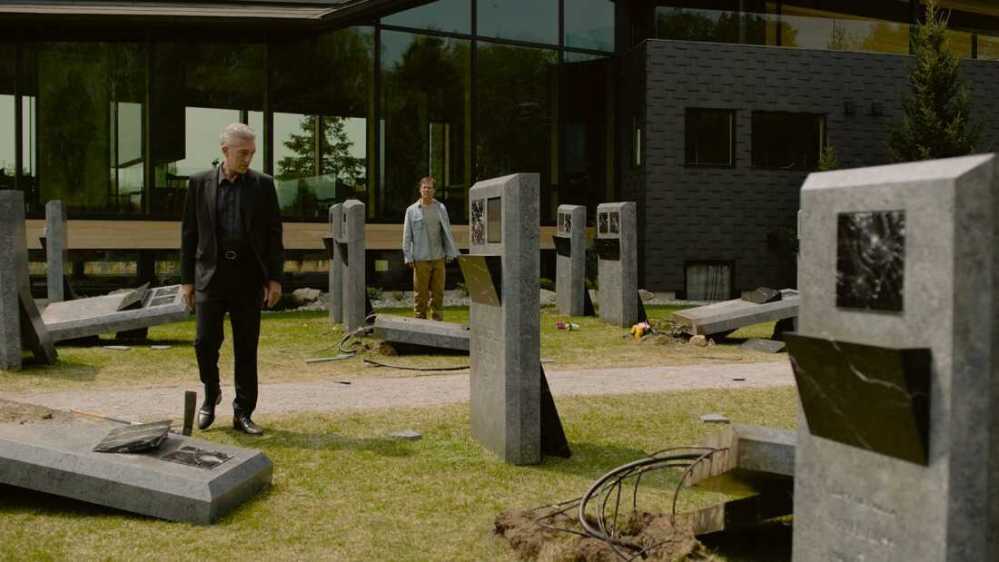
That heady mixture of eroticism, psychological distress, and physical mutilation extends to The Shrouds’ primary narrative thrust, a noir-ish mystery that finds Karsh investigating the desecration of several graves at the cemetery, hackers having encrypted the network so that the corpses are no longer viewable. At the start of the film, Karsh’s date dubs him a “corpse voyeur,” and that concept of voyeurism– a steadfast cinematic indicator of obsession– plays into many levels of the story, with characters continually diverting their focus away from reality and toward screens, and with the camera frequently centering on screens within screens, watching a person watch another person. And what do they do when that access is taken away from them? There are some intriguing ideas there (the notion that the attack may have been discriminatory in nature, as most of those laid to rest at GraveTech were Jewish, for one), but the conflict becomes increasingly convoluted, rather silly, and ultimately irrelevant. That, too, is by design; if the film’s hard turns into a straightforward crime thriller seem less interesting or well thought out compared to its treatise on bereavement, that’s because its little more than a distraction for the characters from their despondency. For Terry, it provides a temporary rush; she gets off on conspiracy theories (and Kruger gets in some delicious line readings, her earnest portrayal of Terry’s enthusiastic paranoia standing as one of the most effective pieces of the movie). For Maury (paranoid too, but more in the schizophrenic sense), it’s an in to confronting the dissolution of his marriage. For Karsh, it’s a blip, a brief interruption in what’s become his normal routine, a conflict that permits him to take some action toward achieving a goal that may allow him to move forward with his life, granting him some purpose and sense of sense beyond his remorse.
It doesn’t really though. I get that; sadness has pressed so heavy on my head and my heart the last year that the parts of my brain that used to be devoted to creative endeavors— writing, for one— have all but ceased to function. Instead, I spend countless hours and sleepless nights rummaging through every nook and cranny of my mind, desperately searching for what went wrong, and how to fix it, like a mechanic tinkering under the hood of a car. Any sort of distracting task, however fleeting, is a welcome release. Even writing this felt like a daunting, insurmountable task when I sat down and opened my laptop. It’s not the same as what the characters in The Shrouds experience; the film is not about the loss of any loved one, but the loss of a romantic partner specifically, someone you were intimate with in both body and spirit. But the feelings the movie conjures that linger beyond any plot specificities are universal. Maybe grief isn’t something we should obsess over, or try to ignore, or attempt to solve like a puzzle. Maybe it’s something we should hold in tandem with the rest of our existence. Maybe I will keep writing, and maybe as time marches on it will become easier again. Maybe I will even enjoy it again.
The Shrouds is now playing in theaters. Runtime: 119 minutes. Rated R.

 Katie at the Movies