I’ve done this song and dance before. I could be lazy and simply refer you to my review of Disney’s 2023 live-action update of their 1989 animated classic The Little Mermaid in lieu of writing an entirely new piece on the studio’s remake of their original princess picture, Snow White and the Seven Dwarfs, as they share a lot of the same issues, ranging from hideous visual effects to misguided reimaginings of their protagonists’ motivations and desires. But Snow White contains some uniquely hellish layers that make the film, while not particularly worth watching, at least worth discussing.
Really, it’s impossible to overstate the importance of Snow White and the Seven Dwarfs not only to the history of the Walt Disney Studios, but to film history at large. The 1937 film, inspired by the 1812 Brothers Grimm fairy tale, was the first feature length animated movie released in the United States (many of Disney and the film’s technical achievements have since been reassessed and reattributed to international filmmakers who pioneered them first, like German silhouette animator Lotte Reiniger, but I digress). Director Marc Webb and screenwriter Erin Cressida Wilson’s update expands on the simple (but effective) original, in which Snow White, a princess who dreams that a prince will someday arrive to whisk her away from living under the thumb of her cruel stepmother, the Evil Queen, who tries to rid herself of the one obstacle to her owning the title of the “fairest one of all.” Snow White opens with a prologue that establishes her upbringing: born during a heavy snowstorm (thus granting her her name), her parents, the king and queen, taught her kindness, and the importance of passing it on to others. But after the queen fell ill and died, the king fell under the spell of a gorgeous, mysterious woman (Gal Gadot), who he married before embarking on a military campaign across the country, never to be seen again. As the years pass, the Evil Queen oppresses the kingdom with high taxes and unnecessary military conscriptions, obsessed only with ensuring that the Magic Mirror will never reveal to her that Snow White is fairer than she, while Snow White (Rachel Zegler; Emilia Faucher plays her as a child) remains trapped behind the castle walls working as a scullery maid, dreaming of the day that she can break free and help her people.
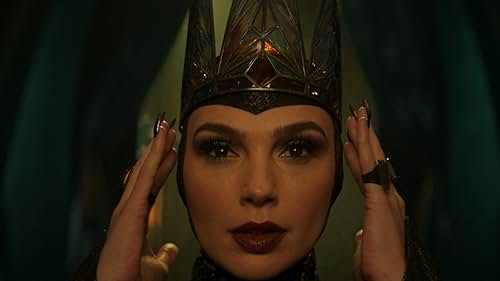
Like many of Disney’s live-action remakes of their animated classics, Snow White awkwardly wavers between retaining the greatest hits of the original while shaking up tropes that can now be viewed as dated or anti-feminist. If I can say one thing in favor of this new Snow White, it’s that it doesn’t create a lot of unnecessarily convoluted plot points in working overtime to ensure that it doesn’t appear like the princess is chasing after the prince, nor does it lose sight of its heroine’s core values, the way that The Little Mermaid did. Where Ariel is buoyed first and foremost by her curiosity about the human world, not her desire for a man, Snow White is propelled by acts of kindness. This is evident in the manner in which she confronts the Huntsman sent by the Evil Queen to kill her (sincere curiosity and concern, as opposed to fear), her treatment of the seven dwarves she befriends after she flees into the forest (exhibiting empathy toward Dopey when witnessing how he is teased by the others, while being undeterred by someone like Grumpy, who initially rebukes her graciousness), and in how scores of adorable animals naturally flock to her. Rather than mangling that key trait, this new Snow White enhances it by making the story less contained, blowing it up to encompass her empathy for her suffering subjects which in turn spurs her to fight back against the Evil Queen’s tyranny. Like Halle Bailey before her, Zegler’s performance goes a long way toward, if not completely compensating for, at least partially obscuring, some of the film’s shortcomings, while highlighting her character’s strengths. Snow White’s personality is a bit zestier than is traditional, but her expressions are open and bright, her wide eyes able to convey optimism or sympathy or sadness at the drop of a hat, her voice cheerful and clear It’s about as opposite of Gadot’s performance as one can get; hers, with her horrendously autotuned singing voice, utterly lacks conviction, all sly smiles and one-note line readings that neither illustrate her villainy, nor serve as camp.
Still, it remains odd that Disney on the whole appears hell-bent on publicly distancing themselves from the pillars that the studio was built upon, while continuing to profit off of them behind-the-scenes. This have-it-both-ways-ness manifests itself across all the industries the company has its fingers in; perhaps the most potent example regards the studio’s 1946 live-action/animated feature film hybrid Song of the South, whose racist slant has led to the studio never officially releasing it on home video, while Disney theme parks, up until the last few years, merchandised the movie’s critter characters and centered them in one of the park’s most popular attractions, Splash Mountain, while ignoring the story’s thornier aspects. As the first Disney princess, Snow White has the most minimal characterization, her desire for a prince frequently criticized over the years for presumably being her sole character trait. Snow White doesn’t entirely eschew romance— Prince Charming is replaced with the leader of a well-intentioned band of rebels named Jonathan (Andrew Burnap, struggling to conjure significant leading man charisma), who pushes Snow White to take action herself, while their relationship evolves from reluctant cooperation to love and respect with more nuance than the all-consuming love at first sight from the original tale— but it often feels like it’s trying too hard to push a female empowerment narrative that lacks the substantial thoughtfulness or political fire to back it up. Snow White eliminates a couple of the animated movie’s most iconic songs that run against this messaging, namely “I’m Wishing” and “Some Day My Prince Will Come” (the latter’s instrumentals only are used as a musical motif), replacing them with forgettably poppy new tunes by Benj Pasek and Justin Paul. Snow White’s original “I want” song “I’m Wishing” is now “Waiting on a Wish,” in which rather than the passive wishing for “the one I love to find me,” she actively ponders taking action, wondering, “Will she rise, or bow her head? Will she lead, or just be led?” Far more egregious is a later duet between Jonathan and Snow White titled— in what surely must be an intentionally meta move— “Princess Problems.”In this song, Jonathan accuses Snow White of ignorance borne of her privileged position:
“Times are lookin’ bleak, so, Princess, take a peek
See, every day, it’s sink or swim
Famine’s on the rise, with vultures circling the skies
And prospects, well, they’re rather grim
Let me break you the news, the odds can’t be beaten
And a man’s gotta choose, will he eat or get eaten?
Does that dampen your day? Do the facts make you frown?
Wakin’ up to the real world is bringin’ you down?
Well, that sounds an awful lot like princess problеms
Finally learnin’ that life’s not fair
Seems to me you got somе princess problems
Ain’t it crummy when folks won’t share?
I could try bein’ kind or whatever you said
It’s just that I’m partial to not bein’ dead
So I’m stickin’ to my plan of grabbin’ all I can
Intead of livin’ in a fantasy
See, your princess problems don’t apply to me”
Even in the context of the film, these lyrics don’t quite jive (even Jonathan, on his initial meeting with Snow White on the castle grounds, when she catches him stealing food to bring back to the poor, ought to see that she is neither ignorant of what is happening around her, nor privileged), but like The Little Mermaid and Aladdin and many of the live-action Disney remakes before this, they convey a fundamental misunderstanding of these women, and the fact that they have always been empowered. They are loving and kind and intelligent and concerned for the world. They don’t need to lead a literal uprising to prove that. And will Disney, while in the middle of dismantling the core principles of some of its most popular and enduring content, continue to profit off of tie-in merchandise ranging from dolls to popcorn buckets to costumes targeted at princess fans young and old? Absolutely.

While spending so much time reworking these so-called princess problems, Snow White offensively renders its dwarf characters as CGI abominations intended to look like real-life iterations of their animated counterparts, effectively creating entities more frightening than any of the creatures in the scary woods, while swerving away from what would actually be a modern update worth having: casting real dwarf actors to play these roles. The backlit sets, hazy visuals, and cartoonish non-human characters place Snow White in a perpetual uncanny valley, where everything is not quite grounded enough to feel real, nor quite fanciful enough to exist as fantasy. The production and costume design is just as confused, with no unifying aesthetic (this take on Snow White’s famous blue and yellow dress is both fresh and classic, but everything else? It’s giving Ren-faire). Its homages to the original film are clumsy; when the dwarves sing “Heigh-Ho” while traveling through the mine where they work, the scene plays more as an advertisement for the mine train rollercoaster at Walt Disney World. With a budget of over $240 million, Snow White is one of the most expensive movies ever made, but it has nothing to show for it. 1937’s Snow White and the Seven Dwarves was ground-breaking. 2025’s Snow White may be worse than bad— it’s bland, and confused about what it wants to be. It coasts on the notion that audiences’ existing feelings for these characters and stories will be enough to compensate for the fact that there’s next to nothing to grab on to here. This won’t be the last time this discussion is had— the trailer for Disney’s upcoming live-action remake of Lilo & Stitch played before Snow White— but it’s the first time I’ve felt the weariness and frustration with one of these projects (just look at the poor box office returns, and the numerous off-screen controversies) extend so far beyond myself.
Snow White is now playing in theaters. Runtime: 109 minutes. Rated PG.

 Katie at the Movies