It wasn’t until a little over three years ago that I saw Out of Sight for the first time, at a rep screening at a local cinema running a Steven Soderbergh series. I remember walking out of the theater into the chilly night air, dazzled by what I’d just seen. Soderbergh’s 1998 crime flick may be less than 30 years old and starring actors who still have steady careers today, but it felt like something out of another time, namely in the sparring (both of the verbal and physical variety) between George Clooney’s bank robber and Jennifer Lopez’s marshal, which from the moment they first meet scrunched together in the trunk of a car vacillates between light, flirty banter and serious, lusty gazes. Soderbergh’s Black Bag is a very different movie— it’s leaner, concerned with a small group of spies supposedly working on the same team, as opposed to multiple criminal factions and law enforcement maneuvering around each other— but walking out of the theater, I got that same feeling.
Much of that has to do with how Soderbergh and screenwriter David Koepp (this is his third collaboration with the director, following the solid Kimi and Presence, released just under two months ago) lean into the star power of Michael Fassbender and Cate Blanchett, who play married British intelligence officers. But where most spy movies with a similar premise amble toward duplicity, Soderbergh and Koepp swerve toward devotion and desire. “I can feel you watching me,” Blanchett’s Kathryn says to Fassbender’s George in their first scene together, as she dresses for dinner in their bedroom. “I like it.” In two seconds, the filmmakers effectively set up two things: the voyeuristic lens that is intrinsic to this genre, and the seductive interplay between the two leads.

These seductive games carry over into their dinner, a party the pair are throwing for two other couples/colleagues: satellite imagery specialist Clarissa (Marisa Abela) and her agent boyfriend Freddie (Tom Burke), and psychiatrist Zoe (Naomi’s Harris) and her agent boyfriend James (Regé-Jean Page). George doesn’t fully reveal to Kathryn his plan for the dinner— his superior officer just gave him a list of potential suspects who may have leaked a top secret software program called Severus, and his four guests and his wife are on it— but she’s clearly done this dance before. The black bag of the title, after all, doesn’t refer to a literal object, but the phrase the couple says to each other any time their conversation veers into classified work territory. Needing to investigate his wife, however, pushes George to cross those boundaries they’ve established.
What exactly Severus is and what the stakes are aren’t something that Soderbergh and Koepp complicate Black Bag with— it’s a classic MacGuffin. What they are interested in, rather, is all laid out in that initial extended dinner scene: the relationships between these people, and at what point loyalties to your job, to your partner, and to yourself become crossed. The dialogue is whip-smart and frequently fiercely funny; the filmmakers both acknowledge and accentuate the absurdity of the reality these people live in, where a handgun is an everyday accessory and one of your best friends may issue you a polygraph test or lightly poison your dinner.
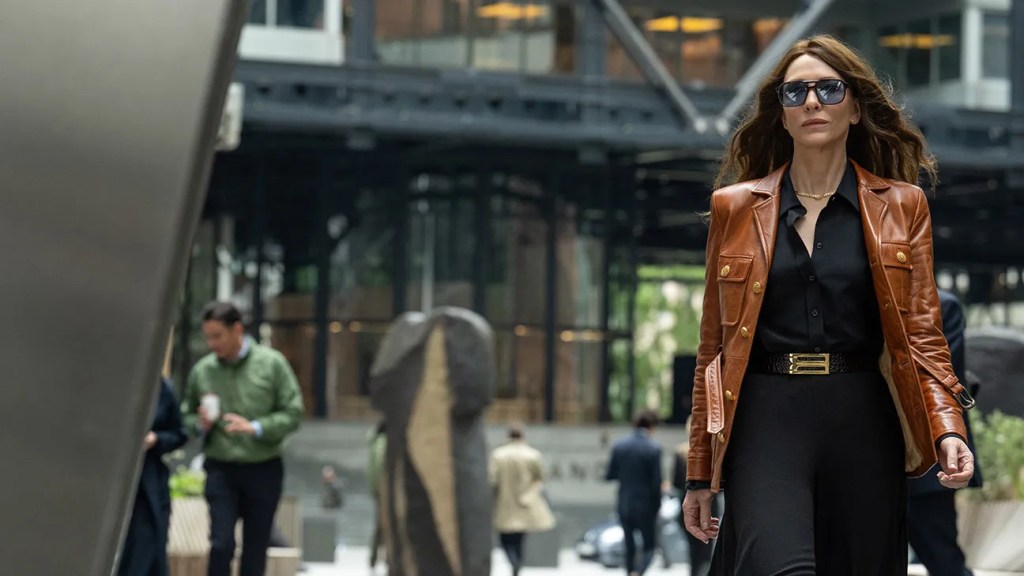
Even when Black Bag is just two people talking in a room— which is, frankly, the bulk of the film— it’s tightly edited and beautifully shot (the opening tracking shot of George moving from nightclub to city street, and the pensive tension implicit in the scenes where he goes fishing) and designed (the interiors and wardrobes, Kathryn’s in particular, are uber chic). Every performance is perfectly calibrated, whether it’s Blanchett and Fassbender’s icy coolness (which flips to scorching any time they’re together), or Abela’s unpredictability that makes her surprisingly the most fun character to track throughout the movie. Black Bag never beats us over the head with its meta-ness (even with the casting of former Bond Pierce Brosnan as Kathryn’s shifty boss Stieglitz), and yet, it makes us keenly aware of the pleasure we’re deriving from watching people watch each other, waiting with bated breath for the glance or gesture or shift in expression that will give someone away, or clue us in to their next move. But it’s when this messy, juicy tangle of relationships culminates in Kathryn’s final denouement that really took my breath away. This isn’t a spy movie about betrayal, but about loyalty, and even though the film doesn’t exactly depict explicit physical intimacy, it revels in the horniness of a look, or a scintillating line reading. I’m admittedly a fan of the genre playfulness of this stage of Soderbergh’s career, but Black Bag is an exercise that gets away with existing both as a throwback and its own fresh new thing.
Black Bag is now playing in theaters. Runtime: 93 minutes. Rated R.

 Katie at the Movies