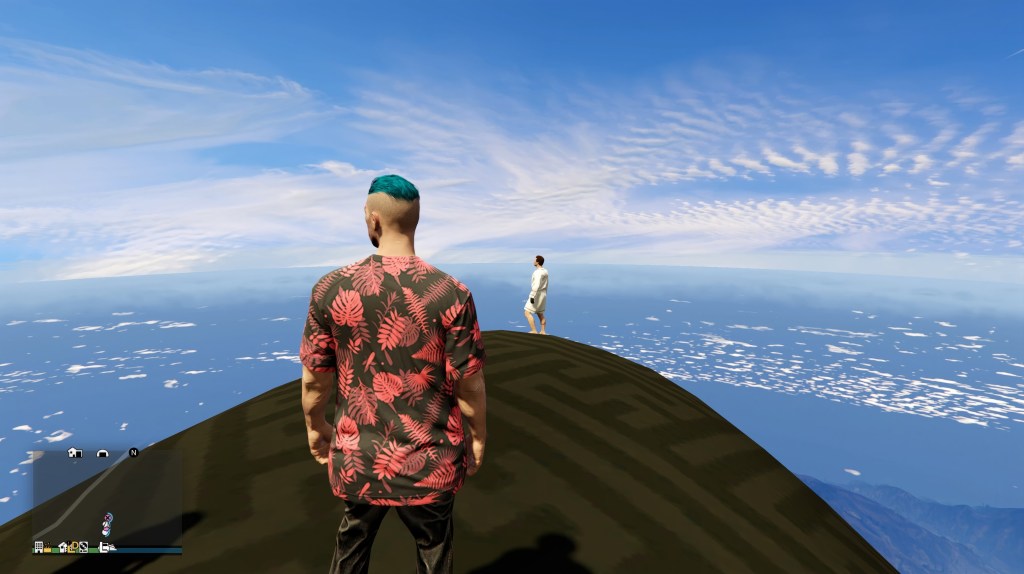
To game, perchance to dream. During the United Kingdom’s third COVID-19 related lockdown in 2021, Sam Crane and Mark Oosterveen— London-based actors unable to find work while their industry remained at a standstill— found a way to merge two seemingly disparate interests: Shakespeare, and Grand Theft Auto. The latter— an online open world video game known for its ultra-violent tendencies— became more than just an entertaining diversion during the pandemic, but a safe space for not only Sam and Mark, but people around the world, to “meet up” when they were unable to do so in person. It’s when their avatars stumble upon an open-air amphitheater within the game that they get the idea that this could be harnessed as an outlet for their stifled creativity. They could mount a production of Shakespeare’s Hamlet entirely inside the world of Grand Theft Auto Online.

Grand Theft Hamlet is directed by Crane and Pinny Grylls, Crane’s partner and a documentary filmmaker who eventually joins the game herself to shoot footage of the guys as they go through every step of the process of mounting a play: getting the word out, holding auditions, scouting locations, having rehearsals. The collision of what’s now considered high art with a game in which a random teenager could run up and shoot you dead at any moment is initially the main draw of the film’s premise. Humor emerges organically from the scenario’s sheer absurdity, and the game’s limitations: when a character dies in the game, they frequently respawn in an entirely different location, prompting Sam and Mark to beg other players approaching them not to shoot them while they’re reciting a soliloquy. Of course, that’s easier said than done when the name of the game is carnage, fantasy violence an indulgence not permitted in the real world and a cathartic outlet for all those pent-up emotions: in-game cops crash their rehearsals, and what few seemingly interested players they encounter often disappear without a trace.
But while, as Sam and Mark mention, the Venn diagram of those individuals interested in theater and video games is likely small, they do, after much trial and error, find a community, consisting of other professional actors struggling to find work (such as Diplo, whose outside career throws a wrench in the virtual production’s plans), people who have always wanted to act but never had the chance, and those who know nothing about Shakespeare or theater, but latch on to what the duo are trying to accomplish, becoming sort of de facto stage managers and body guards— like ParTeb, a user dressed as an alien who happens upon the scene and just sort of hangs around (and who hilariously reads from the Quran for his audition). It’s there that the film finds its heart, even though the adherence to shooting the film in-game only keeps it quite insular (the full scope of their production’s reach doesn’t really become clear until the final scene, and without some outside research). Grylls, however, makes stellar use of Machinima and the game’s cinematic capabilities to showcase the environment’s rich sense of place: shots of sweeping vistas and city streets are enhanced by Jamie Perera’s score and sound design, while close-ups on the rugged faces of players and NPCs (non-playable characters whose stray lines of dialogue that have absolutely nothing to do with Hamlet drift in and out of scenes) lend the filmmaking an observational, pensive quality that may not seem like it matches the free-wheeling nature of what Sam and Mark are trying to accomplish, yet lend the movie some much-needed texture (especially for those viewers who may be averse to the idea of essentially watching people play a video game for 90 minutes).
It’s when real life bleeds into the world of Grand Theft Auto that Grand Theft Hamlet’s offbeat charm starts to fade. The emotional drama, whether it’s Mark lamenting about how especially difficult lockdown has been for him as he is single with no children or other family, or Pinny berating Sam for spending so much time in the game that he’s forgetting birthdays and neglecting their children, reads as not only overly manufactured, but quite smug. Not to discount the very real problems and fears that the filmmakers faced, same as everyone all over the world, but beyond the initial set-up of the film taking place during the pandemic, these scripted moments— which are clumsily shoehorned into the narrative— aren’t even really necessary. The movie stands on its own quite nicely otherwise as an inspiring tribute to the enduring artistic spirit, the powerful kinship of online communities, and how different art is always in constant conversation with each other, even across hundreds of years. Shakespeare may be considered highbrow now (it doesn’t help that the theater industry at large isn’t often financially or physically accessible to the vast majority of audiences), but in the writer’s time, his plays were populist, performed to the low-class masses in dirty, dingy spaces, where viewers would frequently interrupt the production with heckling and acts of violence. In that respect, Grand Theft Auto is less a questionable space to mount such a play, and more a return to its roots. Against all odds, Hamlet delivering his dying soliloquy to a crowd of thugs while an alien thrusts in the far background becomes strangely poetic. To quote the show’s producers, and reiterate the film’s thesis statement, “You can’t stop ART, motherfuckers.”
Grand Theft Hamlet is now playing in theaters, and will be available to stream on Mubi on February 21. Runtime: 90 minutes. Rated R.

 Katie at the Movies