You can’t fully know Bob Dylan. Thats’s something that Todd Haynes understood when he made I’m Not There, his radical 2007 biopic that crafts an image of the legendarily enigmatic musician’s life in fragments portrayed by six different actors, ranging from a young Black boy to Cate Blanchett. Perhaps that’s also something that director James Mangold understands with his take on a segment of Dylan’s life and career, A Complete Unknown, the title derived from a line from Dylan’s song “Like a Rolling Stone,” off his Highway 61 Revisited album that serves as the crux of the film. The difference between the two is that I’m Not There makes a concerted effort to piece the fragments together, catching meaningful glimpses even while gazing through a prism, while A Complete Unknown doesn’t try, remaining content to view its subject from the outside in. The result is a frustratingly shallow exercise made all the more disappointing but its occasional glances at something really electric.
Based on Elijah Wald’s 2015 book Dylan Goes Electric! which zeroes in on the controversy over the folk singer’s adoption of electric instruments, A Complete Unknown focuses on the four years between Dylan’s initial arrival in New York from Minnesota in 1961 to his concert at the 1965 Newport Film Festival, just a couple months prior to the release of Highway 61 Revisited. Timothée Chalamet plays the mop-haired and mumbly young man, who hitches a ride into town and immediately looks up his idol Woody Guthrie (Scoot McNairy) in the New Jersey hospital where he’s staying, unable to speak or move due to increasingly debilitating Huntington’s disease, hoping to “catch a spark.” Also present when Dylan arrives is folk singer and activist Pete Seeger (Edward Norton); it’s one of the many conveniences that comprise this by-the-numbers biopic. They request that the young Dylan, who turned up with guitar in hand, play something for them, so he performs a song he wrote for Guthrie. It’s so clear that he already possesses that spark that Seeger brings the drifter home with him, and his subsequent rise to fame from nightclubs to a record deal to huge concert tours unspools with all the precision and predictability of a fairy tale.
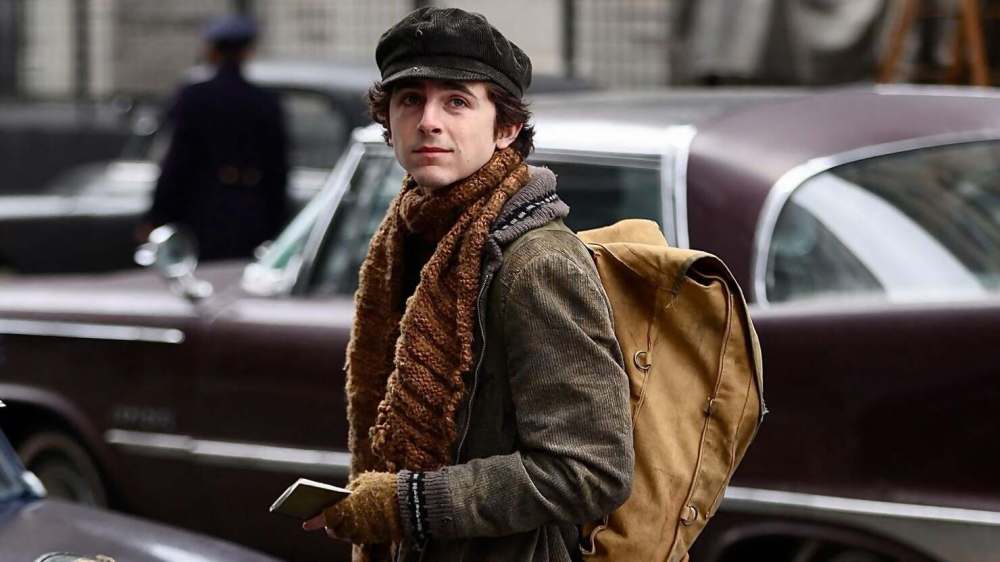
Director James Mangold returns to the realm of music biopics nearly 20 years after helming Walk the Line, his film about singer/songwriter Johnny Cash (who, coincidentally, makes a brief but pivotal appearance in this film) that virtually set the template for the generally critically well-received crowd pleasers that would dominate the genre for the next couple decades. A Complete Unknown, at the very least, doesn’t fall into the annoyingly usual trap of committing to winking nods, in-jokes, and obvious fan service. There are references, sure, but they are more subtly engineered and emerge organically through the narrative— a stroll past Greenwich Village hotspots like Cafe Wha? and the Folklore Center that would soon become synonymous with the artist, for instance. But the narrative’s straightforwardness doesn’t jive with Dylan’s jittery, elusive persona. The story jumps between Dylan penning hit after hit and bedding woman after woman, all while confronting the usual obstacles that accompany celebrity— in this case, it’s the folk music establishment represented by Seeger pushing back against Dylan’s evolving style.
In D.A. Pennebaker’s seminal 1967 verité documentary Dont Look Back, which follows Dylan and a handful of his contemporaries on his 1965 England tour (his final to use acoustic instruments, making it a valuable companion piece to A Complete Unknown), there’s a scene where he gazes at a reporter phoning in a story following one of Dylan’s concerts. Reading from a notebook, the reporter says of Dylan, “He is not so much singing as sermonizing. His tragedy perhaps, is that the audience is preoccupied with song.” The latter half of that statement is certainly obvious as A Complete Unknown meanders toward its anticlimactic conclusion, with the crowd at the closing night of the Newport festival booing Dylan and his band and throwing things on the stage because he won’t acquiesce to their requests to play the hits. There’s something there to be said about fan entitlement, a discussion about current mainstream entertainment that is ongoing. But A Complete Unknown largely has nothing to say at all, despite veering closely to some meaning on several occasions. Dylan is too much of an enigma here (his backstory prior to the start of this film is only briefly alluded to through bits of dialogue). In Pennebaker’s film, we watch him philosophizing in interviews and trading barbs with reporters. He’s arrogant, but there’s a righteousness in the air that justifies his arrogance. In A Complete Unknown he’s mostly just, as fellow musician/love interest Joan Baez (played by Monica Barbaro) phrases it, “an asshole.” He’s devoid of any political beliefs (a scene where he has to ask the meaning behind the acronym C.O.R.E.— Congress for Racial Equality— is telling), his actions and words outside of his songs failing to reflect his counterculture anthems. He’s an entrancing personality, but there’s little behind those dark glasses.
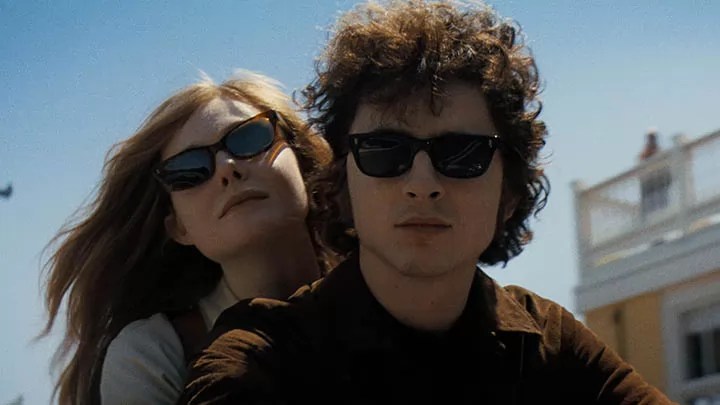
That failure is more on the script side, however. Chalamet’s performance is good, his incredible ease transcending any sense that he’s just doing an imitation. Norton is good too, his face always so open and vulnerable. In fact, the whole cast is quite capable and play off each other easily, but the women really get the short shrift. Even as the story is engineered to show how Dylan viewed women as disposable, they largely serve that same purpose within the film itself. Elle Fanning plays Sylvie Russo, Dylan’s other major romance at the time (she’s a version of Suze Rotolo, Dylan’s girlfriend whose real name he requested not be used). Unfortunately, she never stood a chance. She, along with Barbaro’s Baez, exist in this film mainly to moon over Dylan and reflect his shallowness back at the audience. Their personalities beyond him are virtually nonexistent (even Baez, an incredibly talented artist herself).
A Complete Unknown samples many of Dylan’s songs, but there are so many that they aren’t given the space to breathe, or their lyrics to land. At the very least, the film made me realize that I didn’t own Highway 61 Revisited (I went out to a local record store and purchased it on vinyl the day after seeing the movie). Like most music biopics, it serves at least a small purpose: introducing artists and their work to new fans, while scratching an itch for existing ones. But for a figure as groundbreaking as Dylan, it’s far too routine and incomplete a portrait to relay not only the full extent of his cultural impact, but what makes him tick. There’s a scene in A Complete Unknown right after Dylan meets Sylvie at a church gig he’s playing, where the pair, having hit it off, head out on the town and wander into a matinee of the 1940 melodrama Now, Voyager, in which Bette Davis plays a homely woman whose sense of self-worth grows after undergoing a glamorous makeover. After the film, the two have a lively debate about it, in which Dylan objects to Sylvie’s claim that Davis went off to “find herself.” “She just made herself into something different,” Dylan says. “Something better,” Sylvie adds. No, Dylan insists. “Different.” This conversation is about as close as A Complete Unknown gets to engaging with Dylan’s ever-shifting nature and tearing down the myth. This film may be handsomely mounted, but rather than demystifying its subject, its obvious sense of self-importance only serves to deitify him further.
A Complete Unknown opens in theaters on December 25. Runtime: 141 minutes. Rated R.

 Katie at the Movies