You likely won’t walk out of Anirban Dutta and Anupama Srinivasan’s Nocturnes with a lot of newfound facts and figures about moths knocking about in your brain. What their film accomplishes, however, is much more impressive than many nature documentaries: an inherent love for and understanding of the need to protect these creatures, achieved not through lectures but through images and sound. Set in an Eastern Himalayan forest, Nocturnes follows Mansi, an ecologist, and her assistant Bicki, a member of India’s indigenous Bugun tribe providing temporary aid, as they spend their nights mounting a cloth screen that they then illuminate with lights in the otherwise pitch blackness. What this seemingly simple act reveals is a world entirely foreign to most humans, as a mind-boggling variety of moths flock to and land on the grid-marked cloth, allowing Mansi to photograph and measure them as they rest.
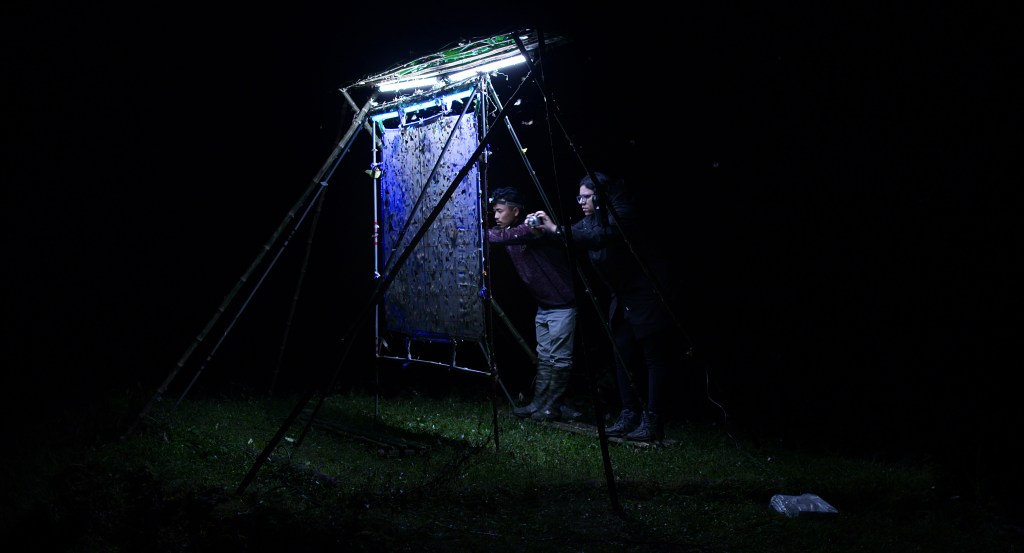
Nocturnes establishes its mediative tone before we even see anything on screen; the pleasant chirruping of nocturnal insects and fluttering of wings that comprises the film’s richly immersive sound design overwhelms the senses, and is about as soothing as your favorite white noise playlist. That the directors introduce the audience to these creatures before the human players speaks volumes to their priorities. Not that Mansi and Bicki are cyphers, exactly, but they do fill the standard teacher/student roles here. When the action briefly moves from outside in, we’re filled in on the nature of their mission, even as the computer screen populated with the photos taken of the moths that Mansi gestures to keeps the insects as the primary focus in the frame. The pair set up the screen at different elevations, their work restricted to the 10 nights around the new moon when the attraction of their light competes with that of the sky. By looking at the grid, and zeroing in on one species of moth in particular (hawk moths), they can study whether or not their body size changes with temperature, and in turn predict what will happen to the moths if temperatures in the region continue to rise. Will the moths migrate to a higher altitude, or will they go extinct? Nocturnes may narrow its focus exclusively to moths, but it widens its lens to encompass the broader ramifications of climate change, particularly in its deeply sobering conclusion as Mansi details the findings of their study. If the temperature rises and the moths move to a higher altitude, will the birds that feed on the moths follow them? And will the reptiles that feed on the birds that feed on the moths follow them? What will happen when they all reach the top of the mountain and can go no further?

It isn’t the job of Nocturnes to answer these questions, but rather to bring them to the forefront of the audience’s consciousness. That may make the film occasionally seem less than substantive, but it accomplishes that goal spectacularly through photography that captures a tangible sense of place. The long takes of lush green forests captured during the day alternate with blue-tinged night photography (this is slow cinema at its finest; think the Frederick Wiseman of moth docs), extreme close-ups of the insects granting us an intimate view of their unique beauty while placing them on a scale akin to humans. Dialogue is few and far between, but what we get conveys both thoughtfulness and an uncertainty that’s in line with the film’s core themes. A simple conversation Mansi and Bicki have toward the end of the film about what they might do after they’ve completed this job (for Bicki, farming season in the region is already over) has stuck in my mind long after I watched the movie. Anxiety about the future both on a personal and global scale dominates my thoughts daily; to see the two leveled on an equal playing field throughout Nocturnes made for a uniquely moving experience. That, and the staggering realization that there are so many tiny, gorgeous creatures populating a nocturnal universe that so few of us are privy to. They deserve our affection and protection too— even if we don’t see them.
Nocturnes screens locally in St. Louis at the Webster University Film Series December 13-15, and at the Arkadin Cinema and Bar on January 11. Runtime: 82 minutes.

 Katie at the Movies