A red door, whose eventual closure will mark a turning point in the lives and relationship between Martha (Tilda Swinton) and Ingrid (Julianne Moore), is just one of many simple yet strong visual markers placed throughout director Pedro Almodóvar’s The Room Next Door. Martha is dying of cancer and— unwilling to spend the rest of her days slowly wasting away under the pressure of miserable treatments— obtains a euthanasia pill on the dark web (the rare clumsy convenience in an otherwise eloquently-rendered meditation on mortality and grief). She rents a sprawling home in the woods in upstate New York for a month, intending to take the pill one day over that time span, and asks Ingrid— arming her with deniability for when the cops inevitably come calling— to stay with her until then. Martha is staying in the bedroom behind that red door (Ingrid is supposed to stay in the room next to hers, but opts for one downstairs, purportedly because it is bigger, but more likely because it isn’t so close), and tells Ingrid that she will leave it open at all times. When she sees it is closed, that will be her signal that Martha has taken the pill. You would think, based on this description of events, that Martha and Ingrid have been close friends for many years, but in fact, that couldn’t be farther from the case. The latter, a successful novelist based in New York City, discovers from a friend who attends a book signing that Martha— with whom she worked at a paper years ago— is in the hospital. It’s only then that they reconnect, and while they immediately fall into a pleasant and easy rhythm upon reconnecting, Ingrid wasn’t Martha’s first, second, or even third choice for this task. That’s just one of many wrenches that Almodóvar throws into his adaptation of Sigrid Nunez’s novel What Are You Going Through, which he also wrote as his first entirely English-language feature, a story with a bleak undercurrent which is nonetheless gentle, and even joyous.
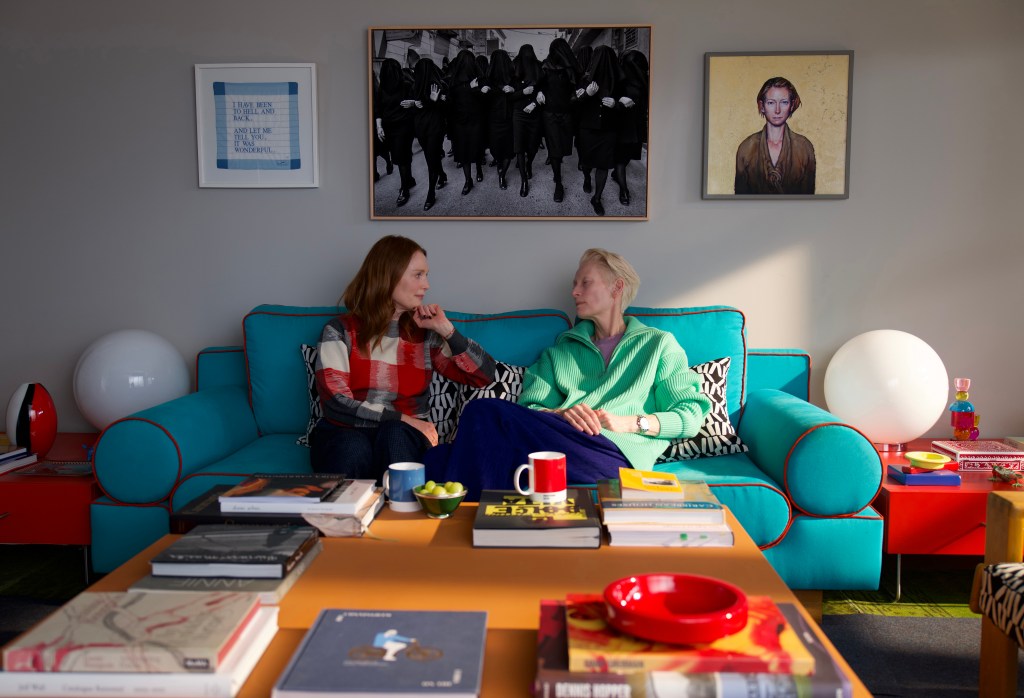
It’s a testament to the fullness of the emotions present in Almodóvar’s films that these characters, in what is essentially a two-hander, never feel too thinly sketched, despite knowing the bare minimum about them. The majority of the requisite details about each woman are deployed early, during their initial reunion in Martha’s hospital room. They’re both storytellers, so the flashback scenes via which Martha relays a couple key life events to Ingrid— the tragic love affair behind the birth of her now-estranged daughter, Michelle (Esther McGregor plays the younger Martha in these sequence), and an encounter in the Middle East during her time as a war reporter— unfurl naturally. The mere fact of the different career paths they took— Ingrid crafting fictional worlds, Martha plunging herself into the most dangerous corners of reality— reveal so much about each woman, and her approach to the situation Martha eventually finds herself in. Martha, who’s been so close to death before, is practical about calibrating every detail of her passing, while Ingrid, who says she’s scared of death (despite writing a successful novel on the very subject), nervously tiptoes around the topic, refusing to confront it head-on (the neat detail, however, that Martha wrote a fictionalized account of a colleague’s romance that has remained unpublished and unseen for years, works to bridge the gap between these two seemingly very different women). Moore and Swinton could not be better suited to crafting miraculous performances in these roles; they do so so easily that it would be simple to discount or overlook their talent. They’re both so tender with each other (in the sweet and caring ways they gaze at, speak to, and touch one another), pushing each other to make delightful acting choices, and deftly navigate the narrative’s shifts in tone, dipping from drama into humor and back with ease. Nor did what appears to be a common complaint with The Room Next Door— a stiltedness in the dialogue, possibly due to Almodóvar’s transition from Spanish to English— register with me. If their delivery is at times clipped or awkward, it’s in line with the heightened nature of the film’s melodramatic aspects, not unlike Almodóvar’s previous works.

Also not unlike Almodóvar’s previous works is the story’s centering on women in the style of Old Hollywood dramas. His mise-en-scène is more Sirkian than ever, using reflections as the frame through which his characters emote, and scenes of gently falling snow to softly mark periods of transition and renewal in their lives. Almodóvar does, at one point in The Room Next Door, employ the famous Persona shot as Ingrid lies down next to Martha, but sex doesn’t enter into their relationship. Nor do they merge into each other; rather, there’s more a passing of the baton, as Ingrid subtly changes while Martha declines. This is illustrated strongly through Almodóvar’s signature use of bold colors, specifically red and green, which feels more intentional here than ever. It’s there in the furniture (the pair of chaise lounges at the rental home), and in the sets (that red door again), but it’s particularly interesting to track the colors that dominate Ingrid’s wardrobe throughout the film. When she and Martha first meet, she is wearing mostly red, and Martha a soft green. It’s a choice that seems to follow their personalities: Ingrid brimming with strong emotions (she begins to grieve Martha before she’s even gone), Martha largely much calmer as she approaches the next stage of her existence (that she’s so in tune with the life teeming around her even as she’s dying is evident in the rows of plants crowded the terrace of her Manhattan apartment). Midway through the film, after Ingrid has reluctantly committed to helping Martha, she dons a green jacket over a red blouse, and by the end of the film, she’s almost exclusively wearing green as she fully steps into a new stage of life. The intertwined relationship between life and death, and the effect that has on people, is almost too deceptively simple a definition to describe what Almodóvar accomplishes so neatly here. There’s a scene toward the end of the movie in which Ingrid sneaks away for a lunch meeting with Damian (John Turturro), a fellow writer who had consecutive love affairs with Martha and Ingrid many years ago; Ingrid’s continued communication with him is the one secret she holds back from Martha. He’s turned into something of a doomsday lecturer, the kind of person who berates his son for wanting to bring a third child into a world that’s on the brink of utter destruction, and his conversation with Ingrid and the fiery politics therein almost seem out of step with the rest of the movie. Almost. Even as Damian defines the world’s problems in broad terms that just about every viewer can identify with (and that felt even more pressing viewing the film the week following a devastating Presidential election in the United States), the film ultimately doesn’t lean into despair. If anything, this scene serves to bolster the hopefulness of its conclusion, which still manages to make unexpected turns even as its ultimate outcome has been clear from the beginning. Never mind that the characters in this film are clearly affluent, their privilege granting them access to things not everyone has. We all have a right to live life on our on terms, rules be damned. It’s a concept that Almodóvar conveys with all the clarity and simplicity of the closing of a door.
The Room Next Door opens in theaters in New York and Los Angeles on December 20. Runtime: 107 minutes. Rated PG-13.

 Katie at the Movies