William “Wild Bill” Wellman is the greatest Hollywood filmmaker that it seems no one ever talks about in the same breath as his contempories: the Fords, the Hustons, the Hawks, the Capras. And 1945’s Story of G.I. Joe is the greatest war movie that no one seems to talk about, or remember. But Wellman— a World War I pilot who was reluctant to take on the tale of Army infantryman, believing the group despised pilots— considered it his favorite film he made.
Perhaps Story of G.I. Joe failing to serve as a boon to the box office on its release, despite widespread critical acclaim (the New York Times named it as one of the ten best movies of the year, and it received four Academy Award nominations, including the sole acting nomination for a young up-and-comer named Robert Mitchum) is why it often isn’t the first film to spring to mind when conjuring the titles of great Old Hollywood war movies like All Quiet on the Western Front or Thirty Seconds Over Tokyo, or even Wellman’s own Battleground. But it’s also an incredibly low-key film, particularly coming from an action-oriented director like Wellman, who was so known for spectacles like the aviation drama Wings (the first Best Picture Oscar winner) as well as zippy Pre-Codes like The Public Enemy and Night Nurse. It’s that swerve away from on-screen action and violence, however, that so distinguishes Story of G.I. Joe from its contemporaries, zeroing in on the personal stories of soldiers as they hang around in the trenches, dreaming of home and, in some cases, waiting to die.
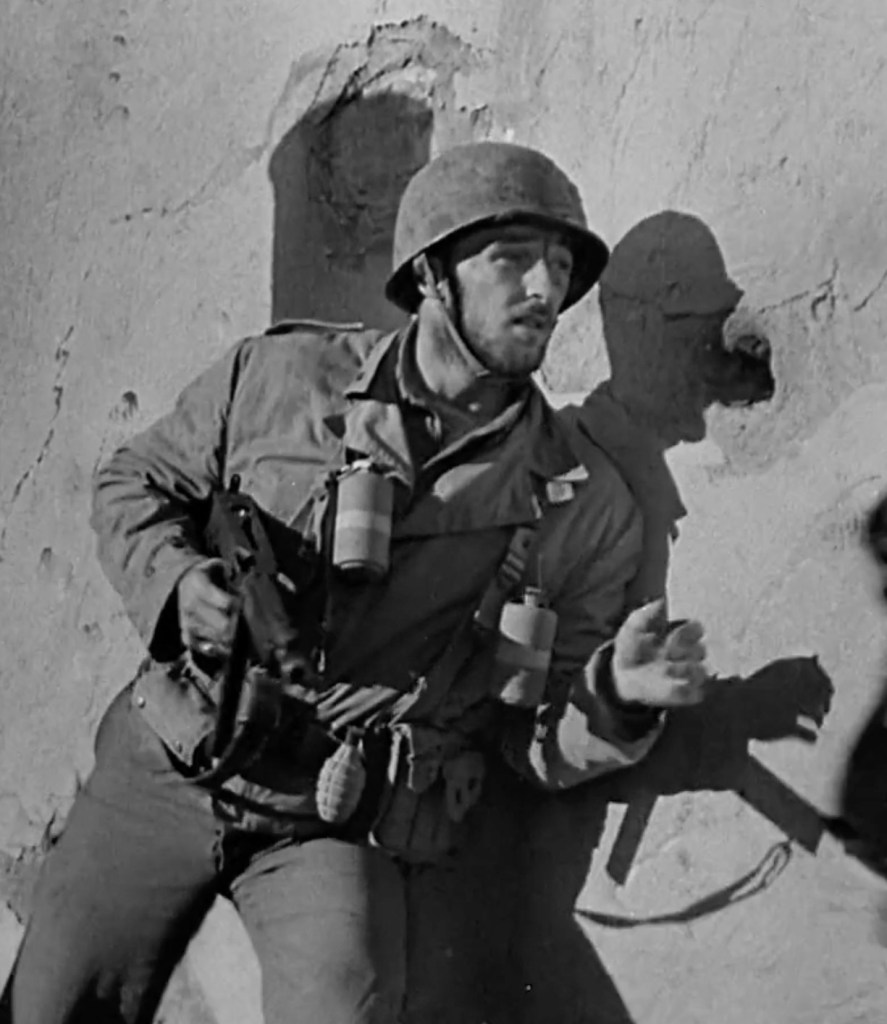
Story of G.I. Joe finds its angle in telling this story through the eyes of Ernie Pyle, the correspondent who followed soldiers into the trenches throughout World War II, documenting the war firsthand (although not specifically credited in the film, many of his writings serve as direct sources, including his 1943 book Here Is Your War and a column titled “The Death of Captain Waskow”). Pyle is portrayed by Burgess Meredith, a performer as appropriately low-key as his subject. A combat novice, the film begins with Pyle dropping in on the 18th Infantry’s Company C, led by Lieutenant Bill Walker (Mitchum) a group of rookie soldiers who quickly become hardened to the ravages of war as Pyle follows them through battles across Tunisia and Itay.
Story of G.I. Joe unfolds in an almost episodic structure, concentrating, as its broad title suggests, on the group rather than the individual (even that integral lack of a “The” in the title lets us know that this is not the story, but a story out of many). But it finds its strongest, most gut-wrenching footholds in small character beats: a wedding between a solider and a nurse (played, uncredited, by Wellman’s real-life wife, Dorothy Coonan Wellman), the ceremony interrupted by enemy fire but culminating sweetly in a makeshift bridal suite. Pyle numbly acknowledging his receipt of the Pulitzer Prize for combat reporting while still down in the trenches. Sergeant Warnicki (played by real-life middleweight champion Freddie Steele) trying in vain to find a working phonograph to play a record he received in the mail of his child uttering its first words, and breaking down when he finally gets to listen to it. The cast is uniformly excellent, as is Wellman’s spare yet efficient direction, but the craft of the film itself holds its subjects in as high regard as the script. Many war correspondents, contemporaries of the real Pyle, served as technical advisors, a couple of them even appearing on screen, while extras were filled out by a group of 150 Army soldiers who were veterans of the Italian campaign portrayed on screen, training in California during production as they prepared to ship out to the Pacific front, and lending the film a rare authenticity. Few of those soldiers, following their deployment, survived to see the finished film. And neither did Pyle, who garnered such obvious respect from soldiers that the hesitant Wellman decided to work on the film after meeting him. Pyle was killed by a sniper during the invasion of Okinawa, in the trenches with the men he had grown so close to. The visceral realism of post-Code Hollywood war movies— the likes of Saving Private Ryan or Dunkirk— have likely only prompted Story of G.I. Joe to seem quaint by comparison. But the film’s poeticism and lack of epic scope is precisely what makes it such a magnificent tribute to the courage and sacrifices of common men working together and putting their lives on the line in the name of freedom.

Story of G.I. Joe was preserved by the Academy Film Archive in 2000 and the National Film Registry in 2009, but a new enhanced 2K restoration has just been released by Ignite Films, whose work also includes restoring the film’s previously incredibly damaged original nitrate trailer. The new print is remarkably crisp, removing practically all specks and other visible bits of damage from the film evident even in the previous restoration. The Blu-ray and DVD release includes not only the film and a before-and-after of the restored trailer, but a slew of informative features, including a new interview with Wellman’s son, William Wellman Jr., a featurette about the restoration, a gallery of publicity stills and press materials, and an audio commentary historian Alan K. Rode. It’s an essential set for classic film fans and war movie buffs, and now available for purchase here.

 Katie at the Movies
Yesss, more classic movie reviews!
LikeLike
Yesss, more classic movie reviews!
LikeLiked by 1 person