As the credits rolled on the first part of Kevin Costner’s epic western series, Horizon: An American Saga— Chapter 1, I had but one thought: “I cannot believe he’s promised three more of these.”
For those who have never seen a western before, or possess only a fleeting familiarity with the genre, Horizon is serviceable. It’s handsomely mounted, with location shooting in Utah that includes sweeping shots of Monument Valley, the area director John Ford and his contemporaries transformed into an icon of American expansion with their western films made during Hollywood’s golden era. It’s boasts a deep ensemble cast of movie stars and that-guys, including Costner, Sienna Miller, Sam Worthington, Jena Malone, Danny Huston, Michael Rooker, and Luke Wilson, among others. And the breadth and variety of stories that cast is employed in acting out suggests a story that’s epic in scale and scope, excavating such topics as the pursuit of the American dream and erasure of this country’s Native peoples that is just one of the costs.

I say suggests, because there are neither very deep themes nor particularly compelling stories present in Horizon— the title referring to the name of an idyllic settlement around the San Pedro Valley—as it stands. Costner first conceived of Horizon in 1988 as a series spanning the years before, during, and after the American Civil War, and how that war affected the West. He produces, directs, stars in, and co-wrote the film as it stands, from a story conceived by him, Jon Baird, and Mark Kasdan (whose previous genre bonafides include co-writing the 1985 western Silverado with his brother Lawrence, a film which stars Costner). Not to mention all the westerns he acted in, Costner’s previous directing credits include Open Range and Dances with Wolves, for which he won Oscars for Best Picture and Best Director. In other words, his familiarity and respect for the genre requires no questioning, and it’s clear watching Horizon that he’s laboring to replicate the grandeur of classic westerns— which idealized the myth of the American West while pushing a false history that either demonized or erased people of color from the narrative— while subtly attempting to right their wrongs. These two concepts aren’t working hand-in-hand especially well, at least thus far. One of Horizon’s early sequences involves a Native American attack on the town. It’s brutal, with arrows and tomahawks being taken to women and children alike. But what begins as an unsettling adherence to early portrayals of Native Americans on screen— as faceless entities who murder white people without remorse— shifts afterward when the leader of the Apache raid, Pionsenay (Owen Crow Shoe) comes into conflict with the rest of his tribe, some of whom believe they can exist side-by-side with the white settlers in peace. These people are given faces and names and speak in their own language, and while some brief later scenes clearly call out white abuse on toward their people (there’s also a bit of time thrown toward the Chinese immigrants who moved west looking for work and their piece of the American dream), there isn’t enough thoughtfulness directed toward that subject, at least not yet.
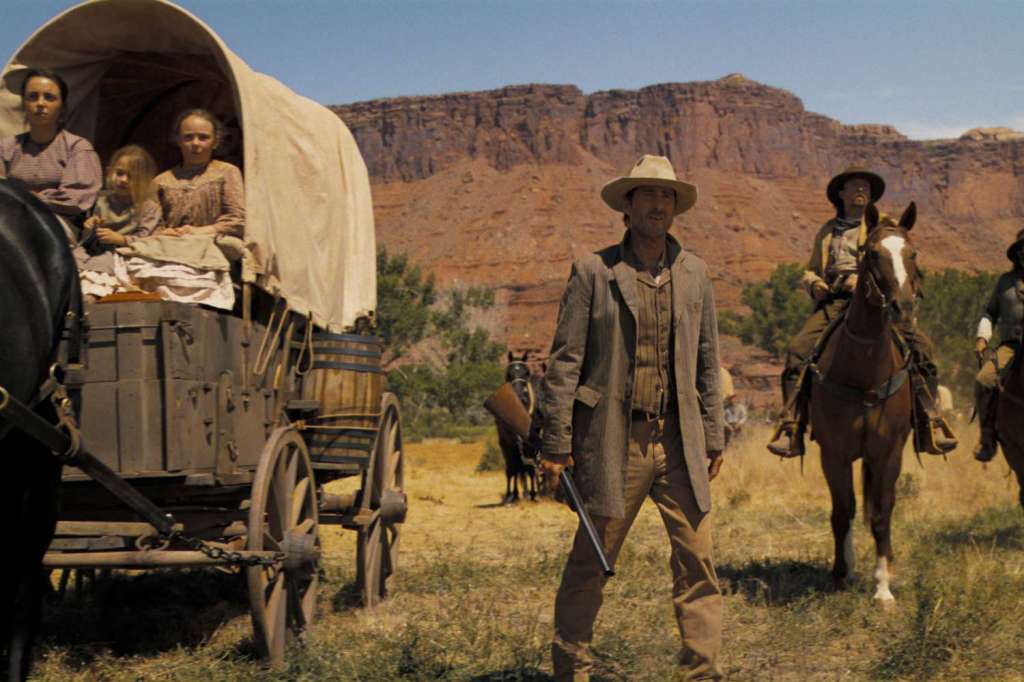
That’s because chapter one of Horizon is more concerned with setting up the narratives for its many white characters, who at this point still take precedence. Just about every western archetype is present and accounted for: Costner plays Hayes Ellison, a noble horse trader who gets involved with Marigold (Abbey Lee), a whore with a heart of gold. Romance blooms between a beautiful widow, Frances (Miller) and an Army Lieutenant (Worthington), who clashes with his superiors over his refusal to interfere with Indian land, versus their belief in manifest destiny. Matthew (Wilson) leads a wagon train going West, and Lucy (Malone) flees a terrible situation with her infant son. Some of these stories lightly intersect, but for the most part, they remain separate for the bulk of Horizon’s three hour runtime, none of them resolving or at least reaching a climatic stopping place before chapter one peters out, its non-ending rolling right into a lengthy montage of scenes teasing what looks to be a much more action-packed and compelling chapter two. I’m hesitant to pass too harsh a judgement on Horizon as it stands; it’s so clearly just a piece of what’s to come, but it’s also difficult to hop on board of three hours of set-up that jumps around so many different characters and stories it quickly becomes hard to track them all, not to mention become invested in any of them. The lack of sincerity in the sentimental tone the film occasionally lurches toward— like an overwrought farewell to young soldiers leaving the settlement to go fight— causes Horizon to be not only hard to take seriously, but read as borderline laughable (that’s not to mention the occasional attempt at actual humor, the caricatured performances of some of the cast, and an awkward sex scene that Costner’s Hayes literally sleeps through). As one of the leads, Costner’s performance is particularly too reserved to suss out what his character’s deal is; it’s hard not to compare him to the Henry Fondas, James Stewarts, and occasionally John Waynes, western protagonists who get involved in situations that prompt them to experience some sort of moral reckoning. But despite not making a particularly great case for why any of this merits a cumulative 12 hour, four film saga, it’s so extremely one piece of a great whole that it’s hard not to feel the need to see this thing out (chapter two is already completed and will be released in theaters next month, while chapter three is currently in principal photography). Maybe that’s just me being a completionist. But maybe I’m still rooting for Costner— whose personal investment in this series also includes sinking over $30 million of his own money into its production— to pull this off. I just wish his vision was clearer beyond merely crafting an aesthetic.
Horizon: An American Saga— Chapter 1 is now playing in theaters. Runtime: 181 minutes. Rated R.

 Katie at the Movies