When we meet Harry Belafonte at the start of Following Harry— Susanne Rostock’s documentary culled from footage from the final 12 years of his life— he’s well into his 80s, and wearing a gray hoodie emblazoned with the name “Trayvon.” It’s an image that Rostock doesn’t linger on, but it’s nevertheless striking: that this man, whose civil rights activism stretched all the way back to his close involvement with Dr. Martin Luther King Jr. in the 1950s and 60s (including participating as one of the organizers of the 1963 March on Washington) is still in the trenches, advocating for equal rights for Black Americans on the heels of the racial reckoning spurred on by the 2012 murder of the 17-year-old Black boy.
Most know Belafonte— who passed away in 2023 at the age of 96— for his barrier-breaking entertainment career. As a singer, he popularized calypso music on the international stage, and as one of Hollywood’s only Black leading men at a time when the studio system and its traditional (and often narrow) values were beginning to collapse, he helmed such racially-charged dramas as 1954’s Carmen Jones and 1959’s Odds Against Tomorrow. Following Harry occasionally alludes to this side of Belafonte’s career— for those unfamiliar with his biography, it may render it too slight— but the film otherwise wholeheartedly concentrates on his extensive political and humanitarian activism. Following Harry unfolds in a sort of segmented structure, with concentrating on the organization of protests and demonstrations following some key incidents in America over the last decade: Martin’s murder in Florida, Michael Brown’s murder in Ferguson, Missouri in 2014, the 2017 Women’s March in Washington, D.C. that coincided with the inauguration of President Donald Trump, and the cries for gun control following the deadly 2018 school shooting in Parkland, Florida.
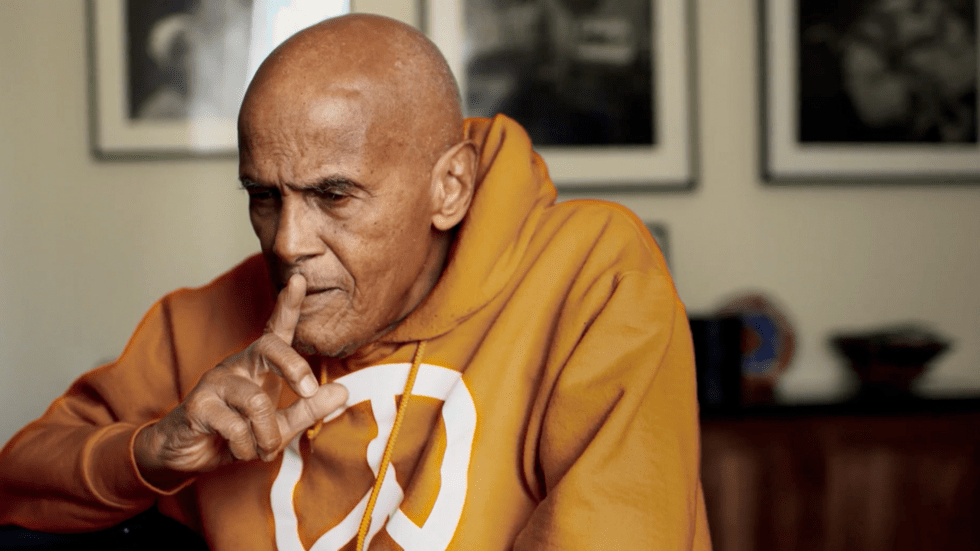
Throughout, Belafonte often serves a reactive role, gently guiding a new generation of activists with his wisdom and experience. Occasionally, his wide-ranging connections come to the rescue (it’s hard not to chuckle at his ability to pick up the phone and casually say that he needs to first speak to Lady Gaga, then Alicia Keys, when looking for big-name talent to lend their voice to the Women’s March), but for the most part, he’s hearing their concerns and pointing them in the right direction. This way, we get to know the individual activists— who all affectionately refer to Belafonte as “Mr. B”— and their goals just as well. Some recognizable faces pop up toward the beginning of the film, including Jamie Foxx and Rosario Dawson, who discuss how Belafonte inspired them to harness their celebrity to make meaningful changes. But Following Harry soon steers toward concentrating more everyday people working hard in their communities, like Carmen Perez, the co-chair of the 2017 Women’s March on Washington, who fielded threats and controversy while trying to mount what was at the time the largest single-day protest in history.
Perhaps some viewers coming to Following Harry will be frustrated by how little the film is actually about him (although there’s an introspective interlude in which he pays a visit to his old friend Robert F. Kennedy’s daughter Kerry, and a moving final scene puts a nice bow on his involvement and beliefs). In reality, the movie is less about following Belafonte, and more about those who follow his lead, less about regurgitating information about well-known recent events (although there is a little of that in the process) and more about the hard work put in behind the scenes to create real systemic change— in other words, exactly the sort of film he would have been proud to see.
Following Harry had its world premiere at the 2024 Tribeca Film Festival on June 14. Runtime: 95 minutes.

 Katie at the Movies