If there’s one thing Rowdy Herrington’s 1989 sleaze-fest Road House understood, it was how best to utilize Patrick Swayze’s appeal as an object of desire. The morning after Swayze’s cool bouncer James Dalton blows into town, having taken a job at a rough-and-tumble bar called the Double Deuce in Jasper, Missouri (a tiny town that hovers on the Missouri/Oklahoma border; Valencia, California, where the movie was actually filmed, is a poor substitute for the Midwest, but there’s still a vibe), he’s startled awake by one of the female bartenders bringing him breakfast in the room he’s taken residence at. The camera overtakes her gaze, following Dalton as he drowsily climbs out of bed, nude. He isn’t just seen as an object of female desire, however. Dalton’s cool exterior and raw physicality, only occasionally broken by the memory of past trauma, becomes both the envy and ire of Jasper’s male population. He’s the masculine ideal, tossed into an environment rife with violence, sex, and corruption, and there’s never any doubt that he will emerge on top of it all.
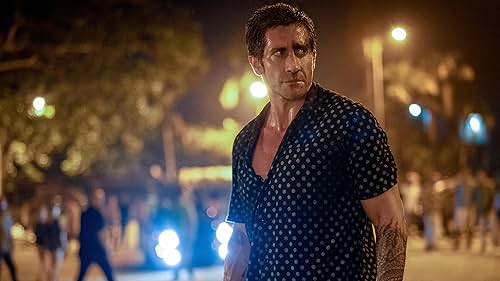
That bedroom scene is mirrored in Doug Liman’s 2024 remake of the same name, with Jake Gyllenhaal taking the role of Elwood Dalton, this time around a former UFC fighter making a living running scams who is recruited by owner Frankie to be the head bouncer at her Florida Keys bar, this time simply called The Road House (the sort of silly tongue-in-cheek name change that alone should indicate how blatantly stupid of a movie we are about to be subjected to). It’s the sort of place where the rowdy clientele have given the existing bouncers black eyes, and where the music groups that perform nightly play behind a floor-to-ceiling chain-link fence that serves as a thin shield between them and a beer bottle being hurled at their face (it oddly feels like not a lot of time is spent here, which is a shame, because like in the original, it’s a tangible, exciting environment). But when the bartender barges in to Dalton’s bedroom here, a cramped compartment on a half-sinking houseboat, the camera doesn’t travel with a sensuous gaze. The scene doesn’t reek of lust. Actually, it doesn’t reek of anything, the blandness of the story and characters reflected in the film’s sterile visuals (despite the action being moved to sunny Florida, the movie is almost constantly bathed in cloudy skies or murky darkness). Where 1989’s Road House knew exactly what to do with Swayze, it doesn’t seem to know what to do with Gyllenhaal, who plays the part with a cockiness that is almost too self-aware in lighter scenes (his winking insistence on making sure his soon-to-be-victims have insurance and know where the nearest hospital is located, for instance, is the complete opposite of Swayze’s sincerity), undermining the scenes that require him to pull from his character’s darker side (frankly, he’s miscast). The fleeting scenes that showcase his toned physique don’t revel in lingering on the body; it feels rather like Liman is going through the motions, stuffing a brief training montage in the middle of the film because that’s just what action movies do. And there’s never a sense that his reputation has grown in stature in the community; he isn’t a specimen of the pinnacle of masculinity, but just a tortured soul with a talent for tossing other dudes around.
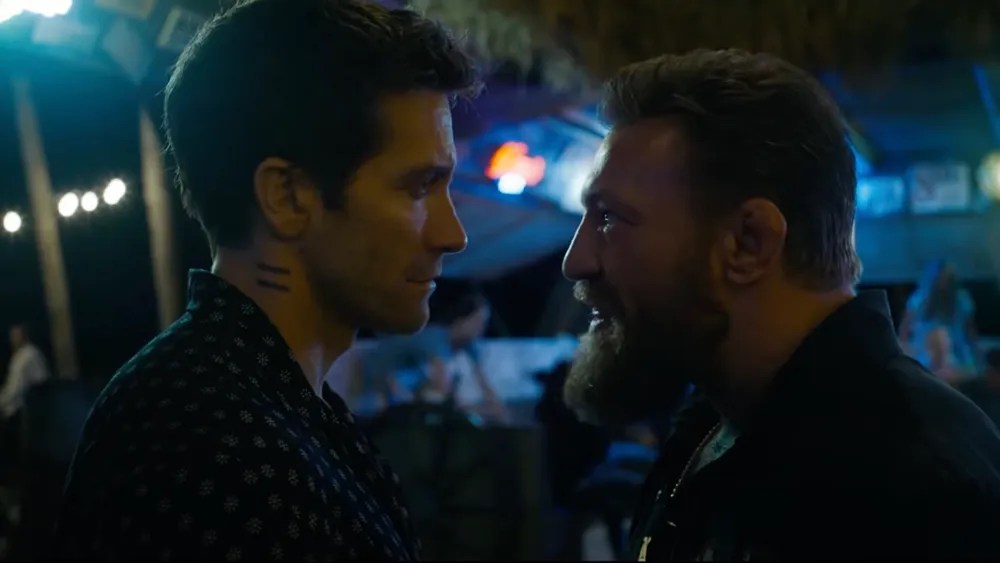
That’s surprising, because Liman is no stranger to action filmmaking, having directed the first installment of the Bourne franchise, 2005’s Mr. and Mrs. Smith, and the very fun 2014 sci-fi feature Edge of Tomorrow. There are plenty of moments throughout Road House where Dalton gets into brutal fisticuffs— with the goons working for local crime boss Ben Brandt (Billy Magnussen), who wants to buy the Road House and install a ritzy resort in its place, and with Knox (real-life UFC fighter Conor McGregor in his first film role), a buff mafia enforcer sent down by Brandt’s father to make things right— but these scenes fail to let the performers cook, trading in the raw physicality of simple hand-to-hand combat for overblown spectacle that no amount of tricky camerawork can compensate for.
It doesn’t help that this Road House (written by Charles Mondry and Anthony Bagarozzi) has an identity crisis, over-complicating the B-movie shenanigans of the original and playing them with utter seriousness— with the exception of McGregor, who feels like he stumbled in from a completely different movie with his loud and large performance (he’s very bad to the point where he becomes grating, unfortunately). Dalton’s romance with local doctor Ellie (Daniela Melchior) feels like an afterthought; this film is as devoid of sex as it is a sense of fun. The friendship Dalton strikes up with Charlie (Hannah Lanier), a local teen who runs a bookshop with her father, is sweet, but again, there just isn’t a lot there, and as the film chugs toward its tiresome finale, it becomes clear that those characters were only present as motivating factors for Dalton in the first place. Remaking Road House ought to have been the easiest job in the world: you just have to create a film that’s dumb, but fun. The new Road House, which often takes itself way too seriously, only barely manages one of those things.
Road House is now streaming on Prime Video. Runtime: 121 minutes. Rated R.

 Katie at the Movies