He’s tall and thin, and speaks in a tone and cadence that I can only describe as regular— neither too booming, nor too quiet. He can employ these traits in a couple of different directions: for comedy, tripping over his lanky frame, awkward and stuttering (especially when around women— think of his brush-ups with a seductive Barbara Stanwyck in Preston Sturges’ The Lady Eve), or for authority, delivering his lines clearly and confidently, and using his determination to uphold justice and do what’s right to sway others to his side (as the one juror holding out on convicting a man of murder in Sidney Lumet’s 12 Angry Men, or as the marshal Wyatt Earp attempting to bring order to the lawless town of Tombstone in John Ford’s My Darling Clementine). He’s Henry Fonda, who perhaps embodied the everyman persona more ably than any other actor in Hollywood history.
And sometimes that everyman persona was used to envision a higher power: as the seemingly ideal American, he was also seemingly the ideal President of the United States, a role that he flirted with on film a few times. In 1939’s Young Mr. Lincoln— the actor’s first of many collaborations with director John Ford— he portrayed the renowned President before he entered politics, when he was just an affable country lawyer who possessed innate leadership capabilities; the perfect marriage of those dueling qualities in Fonda himself. In 1964’s The Best Man, he played Presidential candidate William Russell, whose opponent in the campaign was a shady populist candidate who served as a stand-in for Richard Nixon, who in reality would be elected to the presidency just a few short years later. And he played the actual President in Sidney Lumet’s terrifying 1964 thriller Fail Safe, in which he must bury emotions in favor of stoicism and reason when facing the potential end of not just the U.S., but the world.
It’s through this lens of Fonda as a leader who guided us through major points in history that Austrian film historian Alexander Horwath frames his monumental three hour debut feature, Henry Fonda for President. But he makes it clear from the start that Fonda was a reluctant leader, somehow who was incapable of stepping back and acknowledging the impact he had on pop culture. Horwath draws on around 40 of the nearly 100 movies Fonda made during his lifetime for his film, but the footage that perhaps most clearly illustrates this idea of a reluctant leader actually comes from a 1976 episode of the sitcom Maude titled Maude’s Mood, in which the title character mounts a campaign to get Fonda elected as President. Fonda himself guest stars on the episode, but when he shows up, he’s unimpressed with Maude’s proposal, right down to her massive “Henry Fonda for President” campaign poster. She says that he represents all Americans, but he walks away, simply because— as Maude herself says— he doesn’t want it.
AUT, DEU 2024, Forum
© Michael Palm / Mischief Films, Medea Film Factory
Horwath narrates the bulk of his film, establishing his personal connection early on when he reminisces about a trip to Paris he went on as a child, where he saw three seminal Fonda films in quick succession: The Wrong Man, Once Upon a Time in the West, and The Grapes of Wrath. But he also has a co-narrator of sorts: extensive audio is used from Fonda’s final interview, conducted at his home by journalist Lawrence Grobel in July 1981, a mere year before Fonda passed away. Fonda’s voice sounds older, but it’s still distinctly his, and he’s just as reluctant to comment on the worth of his own artistry. Consider this exchange with Grobel:
Grobel: Do you feel that there is an art to the movies?
Fonda: Yeah. I think De Niro is an artist.
Grobel: How about yourself, in that regard?
Fonda: I don’t think about it. I don’t think about myself like that. […]
Grobel: Would you attend the Oscar ceremonies this coming time if your picture’s nominated?
Fonda: I will not be there and put up with that shit. I’ll watch it on TV. No way.
Fonda did win the Oscar that year, for his role in his final film, the 1981 drama On Golden Pond. His daughter Jane accepted on his behalf.
Horwath opens his movie in 1980, the memory of his Paris holiday colliding with Ronald Reagan receiving the Republican Party’s nomination for the presidency. Reagan is the former actor who did make that transition to political leadership, but his time in office initiated a turn toward a conservatism in America that alienated many of the marginalized groups and average joes who Fonda’s characters where often known to represent (Fonda himself, in his interview with Grobel, said of him, “Reagan upsets me so much that it’s hard to talk about. I think we’re headed for disaster”).
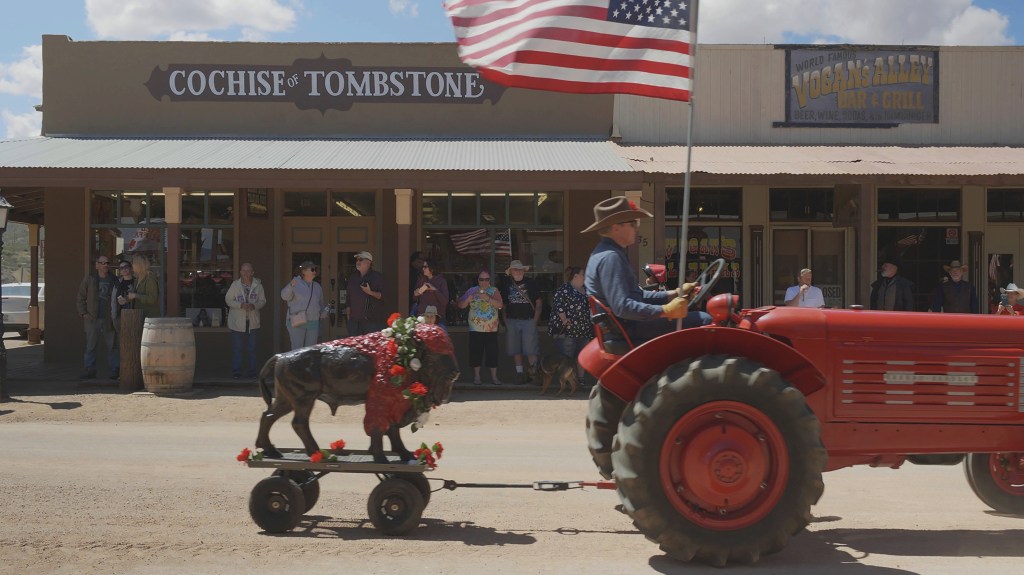
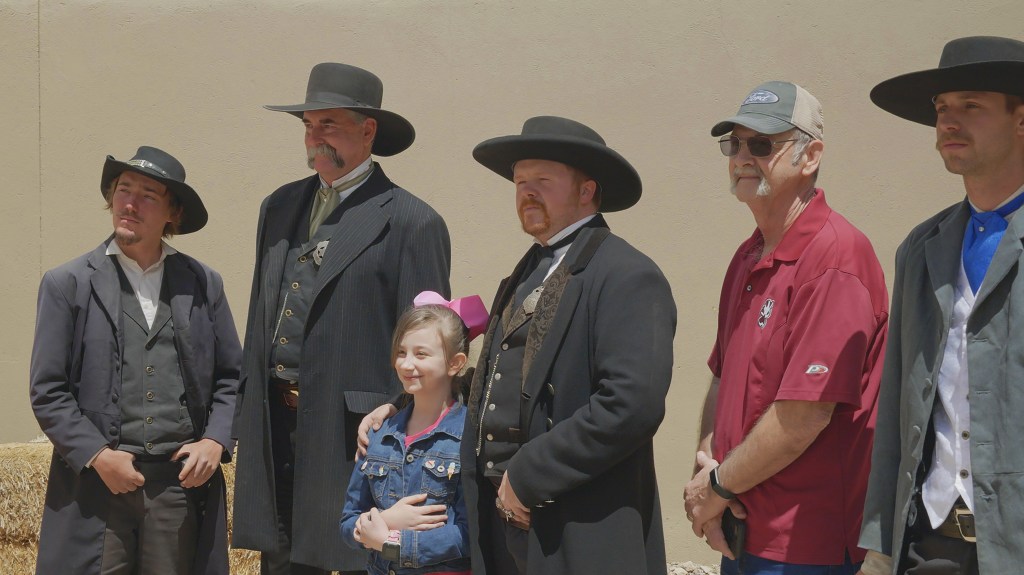
After this intro, Horwath jumps in time all the way back to 1651, and the roots of the Fonda lineage in Holland. From there, Henry Fonda for President moves forward in chronological chunks, each section devoted to a different time and place, and tied to Fonda— or one of his films—in some respect. Some of these ties are more personal than others. For instance, Horwath claims that in Drums Along the Mohawk— a color western that Fonda also made with John Ford in 1939— that Fonda is playing, at least a version of, one of his ancestors. While Fonda’s character in that film (a film that boasts many historical inaccuracies) is fictional, the fact that the Village of Fonda, New York in the town of Mohawk was named after Henry Fonda’s settler ancestor Douw Fonda is very real. Many of the later segments tie Fonda and his films to a larger portrait of American life. Horwath uses the aforementioned My Darling Clementine, for example, to examine the town of Tombstone, Arizona today, a place that paints the battle for good and evil in black and white, that commemorates Wyatt Earp’s struggles, dramatized so tenderly by Fonda in the film, with raucous reenactments and parades for tourists, all while firmly conforming to right-leaning politics.
Some of Horwath’s arguments are a bit more of a stretch. Toward the end of the film, he places the Okie laborers migrating West in search of work and better living conditions at the height of the Depression of John Ford’s 1940 adaptation of The Grapes of Wrath side-by-side with Mexican immigrants trying to cross the border into the United States. They’re in search of the same, although the film doesn’t really take the impact of their race into consideration. Horwath also occasionally segues into other areas that feel outside the bounds of the film— a man wearing a Donald Trump mask dancing around traffic for tips (the film otherwise doesn’t venture past Fonda’s death and the rise of Reagan, although the comparison between the two Presidents, specifically their manner of talking in a way that certain people like to hear, is apt), or reaching for Martin Scorsese’s 1976 psychological thriller Taxi Driver because Travis Bickle, with his Mohawk hairstyle, forms a bridge between America’s violent past and present.
AUT, DEU 2024, Forum
© Michael Palm / Mischief Films, Medea Film Factory
But it is fascinating all the same to see how often Horwath is able to juxtapose so many turning points in American history— particularly from wartime quickly followed by post-war disillusionment in the 1940s to the counterculture of the 1960s, as evidenced by Fonda’s own children (Peter Fonda created and starred in one of the most emblematic films of the new generation, Easy Rider, while Jane Fonda was the outspoken activist her father never was) and his shifting screen persona, playing a ruthless gunslinger in Sergio Leone’s spaghetti western Once Upon a Time in the West, the subversion of his screen persona making his appearance in the film that much more alarming.
Henry Fonda for President is very much a “your mileage will vary” sort of movie. As both a history buff and a film fan, I found this an intriguing piece of criticism. But it is, again, also three hours long, so if those subjects aren’t your bag, there may be little for you here to latch on to. There’s nothing to suggest cutting out of the final work, however (the first cut was reportedly closer to five hours long), as both sound and images are edited together in such a way that presents information clearly while maintaining a consistently engaging pace. The film makes use of plenty of archival footage, some being late-career television interviews Fonda gave, but primarily footage from his body of work. Sometimes, this footage is cut into the film playfully by editor Michael Palm; at one point, a scene from Daisy Kenyon, a 1947 drama directed by Otto Preminger in which Fonda plays a World War II veteran struggling to adjust to post-war life, is used. Audio of someone exclaiming “Are you the Henry Fonda?” is played over footage of Fonda’s character Peter sitting up in bed in a cold sweat, the distressed look on his face a visual representation of the real Fonda’s discomfort with his fame. Horwath extends this idea in his examinations of Fonda’s acting. The common thread running through all his portrayals becomes even more obvious when viewing them all smushed together in the space of a few hours— his habit of covering his eyes during moments of emotional vulnerability, that line between exhibiting masculine virility and what may be perceived as weakness, is ever-present across the decades.
More often, the film scenes are juxtaposed with new images shot for this movie, forming a bridge between past and present, fictional and real, and the cinematography is lovely, presenting a meditative collage of images of dusty desert towns, national monuments populated by casually-interested tourists, and the bustle and bright lights of Times Square. The final piece, therefore, becomes not just a monument to Henry Fonda, but to America: a celebration of a unique person and place, yes, but also a commentary on their faults. That line between cinematic magic and real world disenchantment is a tricky one to walk, but Henry Fonda for President accomplishes it without ever turning too reverential.
Henry Fonda for President had its world premiere at the 74th Berlinale on February 19. Runtime: 184 minutes.

 Katie at the Movies