It looks like something out of a postcard: the enchanting, almost retro style of a resort lobby, the Bavarian Alps behind it painting the horizon with their snowy majesty. Nothing about this picturesque scene would suggest the insanity and terror that’s to come— nothing, except perhaps for Mr. König (Dan Stevens), the lodge’s proprietor, whose debonair attitude and stylish appearance fails to mask something sinister.
It doesn’t help that he immediately always seems to pop up out of nowhere, startling Gretchen (Hunter Schafer), the 17-year-old who has reluctantly moved to the German countryside following her mother’s death with her father Luis (Marton Csokas), his glamorous and uppity wife Beth (Jessica Henwick, underused but amusing in what scenes she does have), and their young daughter Alma (Mila Lieu), who’s deaf. Gretchen’s self-awareness (she almost always calls out the jump scare immediately after we experience it), combined with the metaphorical mustache-twirling of Stevens’ heightened performance (he, accent and all, is in on the fun from the get-go and never lets up in an immensely fun performance) instantly clues us in on the tone of writer and director Tilman Singer’s wild and weird Cuckoo, a new installment in subgenre of horrific events in beautiful places (think the snowy landscape and majestic yet desolate hotel in The Shining, or more recently, the sunny fields Midsommar) which rolls horror, comedy, investigative thriller, and family drama into a stylish and brutal genre picture.
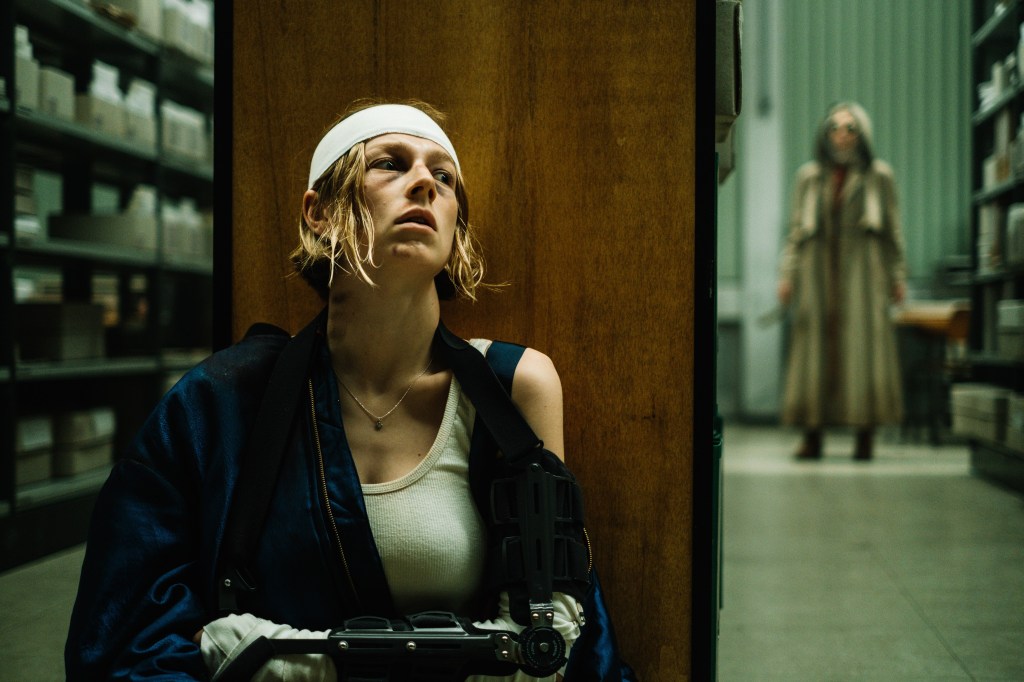
Everything feels a little off from the start, again, in large part due to the uneasy air rolling off of König (who is close to Luis and Beth; they had their honeymoon at his establishment years ago), who offers the rebellious Gretchen a job working reception. It’s there that she begins to notice strange events, things that her coworker Trixie (Greta Fernández) writes off as occasional occurrences: female guests of the hotel stumbling about, zombie-like, and vomiting. And there are other things too: high-pitched noises, reliving the same few seconds over and over again, and the sudden appearance of a sinister, goggle-eyed, hooded woman.
The other characters who circulate around Gretchen at the lodge are nearly as odd— and their motivations nearly as inscrutable— as König’s, including an impossibly cool young woman called Ed (Àstrid Bergès-Frisby) who checks into the hotel and offers to sweep Gretchen off to Paris with her, and Henry (Jan Bluthardt, who appeared in Singer’s similarly unsettling debut feature Luz), a man who says he is a police officer who had been investigating the weird events at the lodge— and is also the only person who seems to believe what Gretchen says she’s been seeing.
Cuckoo is massively entertaining— in large part thanks to the suspense inherent in attempting to determine just what the hell is going on here— and Singer maintains a steadily brisk pace throughout. That is, at least, until the climax, where all the seemingly disparate threads that have formed the fabric of the film up to this point aren’t pulled together into a coherent piece. The third act suddenly becomes too long and drawn out, with the focus directed more toward König and Henry and away from the family dynamic. A lot of those threads are, sadly, left hanging, and although the sister bond that drives the finale provides at least a partially satisfying emotional conclusion, many of the film’s themes— particularly reaching toward motherhood and reproductive rights, with allusions to the cuckoo bird’s habit of being a brood parasite (laying its eggs in the nests of other species)— are half-baked.
And while on the surface Gretchen may appear more like a slunk-over, sad-sack teen than an action hero, Schafer (of Euphoria fame) more than proves her mettle as a lead. She wears Gretchen’s battles visibly on her face and body throughout the film— she’s increasingly beaten to a pulp over the course of the narrative, accumulating open wounds, casts, bandages, and bruises— but she also wears the tough demeanor well, allowing Gretchen’s vulnerabilities (like the feeling that her father cares more about Alma’s well-being than hers) to manifest themselves at the appropriate moments.
Cuckoo also boasts layered sound design and kinetic editing that contribute to the film’s sometimes dizzying quality, and it has a wonderful and distinct texture that lends itself well to the picture-postcard surroundings (cinematographer Paul Faltz photographed the film in 35 mm). Cuckoo may not stick the landing, but it sure is a wild ride getting there.
Cuckoo had its world premiere at the 74th Berlinale on February 16. It is set to be distributed by NEON this year. Runtime: 102 minutes.

 Katie at the Movies