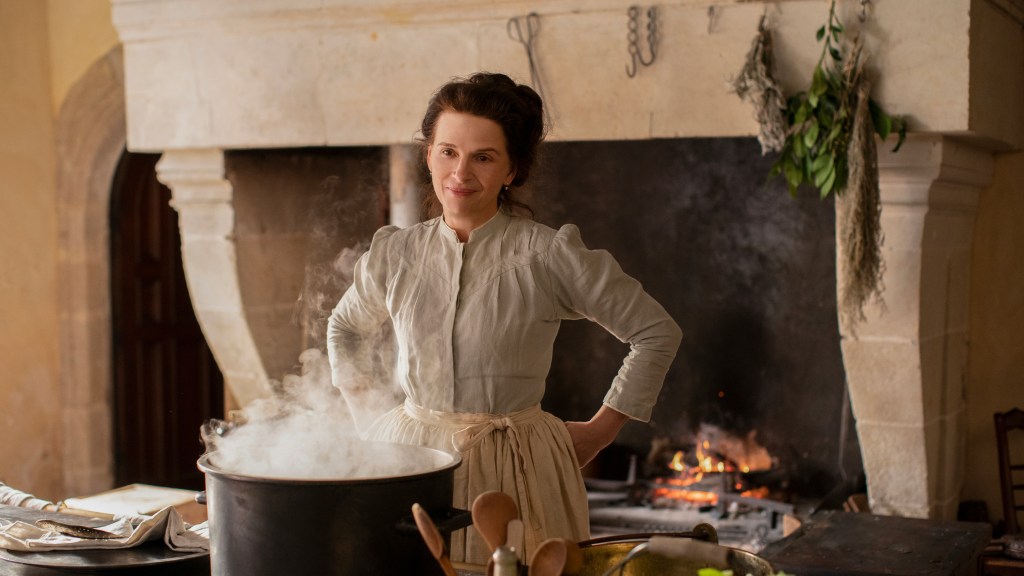
If cooking is one of the most romantic things you can do for another person, then surely Trần Anh Hùng’s The Taste of Things is the most sumptuous instance of that action being committed to film. Immediately, Hùng immerses the viewer in the act, not just the preparing and serving of food, but taking us right to the source. When we meet Eugénie (Juliette Binoche), she is out in the garden at dawn, crouched over rows of vegetables that she’s picking for the day’s meal. Eugénie has been the chef for acclaimed restaurant owner Dodin Bouffant (Benoît Magimel) for 20 years, and the pair have established a close working relationship that has extended to the personal over that span of time. They are married in all but name, the ease in their relationship as seen on screen a likely extension of the fact that Binoche and Magimel were themselves a real-life couple who have worked together before.

Hùng— a Vietnamese filmmaker who has resided in France since 1975— sets this story in 1889, and the attention to detail is impeccable, even as The Taste of Things fails to escape the feeling that it’s a tour of what a foreigner tourist’s concept of French cuisine is. Cooking is an art form in The Taste of Things, and while its previous title, The Pot-au-Feu, directly refers to the common French stew consisting of meat and veggies that becomes a key piece in what plot the movie does have, Hùng and cinematographer Jonathan Ricquebourg lovingly photograph a series of mind-bogglingly elaborate dishes (acclaimed French chef Pierre Gagnaire served as the film’s culinary director and also has a brief on-screen role as a chef). But cooking is not only a visual art form here, but a physical one; the cooking scenes are filmed in long takes, the camera whirling around the actors as they move about the kitchen in an intricately choreographed dance. Even in the few scenes that don’t directly involve the preparation or consumption of food, Hùng rarely cuts. In a scene early in the film, for instance, when Eugénie and Dodin sit outside together in the growing darkness following a successful dinner, the camera appears to almost float between them, as opposed to cutting back and forth. This free-flowing technique visually confirms the easy relationship the two share. What transitions there are serve to place the characters on the same plane as the food they devote their lives to preparing; one of the film’s most striking edits is a match cut from a poached pear to Eugénie‘s nude body curled on a bed.
But as delicious as The Taste of Things is to salivate over, it doesn’t leave a memorable aftertaste. These characters aren’t given much of an interior life beyond the kitchen and their relationship with each other. Food equals love, yes, but what else is there? There is a scene in which Eugénie reminiscences about her time cooking for Dodin, and how she learned her craft from her parents; it’s sentimental, but it grants her a life beyond what we see on screen. The final stretch of the film fast turns from pleasant to grating, as it increasingly feels like Eugénie is being used as a catalyst for Dodin’s emotional state. For foodies and slow cinema fans, there’s certainly enough substance in The Taste of Things to make it well worth seeking out. If Hùng had devoted as much time to his characters as he did the food, perhaps this would have been a feast, and not just a snack.
The Taste of Things opens in theaters on February 9. Runtime: 135 minutes. Rated PG-13.

 Katie at the Movies