The following review contains some spoilers for the ending of The Zone of Interest.
Any time a filmmaker holds on a shot for a length of time, the audience becomes aware of their role as voyeurs. We’re yanked out of the most likely reason why we’re watching the movie in the first place— to escape, to become wrapped up in a story— and recognize that we are watching. The example of this instance that I often like to pull is the opening shot of Lost in Translation, in which Sofia Coppola holds the camera on the backside of a young woman (played by Scarlett Johansson) clad in soft pink sheer underwear as the credits roll. This scene actually lasts less than a minute, and yet it’s just long enough to make its purpose the subject of debate, prompting curiosity in some (who is this woman?), immediately evoking such feelings as loneliness and innocence that the proceeding film would explore in depth, and making still others acutely uncomfortable (is the shot objectifying her?). I’m not sure exactly how long the opening shot of Jonathan Glazer’s The Zone of Interest lasts. It could be a minute; it could be five. It feels like an eternity. However, here, we aren’t exactly watching, because the screen is pitch black. It’s the haunting music that composer Mica Levi wrote for this prologue that overcomes our senses instead. The restlessness amongst the audience in my screening during this sequence was palpable; “Good movie so far,” an older man sitting a couple seats down from me eventually stated, a little too loudly and flippantly. Before we actually see anything in the film, we are made aware of our active participation in experiencing it. It’s an essential piece of what Glazer himself has described as two films in one: “the foreground film” is what we see, while “the sound is the other film.”
That foreground film involves Rudolf Höss (Christian Friedel) and his wife Hedwig (Sandra Hüller). After the prologue fades away, the black screen gives away to a serene series of scenes in which the Höss family, with their five children, frolic in a river. They return to their home, an orderly concrete behemoth surrounded by a large, picturesque garden, complete with a pool. But over the garden wall, we glimpse smokestacks, watchtowers, and rows and rows of buildings. We don’t ever see over the wall beyond that, but that’s where the second film comes into play. Screams and gunshots hang in the air, puncturing the external beauty of the Höss home; sound designer Johnnie Burns’ exceptionally-realized soundscape is the essential complicating factor driving the rift between what we see and what we hear. There’s not a moment of the film where those horrible noises aren’t present. It’s 1943, and Rudolf is the commandant of the Auschwitz concentration camp operated by Nazi Germany. He and his family live next door.
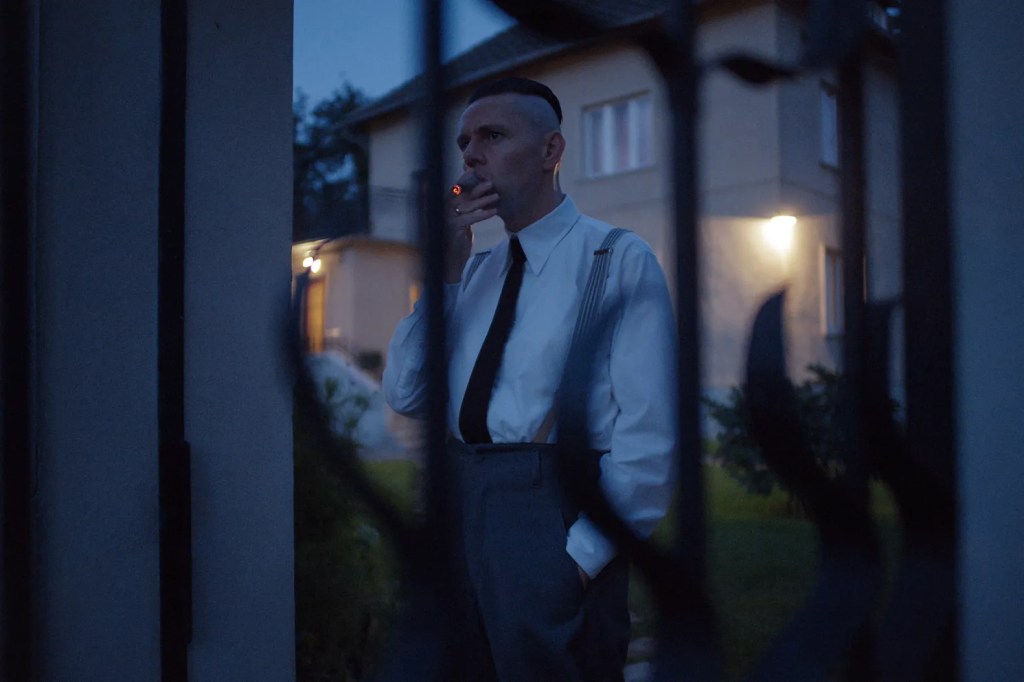
The Zone of Interest is based on the novel of the same name by Martin Amis, but while the fictional couple at the center of the book was inspired by Rudolf and Hedwig, Glazer made the decision to make his adaptation explicitly about them. It’s the first feature film Glazer has directed in 10 years, and only his fourth total, but his formal precision has never been more effectively employed. He composes his shots and navigates spaces in a manner that keeps us both aware of the atrocities occurring on the other side of the wall, but also holds us at a remove from them. The contrast between the garden and the camp in the exterior shots is striking (at one point, the family celebrates while the smoke from a train presumably carrying a new load of Jewish prisoners to their deaths streaks across blue sky), but this technique is even more evident in the interior shots within the home (a meticulous recreation of the real Höss house designed by Chris Oddy). Glazer and cinematographer Łukasz Żalstationed 10 cameras around the house so they could constantly shoot the actors, and the wide, surveillance-style shots maintain that chilly atmosphere, that sense of detachment. Pacing-wise, observing this family going about their day, it’s even a little bit— for lack of a better word— boring.
But don’t mistake that carefully crafted atmosphere for a lack of interest in humanity; awareness of the world’s atrocities that we turn away from every day in service of our own self-interest is its purpose (and that The Zone of Interest is being released now, amidst calls for ceasefires that largely go unheeded, makes it feel even more pointed). Glazer’s previous film, his 2013 venture into science fiction, Under the Skin, bent the genre in fresh and intriguing ways (as he does with the Holocaust film here), but it’s first and foremost curious about the tensions between good and evil, as experienced by a man-eating alien who takes the form of a human woman. For all his stoicism, Rudolf may as well be the alien here. Friedel perfectly calibrates the chilliness of his performance, but Hüller is as slimy as a snake in slipping between domestic bliss and pure evil. There are scenes centered around Hedwig in particular that recalled another recent release to me, Ava DuVernay’s monumental Origin. That film, an adaptation of Isabel Wilkerson’s book Caste, sees its author protagonist embarking on a research trip to Germany to find ways to connect the Holocaust to racism in American, with the roots of both stemming from the idea that people are born into specific stations based on their class or race or religion or otherwise. The Höss family has Jewish servants working in their household, and Hedwig is quick to remind them of how good they have it there; at one point, she admonishes a girl who made a slight mistake by coolly telling her that she can have her husband scatter her ashes, about as blatant a reference to the crematoriums operating on the other side of her property as Hedwig will ever make. While Rudolf frequently comes off as just a cog in the Nazi machine, this belief that Jews are inherently inferior feels particularly baked into Hedwig’s brain.

I initially wasn’t planning to write about The Zone of Interest. There’s a lot about it— the experimental interludes depicting a young Polish girl clandestinely distributing food to the prisoners, for one— I haven’t formed an opinion on yet, and likely won’t be able to before rewatching (not an activity I plan to embark on anytime soon, as much as I admire this film’s craft and sharpness). But its ending is truly a stunner. As Rudolf descends the stairs following a gathering celebrating an operation named for him which will see thousands of Jews sent to Auschwitz to be killed, he dry retches before looking down the hallway. Editor Paul Watts cleanly cuts to the present day, where workers are preparing the Auschwitz site— which currently serves as a museum and memorial— for the day. The scene as they vacuum the floors and wipe down the display cases that house piles of items that belonged to those who died there recalls the incessant tidying we witnessed the Höss’ engage in throughout the film. But their cleaning was a form of erasure, of the Jewish people (Hedwig takes clothes that clearly once belonged to the Jewish prisoners and distributes them amongst her servants, collects a fur coat for herself and tries on the lipstick she finds in one pocket, and tells Rudolf, in between giggles as she lies across from him in bed one night reminiscing about a spa they once visited in Italy, that if he could possibly get her some chocolate, “any goodies”) and of the evidence of their sins (Rudolf rushes his kids out of the river after discovering that ashes from the camp have washed downstream, and every inch of their bodies are scrubbed clean when they get home). This cleaning is a form of preservation, bringing the evidence of atrocities that have up to now remained almost entirely in the background to the forefront. There is one more cut after this, thought, back to the past. Rudolf, now the voyeur, is still looking down the hallway— does he see this future? Following the war, the real Rudolf Höss was arrested, tried, and executed. By most accounts, his attitude was mostly apathetic. In his mind, he was just a guy doing his job; when accused of murdering three and a half million people, he reportedly responded, “No. Only two and one half million—the rest died from disease and starvation.” He more explicitly acknowledged the enormity of his crimes in letters to the prosecutor and his wife and children right before he died, writing that “I have sinned gravely against humanity.” Maybe his conscience really did come back to bite him at the last possible second; more likely that’s just the talk of a man who had nothing left to lose. Regardless, at the closing of The Zone of Interest, Rudolf turns away from the evidence of his actions and continues walking down the stairs. And all we can do is watch.
The Zone of Interest is now playing in theaters. Runtime: 106 minutes. Rated PG-13.

 Katie at the Movies