“Great gowns, beautiful gowns.” The comment thrown by Aretha Franklin in reference to Taylor Swift in a 2014 interview that has often been read as god-tier shade is the first reaction that popped into my head as the credits rolled on Bradley Cooper’s sophomore feature, Maestro. Cooper’s portrait of legendary composer and conductor Leonard Bernstein and his relationship with his wife, actress Felicia Montealegre, is a gorgeous, nothing movie. It’s the sort of movie that begins with a lofty quote from the maestro himself: “A work of art does not answer questions, it provokes them; and its essential meaning is in the tension between the contradictory answers.” Perhaps, by opening his movie this way, Cooper was preparing his audience for a complicated depiction of a complicated man; perhaps he was excusing himself from the fact that his movie doesn’t provide any easy answers. The issue with Maestro, however, isn’t that it doesn’t answer questions, but that it doesn’t ask the questions in the first place. This is a film with nothing to say about relationships, sexuality, or art, laying a lot of impressively-assembled scenes on the table but rarely probing them for any genuine meaning.
If there is something to be said in Maestro’s favor, it’s that it doesn’t take the traditional biopic route. After a brief opening color scene that sees a Bernstein (played by Cooper) toward the end of his life playing piano and giving an interview in which he comments on how much he misses Felicia, Maestro jumps back in time to the 1940s and from color to black-and-white. The shifting photography styles mark a shift in the narrative’s tone. These early black-and-white sequences play like a fairy tale, both in Bernstein’s rapid ascent to fame when he is called in to conduct a complicated piece at the last minute, and in his introduction to and subsequent courtship with Felicia (Cary Mulligan). At almost every turn, Cooper reaches for that Old Hollywood magic. He uses compositions by Bernstein for the score (as well as other influential composers such as Mahler, who Bernstein is credited with bringing renewed attention to), and in the film’s most fantastical sequence, he recreates a swooning ballet from the musical On the Town, dancers clad as sailors swirling around Bernstein and Felicia. And yet, at almost every turn, these visual flourishes and creative flights of fancy feel devoid of the emotional spark required to really make them sing. Not to mention, some of these compositions— the snappy prologue to one of Bernstein’s most famous works, the musical West Side Story, for instance— are employed at strange junctures throughout the film that are at odds with what is unfolding on screen.
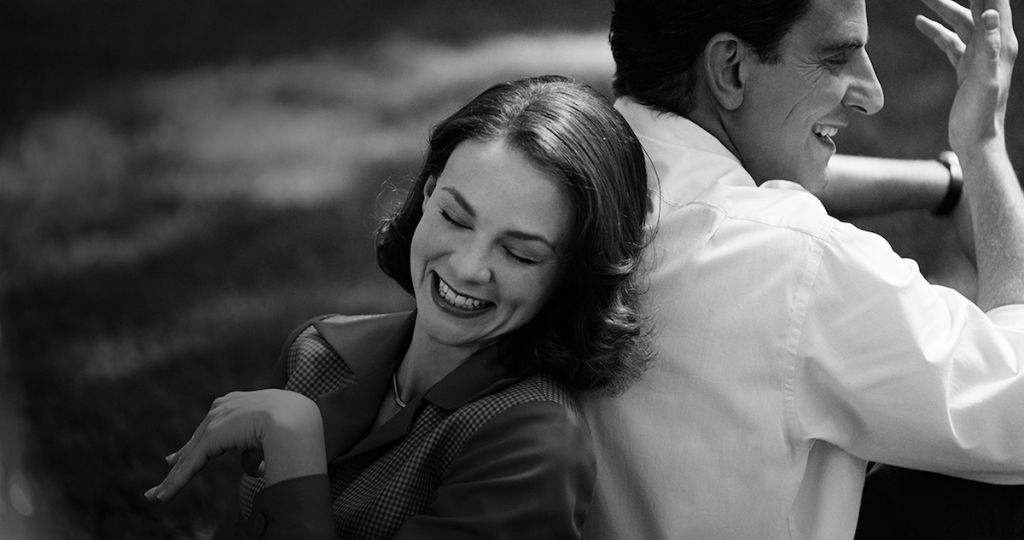
Perhaps that’s because Maestro (which was co-written by Cooper and Josh Singer) is really only interested in the highs and lows of Bernstein and Felicia’s relationship. It’s the best of times, and the worst of times, with no transition points in between. When the film makes the switch from black-and-white to color, their love story becomes less dreamy, and reality crashes down around them. Felicia’s career takes a backseat to her more famous husband as she raises their three children, and Bernstein engages in affairs outside of their marriage, mostly with men. His infidelity and unreliable temperament put a strain on their relationship, until the film’s heart-breaking third act turn, which just narrowly avoids devolving into soap opera theatrics in favor of a portrait of a loving family that feels largely genuine and aching.
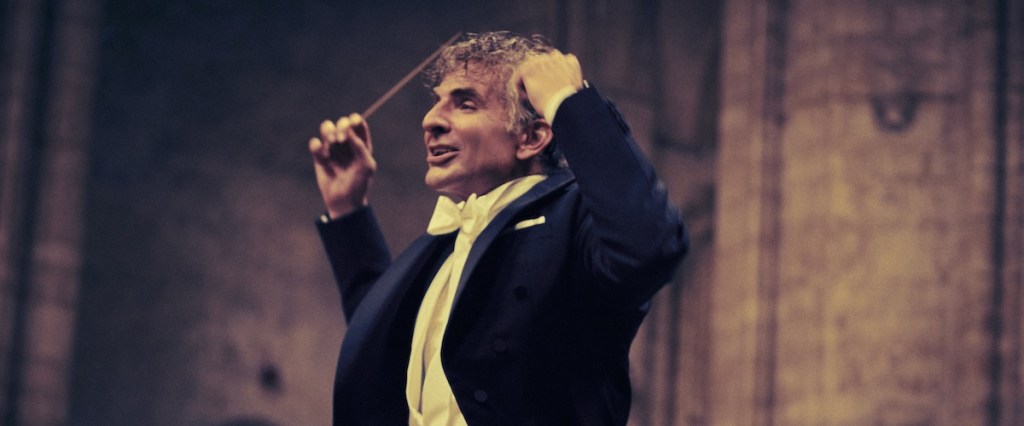
It’s just so difficult to latch on to anything of substance in Maestro, even though individual scenes play like the most melodic symphony. The black-and-white cinematography didn’t really do it for me (against, reaching for that classic feel but only approaching a facsimile of it; it’s often too high-contrast), but the color cinematography, with its warm, nostalgic tones, is quite impressive and enhances the already detailed 60s and 70s production design. The shot that makes the transition between the two— focusing entirely on Felicia’s face as her mood changes over the years— is impressive, as is a darkly comic scene in which an argument between Felicia and Bernstein is overshadowed by the Snoopy balloon passing by their Manhattan apartment windows as the Macy’s Thanksgiving Day Parade occurs outside, and the already much-talked about one-take scene in which Bernstein conducts an orchestra at Ely Cathedral, although the camera, as it travels around the space, keeps us at a bit too much of a distance from Bernstein for most of it. Perhaps that’s for the best; Cooper, in trying too hard to duplicate the real Bernstein’s voice and look and mannerisms, leaves his performance mostly devoid of any soul. It’s an impressive caricature, sure, but it’s only intermittently good acting. He’s shown up quite a bit by his costar, Mulligan, who— thick mid-Atlantic accent and all— reaches down into the depths of her heart and soul and emerges with a real person with wants and needs; Cooper’s Bernstein is just too much of a cypher. The supporting cast is sprinkled with talents (Sarah Silverman plays Bernstein’s sister Shirley, Maya Hawke is their daughter Jamie), but this is Cooper and Mulligan’s show. Unfortunately, both of their roles are saddled with some overt ethnic cosplaying; the white, English Mulligan playing the Costa Rican Felicia, and Cooper donning an unnecessarily large prosthetic nose that has rightly been criticized as “Jew-face” and plays into stereotypes about Jewish people.
With Maestro, a focus on one aspect of Bernstein’s life rather than attempting to pack most of his rich life and career into one two-hour movie is rightly made, and yet, we’re left with little sense of what the give-and-take of Bernstein and Felicia’s long relationship is. Cooper is certainly a filmmaker with vision and skill— his directorial debut, 2018’s A Star is Born, was proof of that— but Maestro reeks of a vanity project in whose creator got a little too carried away and forgot to inject not just style, but meaning, into his work.
Maestro is now playing in theaters and streaming on Netflix. Runtime: 129 minutes. Rated R.

 Katie at the Movies