When we first meet Rosie Forrest (Shelley Winters), she’s sitting by a child’s bed wearing a lavish burgundy gown and white gloves, rocking it softly as she sings. She appears sweet, maternal. But when she finishes her song, we discover that Rosie hasn’t been singing to a human child, but to the mummified remains of one, and proceeds to tuck the decaying corpse into its coffin. A reveal like this might be surprising in any other movie, but it plays more like the inevitable first step in an entry in the psycho biddy genre with a title like Whoever Slew Auntie Roo? (released in the U.S. under the more palatable title Who Slew Auntie Roo?).
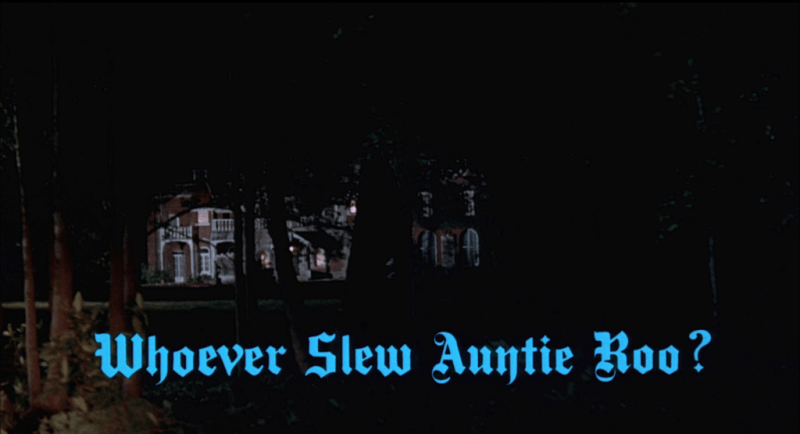
The psycho biddy picture (alternately referred to as hagsploitation and Grand Dame Guignol) is considered to have officially launched in 1962 with the release of Whatever Happened to Baby Jane?, and while the horror subgenre that frequently found once-glamorous leading ladies playing increasingly unstable women in stories with provocative and punctuated titles has garnered its fair share of criticism for exploiting its stars, it also granted many aging actors a whole third act they might otherwise not have had, including Bette Davis, Joan Crawford, and, of course, Winters. Hag horror was already on its way out by the time Winters worked with director Curtis Harrington (a forerunner of the New Queer Cinema movement) in 1971 on What’s the Matter with Helen?, a tale of the dark side of Hollywood in which Winters played opposite Debbie Reynolds, but the film was successful enough that Winters requested him to direct this slightly less-superior 1972 follow-up from American International Picture (AIP). A sort of dark fairy tale based in part on the story of Hansel and Gretel (although it more just refers to the story as opposed to adapting it), Whoever Slew Auntie Roo? is set over the Christmas holidays. Holed up alone in her English manor circa the 1920s, Rosie mourns the death of her daughter Katherine, and grapples with her grief every year by inviting the children from the nearby orphanage to spend Christmas with her in her lavishly-decorated, gingerbread-like home filled with sweets and toys. But there’s no real malice behind this invitation, although Winters keeps Rosie straddling that line between kind and insane so effectively that there’s always some suspicion that there’s more going on. But no, Rosie genuinely seems to enjoy the company of and caring for children.
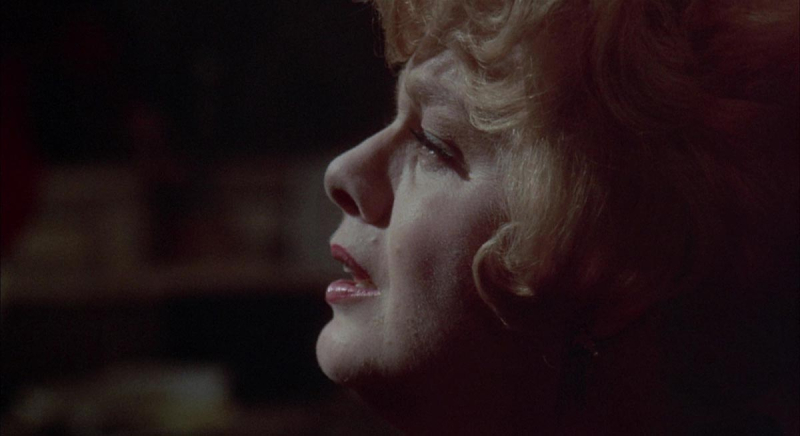
Winters’ boisterous persona was well-suited to this type of film and character, but while it teeters on the brink of camp, Whoever Slew Auntie Roo? is much too sympathetic to Rosie and too tender in its portrayal of loss, loneliness, and guilt to be entirely written off as such. If anything, the children are the bad seeds who push Rosie over the edge. A troublesome brother and sister from the orphanage, Christopher (Mark Lester, of Oliver! fame) and Katy (Chloe Franks), inadvertently stir something in Rosie, who finds Katy to be the spitting image of her deceased Katherine and ends up kidnapping her. Christopher, meanwhile, is convinced that Rosie is the witch from Hansel and Gretel and sets about trying to ruin her and save his sister. He comes off less as a good-hearted kid trying to help his sister, and more like a little brat preying on a grieving woman, right up to his sinister toying with a tiny guillotine. The finale of the film isn’t exactly a surprise— it’s in the title— but it really feels like it’s reaching to give Rosie some sort of comeuppance that she doesn’t deserve. Whoever Slew Auntie Roo? isn’t exactly a great movie for that reason, but it’s worth a look both for borderline creepy holiday vibes (the camera reads the walls of dusty dolls and decorations as simultaneously cute and unnerving) and a riveting late-career turn from Winters.
You can currently watch Whoever Slew Auntie Roo? for free on Pluto TV. Runtime: 91 minutes. Rated PG-13.

 Katie at the Movies